Thousands of people are forcibly ‘disappeared’ in Southern Africa:
On 9 March 2015, five men burst into a barber shop in Harare’s Glen View suburb, grabbed activist Itai Dzamara, bundled him into a white truck with concealed number plates and drove off. Two days earlier, Dzamara had publicly called for former president Robert Mugabe’s resignation. To date, Dzamara’s fate remains unknown, and the Zimbabwean government has been silent on his whereabouts, despite repeated demands for an investigation.
Dzamara is a victim of enforced disappearance, which is a crime under international law whereby authorities take someone away and then deny it or refuse to acknowledge their fate or whereabouts. It is a cruel tool of repression that exposes victims to torture and even death, leaves families in anguish as they struggle to trace their missing loved ones and instils fear in anyone who might demand answers.
Dzamara’s case is one of thousands of unresolved cases of enforced disappearances across Southern Africa.
Today, as we mark the 14th International Day of Victims of Enforced Disappearance, we join all families of the disappeared to remember everyone who has vanished without a trace at the hands of unnamed and unaccountable perpetrators. We also demand action to prevent future enforced disappearances and to find justice for everyone affected.
All Southern African countries that have not yet done so must urgently ratify and implement the International Convention on Protection of All Persons from Enforced Disappearance without reservation.
Only five of the 15 Southern African countries have ratified it, underscoring the lack of political will in the region to end this human rights violation.
Enforced disappearances cast a long shadow over Southern Africa.
In Mozambique, journalist Ibraimo Abú Mbaruco was forcibly disappeared in 2020 while reporting on the war in Cabo Delgado and remains missing. In Tanzania, the family of Oriaisi Pasilance Ngiy’o still awaits information on his fate and whereabouts after police shot him in the legs and loaded him into a car during a protest for Maasai land rights in 2022.
In 2021, Comoran authorities held Inssa Mohamed, known as Bobocha, in secret detention for months before trial, leading United Nations experts to condemn his enforced disappearance and demand proof of life.
Just last month, Zimbabwean security agents forcibly disappeared four people and allegedly tortured them in custody ahead of the Southern African Development Community (SADC) summit in Harare. They were the latest of dozens of other enforced disappearance cases in Zimbabwe since Dzamara was taken in 2015.
Meanwhile in the Democratic Republic of the Congo, armed groups, particularly Allied Democratic Forces(ADF) militants, have abducted or forcibly disappeared thousands of people in the country’s east over the past 10 years. But the ADF is hardly the only perpetrator — 10 people were forcibly disappeared last August in the flashpoint city of Goma after an army massacre there.
None of the above countries have ratified the convention, perpetuating a culture of fear and silence around enforced disappearances and leaving victims’ families with little hope for justice or confidence that authorities will find their loved ones.
Even countries that do not have recent known cases of enforced disappearance must ratify the convention to prevent future disappearances within and beyond their borders.
For instance, Inssa Mohamed’s enforced disappearance in Comoros took place after Madagascar unlawfully extradited him. If Madagascar had ratified?and implemented the convention, authorities there would have been bound to adopt and enact safeguards before sending him to Comoros, where he was at risk of enforced disappearance.
Moreover, migrants face a high risk of enforced disappearance because of rigid migration policies including pushbacks, expulsions and detention. With more Southern Africans on the move looking for work or fleeing climate disasters, now is the time for every country in the region to protect them by ratifying the convention.?
Still, ratification alone is not enough.
Zambia ratified in 2011, but multiple people have been forcibly disappeared there since then, including four then-opposition members in 2016 and journalist Humphrey Jupiter Nkonde, who went missing and was found dead in 2019.
Lesotho’s 2013 ratification also did not prevent Makarobo Mojakhomo’s enforced disappearance after police arrested her in 2018.
That’s why, after ratification, governments must pass national legislation, develop and effectively implement plans for preventing further enforced disappearances and set up independent and impartial investigative bodies to achieve justice for victims and their families.
Importantly, justice measures must not overlook cases that took place before ratification, like the case of Nokuthula Simelane, a 23-year-old abducted by South African Security Police in 1983, more than four decades before South Africa acceded to the convention in May this year.
State authorities must also specifically protect human rights defenders, who not only demand justice for the disappeared but are often at risk of being forcibly disappeared themselves. Such protections could include creating safe channels for reporting disappearances, providing legal and financial support and ensuring physical safety.
Regional bodies like the Southern African Development Community could also establish a dedicated task force?to monitor and report on cases of enforced disappearance within the bloc.
But the true power to end enforced disappearances lies with the people. Civil society movements, grassroots organisations, human rights defenders and activists must continue to document violations, support victims, mobilise people and hold governments accountable to breathe life into international legal documents.
As we commemorate International Day of Victims of Enforced Disappearances, we must remember that the thousands of people who have vanished are not just statistics. They are human beings like Itai Dzamara, with families, dreams and unyielding spirits. It’s time Southern African governments honoured them by ratifying and implementing the Convention.
Nkanyiso Mtolo is a country campaigner in Amnesty International’s East and Southern Africa Regional Office.
Gwede Mantashe and ANC leadership in North West blamed for loss of a ward to MK party:
ANC leaders in the Bojanala region have accused the party’s national chairperson, Gwede Mantashe, and the North West provincial executive committee (PEC) of interfering in the process of choosing a councillor candidate, which resulted in the ward seat being lost to the uMkhonto weSizwe (MK) party.
They say Mantashe and the provincial committee ignored warnings from the regional leaders about imposing a candidate that did not have the support of voters.
By-election results on Wednesday showed that the MK party won its first ward outside of KwaZulu-Natal, securing 43% vote in Photsaneng, Rustenburg. The ward was previously held by the ANC, but fell vacant after the councillor died. The ANC got 33% of the vote this time around, down sharply from 44% in the 2021 local government elections.
The loss is embarrassing for the ANC and there are fears it might be replicated in other areas, said a source in the Bojanala region, who did not want to be named.
Some in the party’s provincial structure have blamed Rustenburg’s executive mayor, Sheila Mabale-Huma, for the loss of the ward, but others have defended her, saying the blame lies squarely at the feet of Mantashe and the PEC.
The ANC’s process of selecting a candidate for by-elections or provincial elections begins with a branch general meeting where party members nominate four candidates, followed by a community meeting where they respond to questions from residents, one source said.
The next step is a community vote where one candidate is selected for submission to the Electoral Commission of South Africa (IEC).
The source said the branch leadership flagged concerns that the candidates for the voting district did not live in Kareng and were Xhosa speakers.
“What happened in ward 45, there are three voting districts, Photsaneng, Thekwane and Kareng. Kareng has Xhosas and when we looked at it in the community meeting, they imported people from elsewhere,” they said.
“They disputed their participation in the process andt wrote to the regional executive committee [which] made a submission to the PEC [which] dismissed the dispute without even entertaining it. The Xhosa guys even called comrade Gwede Mantashe and comrade Madoda Sambatha, saying ‘the Tswanas are driving tribalism and they don’t want us’.
“The interference from Gwede, Madoda Sambatha and the PEC has cost the ANC that ward because when the dispute was raised, they did not even want to entertain the merits of the dispute and said they are going with the candidate that is preferred. We said the candidate is not properly processed because they were voted by people from other wards.”
North West ANC secretary Louis Diremelo denied the allegations saying Mantashe was not involved in the selection of candidates. “The voters from areas outside ward 45 or people whose address … the IEC could not confirm were disqualified. The issue of voting based on tribal lines was discouraged.”
He said the ANC election structures wanted an urgent postmortem on the results from four wards the party contested.
One source said the failure to prioritise service delivery had hurt the party in the province.
During a visit to the Ngaka Modiri Molema region in North West in May last year, President Cyril Ramaphosa warned ANC branches that the party would lose the 2024 elections if they continued with factionalism and infighting.
“If we go to 2024 with this disunity, which I see here, I can promise you we are not going to be successful. If you want to lose the election, then you must proceed with this disunity I am seeing here,” he said.
“For as long as you are divided, we will not be able to solve our problems. You are members of the same family, but you are pulling in different directions.”
AK NPC: Training science club practitioners at West Coast schools:
To date 12 brand new Science Teaching and Learning Centres have been built at five primary and seven secondary West Coast schools
The members of Advancing Knowledge Non-Profit Company (AK NPC) have been involved in the development of science and science education on the West Coast for a number of years.
In 2012 the first science competition was arranged at Steynville Secondary in Piketberg, where science clubs from 20 schools (including primary and secondary schools) participated. In the years 2018, 2022 and 2023 the members of AK NPC held STEMI Roadshows at schools of the West Coast Education District as part of National Science Week, during which time science shows, science exhibitions and science club activities were held for learners.
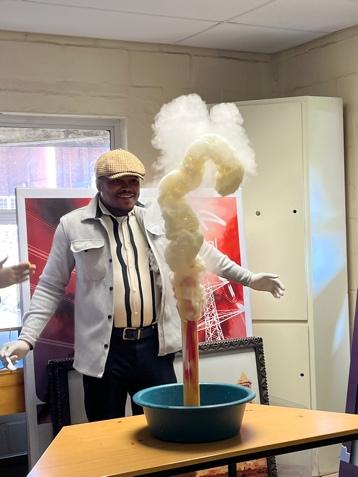
Science teachers were continuously encouraged to develop science clubs at their schools. The last two STEMI Roadshows were conducted in partnership with Arcelor Mittal Science Centre as part of their support to the region. In 2022 Advancing Knowledge, in collaboration with Arcelor Mittal Science Centre and West Coast Education District of WCED, held SACE-endorsed natural sciences training sessions for Intermediate and Senior Phase teachers.
Professor Shaheed Hartley, Director of Advancing Knowledge NPC together with Garden Cities Archway Foundation and Western Cape Education Department have to date constructed a total of 12 brand new Science Teaching and Learning Centres (laboratories) at five primary and seven secondary West Coast schools.
In 2024 Advancing Knowledge Non-Profit Company (AK NPC) was approached by a number of West Coast principals and science teachers for assistance with developing science clubs at their schools, and developing a science competition for their science clubs in the region. This stems from the members of AK NPC’s long-standing involvement in establishing science clubs at schools in the Western and Eastern Cape and its annual science competitions in Cape Winelands, Overberg and Central Education Districts.
After a number of deliberations, the members of AK NPC responded to this call and interested schools were invited to attend AK NPC training sessions for science club practitioners on 23 and 24 August 2024 at Arcelor Mittal Science Centre premises.
This was an opportunity for science and other interested teachers to participate in training on how to establish a science club from scratch and/or to renew, reinvigorate and advance existing initiatives in this regard. Teachers were taught how to start with elementary science experiments, investigations, exhibitions and activities and to expand on it in terms of the level of complication, difficulty and complexity.
During the training emphasis was laid on safety and the use of elementary everyday products to illustrate science concepts, principles and procedures. The idea of the training was for teachers to translate the gained knowledge and skills to their learners in a science club at their schools and to eventually participate in a science competition for West Coast schools.
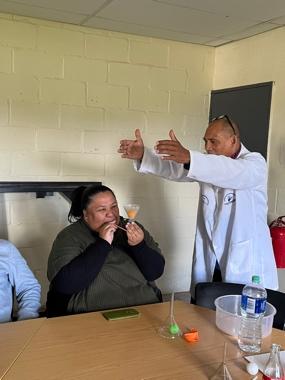
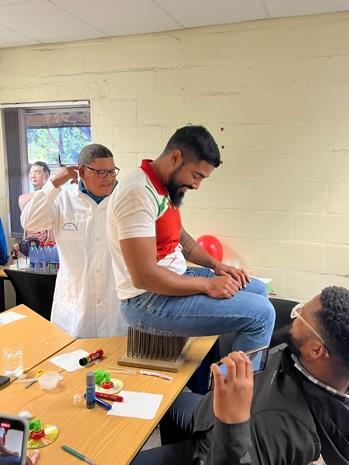
The science club practitioner training by AK NPC was supported by Garden Cities Archway Foundation and was offered in partnership with Arcelor Mittal Science Centre in Saldanha. A total of 33 teachers from 20 schools and members of the Arcelor Mittal Science Centre attended the training and took part in the hands-on interactive sessions. The training started with Prof Hartley presenting the work that Advancing Knowledge NPC has done in developing science clubs and science competitions in the Western Cape. Teachers were provided guidelines on setting up a science club at their schools and how to sustain the science activities conducted in the science club. Safety precautions and procedures when working with science activities were especially emphasised.
Teachers were divided into three groups to attend the three different sessions represented by science activities in physics, chemistry and technology. The training programme was alternated over the two days to allow everyone to attend the different sessions. In each session teachers were faced with demonstrations of interesting activities by experienced facilitators and then allowed hands-on participation in the activities ready-made to be transferred into their science clubs.
The three sessions were led by the lead facilitators Mark Ogilvie (York Road Primary) in physics, Robert Solomon (CPUT) in technology and Professor Shaheed Hartley (AK NPC) in chemistry. They were supported by co-facilitators and experienced science club practitioners Danie Burger (AK NPC), Gert Marero (Ashton High), Analida Malies (Dagbreek Primary), Evelyn Johnson (Bonnievale Primary), Joanne Lindeboom (Oker Primary), Abigail Joseph (Langeberg High), Devon Espin and Recobin Conradie (Ashbury Primary), Saadiqah Fraden and Michaela Willoughby (AK NPC interns) and Melissa Petersen (AK NPC project coordinator).
The facilitators were mostly from schools in the Cape Winelands Education District with established science clubs and could therefore share their experiences with the new science club practitioners of how they started and the challenges they faced. In many instances they could take the new practitioners by the hand and show them elementary science activities with which they started and how they continued to build on such foundations.
These facilitators will be preparing the learners in their science clubs for the Cape Winelands Science Club Competition that will take place on 19 September 2024 at the Cape Winelands Education District office in Worcester.
Evaluation and conclusion
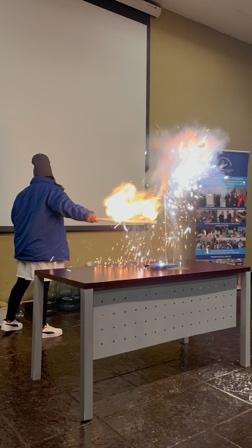
The final session on Saturday afternoon was presented by Dr Gillian Arendse from iThemba Labs, who showed teachers how to put together a series of physics and technology activities into a science show that had all teachers “oohing and aahing” while cheering and applauding the flow and simple outcomes that challenged their scientific knowledge and understanding. As usual, the sessions were rounded off on a high by controlled experiments resulting in loud bangs, huge explosions and a spectrum of coloured flames as Gert Marero and colleagues took teachers to areas of greater possibility as they developed their science clubs.
The following are examples of teachers’ perceptions of science club training as expressed in their evaluation forms:
- This was definitely the best “workshop/training” that I have ever attended. Love the practical aspects. Cant wait to take it to school.
- All presentations were lekker and lively. The fact that we could participate ourselves “het leer lekker gemaak”.
- This was my first time attending such a training. So I learnt a lot.
- The training went beyond my initial expectations. I loved that we could do the experiments ourselves. I teach grade 4 and will definitely start there with these experiments.
- The training showed me that it does not have to be a complicated process. You can start with simple things that are still interesting.
- The science club training definitely added value to my development as a science club practitioner. Before I was a but hesitant and uncertain but this training have given me new found confidence/enthusiasm for building my science club.
- The training challenged my knowledge and skills to such an extent that I will be practicing it at school with my learners eg balancing the coke can, making a model with the CD
- The different experiments triggered a whole new world and made me even more enthusiastic to start the science club.
- The training made me think and rethink the way I do things. Some of the experiments like the hot air balloon was something that was so simple but can be used in different ways.
- The science activities have taught me how to relate most content into real-life and how everything is connected as a whole. For example music and science and math may be taught all at once.
Organisations and corporates that want to contribute and partner in this initiative to empower and capacitate science club practitioners to build a critical mass of future STEM students emanating from rural schools are encouraged to make contact with the Director of AK NPC, Professor Shaheed Hartley (shartley@skatt.co.za).
Submit and get free exposure here: Showcase Your Business | Advertise Your Special Offers.