Top cop Shadrack Sibiya suspended amid inquiry into disbanding of political killings task team:
National police commissioner Fannie Masemola confirmed on Tuesday that deputy commissioner for crime detection Shadrack Sibiya is on “special leave” pending an investigation in the South African Police Service (SAPS) following corruption allegations.
Sibiya’s suspension comes after President Cyril Ramaphosa said on Sunday he was placing Police Minister Senzo Mchunu on a leave of absence after allegations by KwaZulu-Natal police commissioner Nhlanhla Mkhwanazi that he had interfered in investigations and conspired to disband a task team investigating political killings. Mkhwanazi also implicated Sibiya.
On Tuesday, Masemola told journalists in Durban that Sibiya had been served with a formal instruction to vacate his post temporarily while the matter is under investigation.
“I saw on the news that he says he has been served. Yes, he has been instructed to stay home while investigations regarding the matter are ongoing,” Masemola said after receiving a memorandum from protesters who had marched to his office to give him a memorandum in support of Mkhwanazi.
Masemola confirmed that documents had been submitted to the State Security Agency and that departmental processes were under way. He said the police service does not normally comment on internal administrative matters but acknowledged that the issue had drawn significant public attention.
“When a matter arises, we allow the internal process to take its course,” he said. “We do not normally like to discuss details of our departmental processes, but I can confirm that the documents were sent.”
Masemola added that decisions about Sibiya’s future would depend on the outcome of the internal investigation.
“We will see how the matter proceeds. I do not think I am the right person to comment further at this stage,” he said.
Asked whether any other officers had been placed on leave or suspended, Masemola said Sibiya was the only senior police official currently affected.
He also fielded questions regarding the future of Mkhwanazi, whose contract is due to expire later this year. Several community organisations and political structures have called for his contract to be renewed, praising his leadership during major police operations in the province.
Masemola said decisions regarding provincial commissioners’ contracts fall within processes governed by legislation and protocol.
“That matter is between employer and employee. When a contract is about to come to an end, the employer usually approaches the individual three to six months in advance to indicate whether they would like to renew or not,” he said.
“I haven’t been told anything yet, and I haven’t told him anything either. When we reach that point, we will be able to discuss it.”
In his 6 July media briefing, Mkhwanazi said the political killings unit had secured more than 100 convictions before its disbandment in late 2023, shortly after investigators began linking firearms to unsolved murders involving high-profile people.
On Tuesday, Masemola acknowledged the public’s right to demonstrate but urged South Africans to allow police operations to continue without disruption.
“This is unprecedented. We have taken note of that, let us allow the processes to unfold and give the police space to do their work.”
He also responded to concerns that a nationwide shutdown could threaten national security.
“I am calling upon the community and the rest of South Africa to respect the democratic process that is in place,” he said. “Let us go on with our lives and give the police time to do their work.”
Court orders former ANC MP Boy Mamabolo to be barred from Facebook:
The Polokwane high court has ordered that former ANC MP Boy Mamabolo’s Facebook account be deactivated and that he refrain from publishing defamatory statements against Polokwane’s mayor, John Mpe, and his family on any social media platforms.
In a judgment dated-stamped 15 July, acting judge Suné du Plessis also ordered that Mamabolo must not post or publish any photographs or videos of Mpe and his family members on WhatsApp, Facebook, X, Instagram or any other social media platform.
He further prohibited Mamabolo from “harassing, sending messages, or contacting the applicant to threaten and intimidate him in any manner, whether directly or indirectly”.
Du Plessis also ordered that the Facebook account under the name Boy Mamabolo Fans (Bua Kolobe) be permanently deactivated and/or deleted. Facebook South Africa (Pty) Ltd and/or any other person with regulatory control over the said Facebook account has been authorised to give effect to this order.
Mamabolo was also ordered to pay the costs of the application on an attorney-and-client scale.
The ruling comes after Mpe approached the court, claiming that Mamabolo had accused him and ANC provincial secretary Vhamusanda Madhadze of manipulating the Limpopo parliamentary list, resulting in Mamabolo not being sent to parliament by the party.
Mamabolo alleged that he had been nominated by various branches in accordance with the ANC’s constitution and electoral rules, and had received sufficient nominations for his name to be included on the provincial-to-national list for Limpopo.
He has since taken the party to court and the matter is due to be heard in the Johannesburg high court on 1 September. The ANC has accused Mamabolo of being selfish, showing a sense of entitlement to positions and putting his needs before those of the party and the electorate.
WhatsApp messages presented in court showed that Mamabolo had threatened to hire a hitman to kill Mpe and Madhadze, saying he does not “forgive people who take bread away from his table”.
On 22 March 2024, Mamabolo allegedly published false information about the cancellation of Mpe’s annual marathon and music festival at Ga-Molepo with the aim of undermining the event. It took place the following day but Mpe said this caused a financial loss because many believed the event had been cancelled.
On 30 March 2024, Mpe opened a case at the Polokwane police station against Mamabolo for conspiracy to commit murder, alleging he was planning to hire a hitman to assassinate him.
In response to Mpe’s claims, Mamabolo wrote an email to the former’s lawyers on 10 April, saying that he did not have a Facebook account and was only active on X and WhatsApp.
“Therefore, I do not know anything about what you are alleging against me. Your client must use his energy, as the political head of Polokwane municipality, to provide water to the people of Seshego,” Mamabolo wrote, further accusing Mpe of sexually harassing his wife.
“I have personally, on many occasions, stopped my wife from being harassed by your client during the Pirates and Sundowns matches hosted by Polokwane City and Sekhukhune United respectively at Peter Mokaba Stadium last year on different days.”
He went on: “My wife wants to lay harassment charges, which may automatically result in your client being required to step aside from his role as both the mayor of Polokwane municipality and as leader in the Peter Mokaba region once charged.
“Should your client continue to harass me with these ‘love letters’ that you are sending, I will finally allow my wife to proceed with laying the harassment charge at Polokwane police station. I repeat, I do not have any Facebook account, unless you can identify one using my ID number or personal details.”
On 30 April 2024, Mpe instituted legal action in the Polokwane high court, claiming R8 million in a defamation suit against Mamabolo. The matter is still pending.
On 10 June the same year, Mamabolo’s wife opened a case against Mpe, alleging that he sexually assaulted her in 2022 and again in 2023.
Mpe later submitted a warning statement to the police and denied the allegations. The National Prosecuting Authority declined to prosecute the case, stating there was no evidence to support the claims made by Mamabolo’s wife.
The world through Calvin Ratladi’s eyes:
The first thing I noticed about Calvin Ratladi were his eyes. Huge, mysterious pools of something warm and comforting. We met on the stairs leading up to Rhodes Theatre in Makhanda where the play he directed for this year’s National Arts Festival was about to premiere.
Instead of the jingle-jangle of pre-show nervousness, what I saw in his wise and gentle eyes was calm, unabashed patience — an artist’s quiet expectation minutes before the public sees a work for the first time.
And below the eyes, an openhearted smile, the kind you cherish long after you meet him.
For those few moments — “hello”, “great to meet you”, “break a leg” — Ratladi, who is this year’s Standard Bank Young Artist for Theatre, looked at me with such intensity it was as if we were old friends.
His eyes were, I thought, those of someone with a talent for baring his soul, someone familiar with the sensation of opening himself up in front of an audience. It was weird then to later hear him tell me that he avoids looking at people for too long.
“Usually, I don’t look at people when I speak to them,” he told me during a lunchtime interview a few days later. “I hardly look at people at all, because when I do, I start seeing beyond …”
And although his words trailed off then, I understood what he meant, knew that what he was alluding to was a gift, a sensitivity that has doubtlessly fuelled his artistic vision. “I’ve always known about this,” he says.
His ability to see below the surface, see “beyond” what exists in the physical realm, is precisely what catches you off guard in his new play, Breakfast with Mugabe, which — after its debut run in Makhanda — opens this week at the Market Theatre in Johannesburg.
It’s a curious and demanding play, one that works hard for the audience’s attention, and requires intense listening. If you do fall under its spell, you’re rewarded with insights you don’t see coming. It also appeals to what Ratladi refers to as “an African palate” — something that might just throw you off guard with its alternative imagining of an otherwise well-documented sliver of history.
“In my storytelling, it’s never just entertainment,” he says. “There’s also advocacy, and there’s a conversation.”
And, yes, there’s a potential provocation.
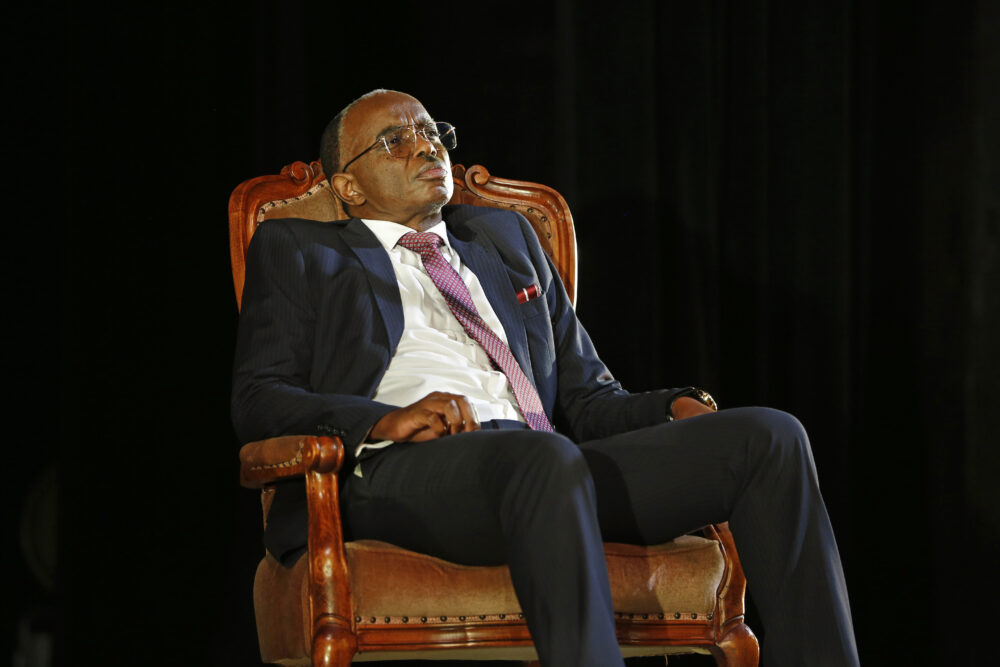
In his work, he wants to take you somewhere you haven’t been before, and it’s not necessarily a comfortable place. When he created a performance about his father, a miner in his childhood home of Witbank, he says he imagined what it must be like to spend so much of one’s life far beneath the surface of the earth. And that was the emotional journey he shared with his audience.
In Breakfast With Mugabe, he uses a classically-shaped play to take the audience through the veil, to share insight into a realm of spiritual reckoning beyond the rational, and to drive home the dichotomy of two worlds co-existing.
The play, written in 2005 by the Cambridge-based writer Fraser Grace, feels particularly poignant at a time when populist authoritarians are having a global moment. It is not a play about Mugabe’s rise to power, though, but of a period during his rule when he is plagued by some manifestation, haunted by unresolved grief. And the play hints that what’s generally ascribed to paranoia might be something quite different, something unknowable if viewed through a Eurocentric lens.
The play has weighed on Ratladi since he first read it in 2016. He tried to produce it previously but couldn’t raise the funding; he says it’s not the kind of show that can be staged on the cheap.
There have been passing thoughts, too, such as casting himself as Mugabe, with non-binary performance artist Albert Ibokwe Khoza in the role of Grace Mugabe. “I wondered what it would have meant if I played Robert Mugabe with my body, to go against expectations, push boundaries.”
His reference to “my body” is an allusion to his small stature, an effect of kyphoscoliosis, an abnormal curvature of the spine which is chronic and incurable. Despite its effect on his physical health and on his ability to do some things most of us take for granted (like drive a car), the condition has not stood in the way of his focus on advocating — through storytelling — for a better world.
Nonetheless, while his theatre work has earned him acclaim and has been even more widely embraced overseas, he’s perhaps best known for his role as Goloza in Shaka iLembe, the popular television series that last month entered its second season on Mzansi Magic.
While Ratladi has wanted to be a director since his early-20s, he says he has spent his career accidentally being cast in performing parts, a number of them created specifically for him — despite trying to avoid performing. He says just about everything he’s ever acted in, including Shaka iLembe, “came from coincidences”.
Breakfast With Mugabe was no coincidence, though.“I love classics … Macbeth, King Lear, Miss Julie … I love them. And this seemed like a classical play to me, a big story with great depth.”
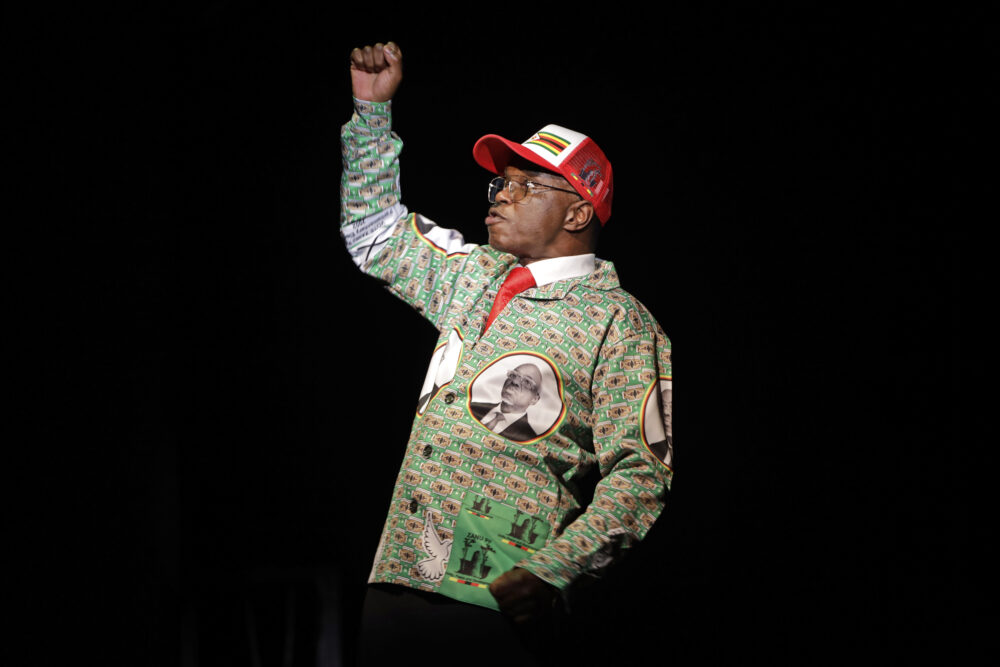
It also grapples with ideas and themes that recur in works he’s created. “What seems to come up over and over in my work are issues of land, of memory, and of power. I found these issues paralleled in the play.”
In the end, he cast Themba Ndaba as Mugabe and Gontse Ntshegang as Grace, with Craig Jackson as Dr Peric, the psychiatrist summoned to attend to the Zimbabwean president’s mounting psychological torment. Ratladi says the play requires actors with stamina who can carry the weight of the drama, endure the heaviness, not to mention the many words.
What you notice first about the play is the set, which suggests an almost violent collision between two worlds: a presidential living room imbued with all the trappings of modern Western existence and, surrounding it, a disconcerting African wasteland of dirt and rubble and shattered earth. It is as though some colonial edifice has been torn out of the earth.
Discussing the design, Ratladi spoke of the fact that, growing up in a mining environment, this shattered landscape was his reality. “I think it’s what I grew up surrounded by — the mining industry. I grew up in the mines. So it’s about the landscape I grew up with. That’s what the set is.”
The issue of the land — and the destructiveness of mining — is, of course, a key issue in any sort of post-colonial analysis of African history. And there’s something elegiac about this part of the set. It’s barely used, though, until — during a truly creepy and ethereal moment in the play — it dawns on you that it is a kind of spiritual wasteland. It’s a realisation that shifts the play’s entire axis of meaning.
For Ratladi, the set’s design visually and figuratively sets up the dichotomy that’s at the heart of the play.
“There’s the European side and there’s the spiritual side in Africa.”
In his sketches of the set, he says he referred to it as “a split personality”, which is something “a lot of Africans have”. He says the set represents these dichotomies, such as the capacity to embrace African spirituality and Christianity.
Ratladi says he was fascinated with the idea that “what was being regarded as paranoia, a psychological issue in the play, for me was a spiritual issue — that’s what I saw this figure of Mugabe actually grappling with as a person”.
“I think some audiences will come with a racial eye,” Ratladi says. “It’s hard not to, because there are so many triggers. Some will feel cheated, some will feel otherwise. For me, that’s the conversation I’m trying to have with people. To discuss the fact that as much as Mugabe was so passionate about the land and taking it back, he’s the same man who earned seven degrees while in prison, and who had embraced Western ways of thinking. He sought medical help in Europe rather than from the people around him.”
Ratladi is interested in the paradoxes and in the possibilities those paradoxes open up. Which is why, when he looks into the story, it seems to him that “there was a spiritual awakening that wasn’t fully embraced — and it caused a lot of suffering”.
“I was interested in what’s not in the media, and also not in the script. I was interested in where we might be missing parts of the story of this man about whom so much has been said and written.”
He says that, as much as the work might have a political message, there is always a human element, always a personal story at the heart of the wider picture. A nation might be suffering, but what if the cause is a personal pain or affliction being experienced by the nation’s leader? It’s that dichotomy — between the public and personal story — that he’s also interested in with this play.
Ratladi says that is the power of theatre; to convey big ideas through a very personal, intimate and digestible story. You sit there in the dark for an hour or two and are not lectured to, but get to witness — and feel — another worldview.
Breakfast with Mugabe plays at the Market Theatre from 16 July until 10 August.
Submit and get free exposure here: Showcase Your Business | Advertise Your Special Offers.