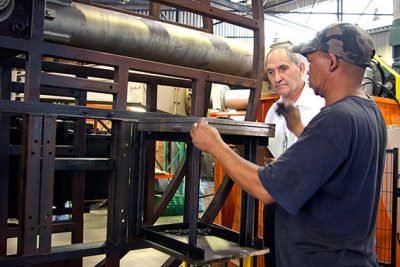
Training spend continues to grow as manufacturers unlock the value of investing in their staff:
 The evolution of the plastics industry over the last two decades has been substantial. Looking at the growing world population and their never ceasing demand for better products, scenario analysts agree that manufacturing pressures will only intensify over the next ten years. This will put growing pressure on plastics manufacturers to demonstrate an ability to reinvent themselves – a skill that will become pivotal for the survival of the plastics industry.
Whilst South Africa boasts many local plastic manufacturers who are successfully demonstrating this dynamic side to the industry, there are still challenges that remain when it comes to monitoring those that help keep the industry going, namely the staff complements.
“Business owners often have to overcome day-to-day challenges in their working environment, such as rising electricity and operating costs, strikes and labour issues such as low motivation levels or indifference to the quality of work employees’ produce. The lack of knowledge regarding both the material and machinery can prove to be a hindrance, as employees can be ill-equipped to fully grasp what is required from them,” warns Kirtida Bhana, Training Executive at Plastics|SA.
According to Bhana, an employee’s ability to understand what is required in terms of producing a quality product for shipping is vital for the growth of an organisation. “While the employee may have the will and intention to learn and do well in their position, without the correct training, the employee will not be able to convert their intention into the desired results without excessive trial and error occurrences”, she says.
Fortunately, it seems that a growing number of plastics manufacturers are realising the value of investing in training their staff. According to Bhana, stats for the past 3 years suggest that training spend has increased steadily year on year.
“We see this as the growing realisation and acceptance that training undoubtedly adds value. As the well-known adage states, “if you think the cost of training is high, try the cost of ignorance”! Employers who feel that training will empower their employees to seek alternative employment and is therefore a waste of money, should consider that training their employees is less costly than trying to run a business with untrained personnel. Also, if no one wants your employees, perhaps you should consider that you might be stuck with inferior personnel draining your resources and ultimately costing your company more in terms of resources”, she argues.
Despite making these compelling arguments for the case of investing in training, the Plastics|SA teams in Johannesburg, Cape Town and Durban don’t spend their time convincing industry partners that training is essential. Instead, their focus is on spurring on this realisation through visits, awareness campaigns and events. Thereafter they facilitate the process of identifying training needs with the willing.
“We build a close working relationship with our clients and get to understand their business, their challenges and their future dreams very well. Based on their individual mission and the objectives they have set for themselves to achieve in the next year or two, and in some cases even a five-year plan, we set out to determine with them what skills are needed to achieve these goals and what are the current gaps? Out of those identified, we determine the priorities and the budget. This helps us plan the most suitable and sustainable intervention for the organisation that not only effectively meets, but even surpasses the expectation,” she explains.
The most popular training programmes being offered by Plastics|SA and which continue to be in high demand, are those which centre around the actual manufacturing processes, with quality and safety programmes being part of these.
“The legacy in the plastics industry is to promote good operators to learn setting skills. From there, good setters are usually promoted to the rank of supervisors. The skills sets required to fulfil an operational, managerial and eventually a supervisory role are completely different, and Plastics|SA provides hands-on training for each of these,” Bhana expands. She adds that they are continuing to see growing numbers of students being enrolled for the Supervisory Management Programmes, providing reassuring evidence that the correct gaps are being identified for development.
Plastics|SA has also recently launched various new training offerings, such as a National Certificate in Production Technology (NQF2) and Generic Management (NQF5). “Next year, we will continue to run our scheduled Pipe and Profile Extrusion Programmes which we started in the 2nd half of 2017, using our newly acquired extruders in each region,” she divulged.
Plastics|SA plays an active role through the Plastics Chamber of the MerSETA by being a voice for the Plastics industry ensuring that the industry’s interests are always represented in skills related matters. This good working relationship enables Plastics|SA to facilitate funding access on behalf of their industry partners and helps to ease the intensive administrative processes required by the SETA.
However, Bhana highlights that whilst tax incentives, grants from the SETA for submitting Workplace Skills Plans and annual training reports and BBBEE scorecard benefits are all the obvious financial reasons to train people, the actual benefits account for so much more on the shop floor. These can be measured using indicators such as lower maintenance and breakdown costs, higher efficiencies, higher morale, lower absenteeism and motivated staff with all-round better work ethics.
“A knowledgeable employee (with the right attitude) is an asset to any company. For this reason, training should be seen as the ultimate motivational tool that every company needs to invest in. By having an adequately trained workforce, you will help create a culture in which your employees care and contribute to the business. They will be more motivated and excited about their work, as they understand what they do contributes to the success of the organisation. Trained and confident employees will be more vocal when they view incorrect practices and will be better equipped to troubleshoot small faults before they become a costly problem – thus illustrating the important relationship between training and motivation. Upskilling people transforms lives and increases their value add. Ultimately, this is what human dignity is all about,” Bhana concludes.
For more information about Plastics|SA’s training offering, visit http://www.plasticsinfo.co.za/training-2/
CLICK HERE to submit your press release to MyPR.co.za.
– MyPR
Submit and get free press releases here: MyPR Free Press Release.
Click here to list your business on BuyPE.