
Truck drivers condemn torchings:
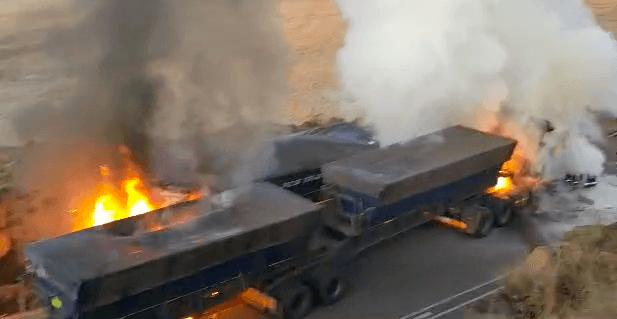
Truck drivers are pleading with politicians to end their “gimmicking” and deal decisively with criminals torching long-haulage vehicles on highways, while analysts have warned of dire economic consequences for the country from what is said to be xenophobic attacks in the logistics sector.
Truck drivers believe the attacks, which have seen 21 vehicles torched on the N2, N3, and N4 highways in KwaZulu-Natal, Mpumalanga and Limpopo, are probably the result of political games and xenophobia, said United Truck Drivers Association spokesperson Phillip Mukwande.
“What really happens when a government is running a certain ministry and using it for political gains, you will end up in a situation like this now,” said Mukwande, who has himself previously been the target of an attack.
He accused former transport minister Fikile Mbalula of having “stooped low” during his tenure, when he would join police roadblocks to check the documents of foreign truck drivers.
“Political gimmicking has to stop,” Mukwande said, speculating that the latest attacks on truck drivers could be a backlash against last month’s Pretoria high court ruling that declared the government’s termination of Zimbabwe Exemption Permits, which allowed Zimbabweans to live and work in South Africa, as “unlawful and irrational”.
Some South Africans have spoken out against the employment of foreign drivers in the trucking industry, saying this is not a special skill and these jobs should be filled by locals.
But Mukwande said most South Africans had been reluctant to drive long-distance trucks in 2000-01, when foreigners initially took up posts.
“They did not see the job of driving trucks as useful and then they saw the industry booming and wanted the jobs,” he said.
“The SA government should come to terms to say enough is enough, if you burn trucks you need to be arrested and then people — employers and employees — should sit down to talk.”
“We have thousands of trucks driving from Durban to Joburg and they [the assailants] cannot tell if they are shooting a foreigner. There have been so many incidents where a driver is shot and it is a South African.
“We call it barbarism. We cannot tolerate a situation where hooligans say they are ‘controlling the trucks’,” Mukwande added.

Sifiso Nyathi, the secretary of industry organisation All Truck Drivers Forum and Allied South Africa (ATDF), said it had signed agreements with the logistics sector and the transport and labour department to raise drivers’ grievances and confront the problem of logistics operators not complying with labour regulations.
“We condemn what’s happening, we don’t support that thing,” he said of the attacks on trucks.
“As ATDF we have voiced our grievances with the department of labour and transport and with various ministers since 2018 but it’s still the same. These people employ foreigners, they are not operating within the regulations of industry, no one is pointing a finger at them.”
Road Freight Association chief executive Gavin Kelly, followed by Police Minister Bheki Cele, described the torching of trucks as “a coordinated attack on the road freight sector”.
Cele told journalists on Wednesday that one of the motives police are investigating is the frustration of local truck drivers regarding the hiring of foreigners.
He said the police and security forces were on high alert to protect national freeways, with 12 suspects having been identified and their arrests imminent.
Kelly said the short-term losses from the attacks would run into millions of rands, including the cost of vehicles, cargo, personal effects, road damage, delays in movement and shipping penalties.
The long-term effect would be increased security costs, higher insurance premiums and toll fees and less freight movement through South African ports.
He said that depending on the vehicle and cargo value, short-term losses could be between R3?million and R10??million. Capital losses of the six trucks destroyed on the N3 alone amounted to “anything between R18??million to R60 million”.
About 7?000 containers move through the country’s ports daily, 4?000 at the Port of Durban, which means a delay on the N3 will result in import and export backlogs, Kelly said.
“Delays in moving [trucks] costs the transporter between R5??000 and R7??500 a day. A rough estimate of loss of revenue to 7??000-odd vehicles affected for a one-day delay at various points of entry, and along the N3 corridor, would be around R35??million,” he added.
Chris Hattingh, of the Centre for Risk Analysis, said the fact that the latest truck torchings had taken place on the anniversary of the July 2021 civil unrest preceded by similar truck burnings could be intended to send a message that underlying frustrations remain.
“Over the last five years we have seen an uptick in the proportion of protest action that is violent.
“In a context of perennially high unemployment and low economic growth, with food prices remaining high, there is an increased chance citizens’ frustrations could manifest in the form of violence and unrest,” Hattingh said.

Azar Jammime, the chief economist at independent economic consultancy Econometrix, said the short-term economic effect was not huge because 21 trucks were a fraction of the volumes moved on South Africa’s roads. But, “from a longer-term perspective it does greater damage because it is going to be a deterrent, not only to foreign investors, but also to locals, who will be less likely to want to run businesses involved in imports and exports because of the high risk. It will result in a big increase to insurance, which raises the cost of business and the price charged for goods.
“The other aspect is the attacks clearly highlight the extent to which the government’s oversight of enforcement of law and order has just collapsed,” he added.
“We saw a first major symptom of that in July 2021 but little has been done to ameliorate the situation. This government has once again proved that it is incompetent.”
The Free Market Foundation’s Martin van Staden said the collapse of government-operated rail meant trucking has become the only viable means of transporting goods, with 80% of freight moving by road.
“No business is exempt from reliance on this economic activity, meaning it should be a top priority for truckers and their cargo to be safe. If this cannot be guaranteed, South Africans can expect prices to start steeply rising as firms, both domestic and foreign, begin treating South Africa as a high-risk destination,” he said.
The economic downturn partly caused by decades of government overregulation “always breeds crime of this nature”, Van Staden said.
“Many South Africans are desperate to find a scapegoat for their relative poverty and foreigners are usually the first to be identified. Ultimately, however, the real culprit is the government and its economic policy dispensation that has sapped the life out of the economy.”
A short-term solution would be for employers and the police to work together to ensure truck drivers are armed and trained to defend themselves and their cargo.
“The long-term solution would be economic growth, which will very quickly diffuse the intensity of economic xenophobia.”
– Truck drivers condemn torchings | The Mail & Guardian
Spy agency boss Thembi Majola to quit:

Tensions between the State Security Agency’s (SSA) director general, Thembi Majola, and Minister in the Presidency Khumbudzo Ntshavheni have boiled over, with the country’s top spy reportedly in the process of quitting.
Although the presidency has denied that Majola has resigned, sources close to the ministry told the Mail & Guardian that she had decided to do so over the deterioration of their relationship.
This comes at the height of renewed attacks on trucks around the country, described by President Cyril Ramaphosa as economic sabotage, and which appear to have continued to catch South Africa’s intelligence community off guard.
Three high-profile insiders in the security cluster have told the M&G that the relationship between the two intelligence leaders has been strained for months and that Majola had been considering vacating her office for some time.
Majola was appointed as head of the SSA in February last year.
The SSA has widely been deemed ineffectual and beset by factionalism since the administration of former president Jacob Zuma, with allegations being made at the Zondo commission on state capture of a parallel intelligence agency being established to benefit Zuma and his political cronies.
The agency was also severely criticised in the high-level review panel report of 2018 and, most recently, in the report of the presidential panel that was established to investigate the July 2021 riots.
“The appointment of ambassador Thembi Majola to this position is an important part of our work to stabilise the country’s intelligence services. Her extensive experience in government, international relations and security makes her well placed to lead the reform and rebuilding of the State Security Agency,” Ramaphosa said at the time.
Majola’s appointment had been expected to give greater impetus to the implementation of the report of the SSA high-level review panel and the recommendations of the expert panel into the July 2021 unrest.
But sources said Majola has found the environment unfavourable since taking the job.
One insider said Majola was not welcomed by the spooks in her office, placing her under further strain.
“Spooks don’t normally take too kindly to someone from the outside. That place wants someone from within, it’s a family. They respect you when you come from within, among them, then you can start weeding out,” the insider said.
Another insider said Ntshavheni’s relationship with Majola first showed signs of cracks when Ntshavheni reinstated Robert McBride as the director of the foreign branch of the SSA.
The security cluster personnel said Majola was firmly against McBride’s reinstatement and that she had her own candidate for the job.
“They don’t like each other. Ntshavheni put her foot down that McBride must come back and Thembi was not happy. McBride is also a forceful person so when you don’t want him and make it known, he will make life difficult for you in return,” they said.
Both Majola and Ntshavheni’s spokespersons referred the M&G to Police Minister Bheki Cele when asked to comment.
McBride was suspended in July 2021, after a bungled diplomatic mission when South African spies ended up stranded during a failed operation that targeted Cabo Delgado in Mozambique, the City Press reported.
The blow to the intelligence services comes as crime intelligence is scrambling to make arrests after 21 trucks were torched along the country’s economic routes. These began on the second anniversary of similar torchings in July 2021, which were followed by eight days of violence and looting, mainly in KwaZulu-Natal.
Cele said this week that they had identified 12 suspects linked to the arson. He said there was currently “no evidence before us to suggest that the recent target on trucks are in any way related or linked to the July insurrection”.
But, at the time of the 2021 unrest, a source involved in fomenting the attacks told the M&G that the plan was to switch to targeting economic interests and infrastructure in KwaZulu-Natal to destabilise the state.
This suggests it is hard to differentiate political unrest and economic sabotage, and the recent attacks have sharply highlighted the incompetence of the country’s intelligence.
Deputy President Paul Mashatile said police crime intelligence had a strategy to deal with the criminality by reverting back to its 2010 World Cup strategy.
“They are going to bring back the methods that they were using during the World Cup. Firstly its visibility, random searches throughout. You are going to see that coming back. More roadblocks on freeways, searches in hostels [and so on].”
Mashatile admitted the recent spate of economic sabotage was a problem for the presidency, adding that restructuring in the security cluster was underway.
“We have quite recently brought in Minister Ntshavheni to take over state security, so there is some restructuring that is taking place. The president has asked me to chair the JCPS [justice, crime prevention and security cluster], which is the security cluster so to speak. We will be looking into this matter.
“We have [had] two meetings already. In addition to that, myself and the president have met all ministers now, one on one, and in our meetings with them, [which] sometimes take three to four hours, we want to know what is the priority,” Mashatile said.
The three insiders said that although the friction between Majola and Ntshavheni may not be a direct cause of the ineffective intelligence, “it has not helped the situation”.
They said that little work had been done by the SSA and its political heads to address the recommendations of the high-level review panel report of 2018.
A former intelligence operative told the M&G “nothing” was done to change the way in which they had worked over the past two years. “Nothing has changed,” they said.
The high-level review panel’s investigation into the security services, conducted over six months in 2018, found wholesale abuses, much of it stemming from executive meddling, but also noted the weakness of the work produced.
The panel was headed by Sydney Mufamadi, now Ramaphosa’s national security adviser, who noted “a number of challenges relating to research and analysis in the SSA”.
The key finding of the Mufamadi report was that there was “a serious politicisation” of the intelligence services, linked to factionalism in the ANC, and that these had been turned into a private resource to pursue the personal ends of particular individuals.
“In addition we identified a doctrinal shift towards a narrow state security orientation in the intelligence community from 2009, in contradiction to the doctrines outlined in the Constitution,” the report stated.
“We are concerned that the cumulative effect of the above led to the deliberate repurposing of the SSA.”
The report dwelled on the level of executive meddling in intelligence work, particularly through the Special Operations unit of the SSA, which it said had “become a law unto itself”. It had become “a parallel intelligence structure serving a faction of the ruling party, and in particular, the personal interests of the sitting president of the party and the country”.
Its findings on the Principal Agent Network were equally troubling. It was designed, the panel said, to bypass procedural requirements for the recruitment of staff, as well as the disbursement of funds and procurement processes.
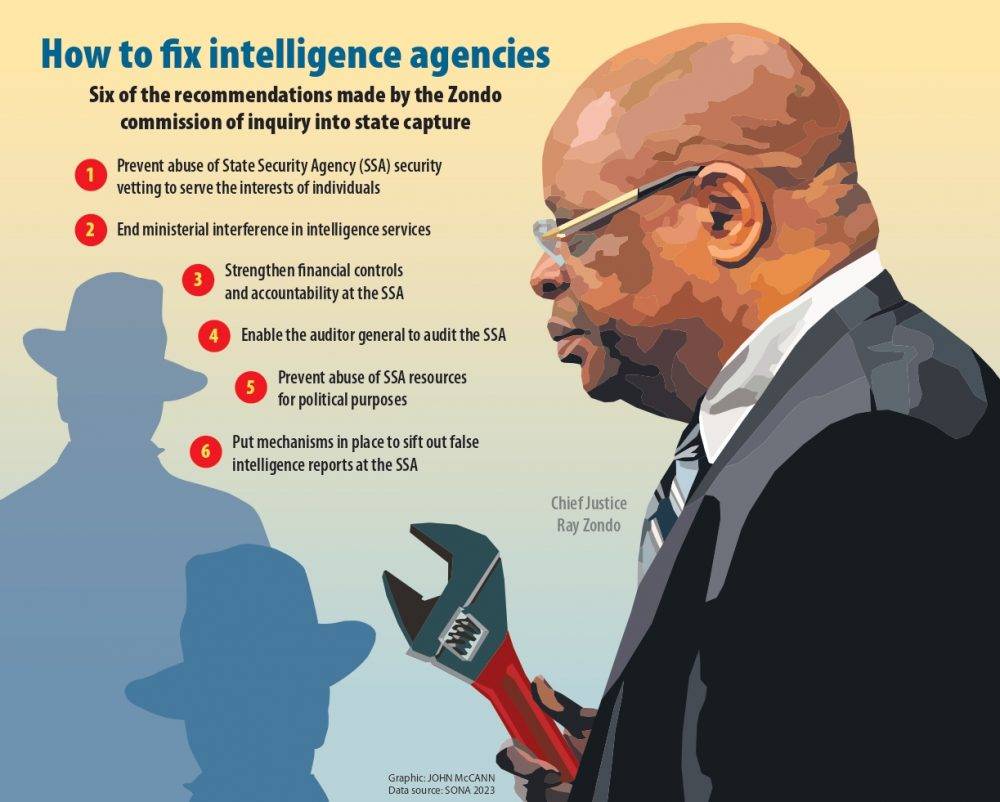
The Zondo commission delved into the state of the SSA and heard testimony about the abuses of the Special Operations unit, plus an account from a witness identified only as Ms K, as to who pulled the strings.
“At the executive level, the abuse of the SSA’s mandate occurred primarily under the political leadership of ministers Siyabonga Cwele, David Mahlobo and Bongani Bongo, and was executed or implemented primarily, although not exclusively, by Maruti [Stan] Noosi, ambassador Thulani Dlomo, ambassador Sonto Kudjoe and Arthur Fraser,” she testified.
Cwele had faced accusations of political meddling since 2013. These came from Gibson Njenje, the former director general of the SSA, who was fired two years earlier, along with then foreign intelligence boss Mo Shaik, for investigating the Gupta family and their nascent influence over the state and Zuma.
The Mufamadi report called for forensic investigations into breaches of financial and other controls to be instituted urgently and recommended that the minister’s powers be reviewed.
– Truck drivers condemn torchings | The Mail & Guardian
Grieving Springboks captain Etzebeth to play against All Blacks:

Stand-in South Africa skipper Eben Etzebeth will play against New Zealand on Saturday despite the death of his father, a team official told AFP.
The 31-year-old lock’s father died on Tuesday, casting doubt on whether Etzebeth would play in the Rugby Championship showdown in Auckland or return home to support his family.
Etzebeth took part in the captain’s run at Mount Smart Stadium on Friday morning, with Springboks media manager Zeena Isaacs confirming to AFP that he would play.
A South African Rugby official had described Etzebeth as “extremely close” to his father, Harry.
“It’s very, very sad. We have done everything in our power to be there for Eben,” Springboks assistant coach Mzwandile Stick told reporters on Friday.
“He made a choice to play and I would like to think that he wants to do it for his dad. We’re 100 percent behind him.”
Etzebeth is standing in as skipper, with the Springboks’ regular captain Siya Kolisi sidelined by a knee injury.
The match will be his first since suffering a shoulder injury three months ago.
New Zealand captain Sam Cane said he commiserated with his South African counterpart.
“It’s been a pretty tough week for him and his family. As a team, we send our condolences to the Etzebeth family,” All Blacks captain Sam Cane told reporters.
“It must be pretty tough for him being on the other side of the world,” he added.
“We’ll see each other at the coin toss and then do battle on the field.”
Both sides come into the clash on the back of commanding opening-round Rugby Championship wins.
The All Blacks hammered Argentina away 41-12 last Saturday, the same day South Africa beat Australia 43-12 in Pretoria.
South Africa’s veteran No. 8 Duane Vermeulen, who led the team against Australia, is among the replacements with six forwards and two backs named on South Africa’s bench.
This season’s Rugby Championship has been trimmed back to three rounds due to the World Cup, which kicks off in September.
Saturday’s Test in Auckland is considered a probable title decider and Cane is anticipating a tough clash between the rival packs.
“You can see by the bench they have picked, it’s going to be a game that will be won up front,” Cane said.
“We are in for a big challenge. I’m just looking forward to it. It’s going to be all on.”
© Agence France-Presse
– Truck drivers condemn torchings | The Mail & Guardian
Submit and get free exposure here: Showcase Your Business | Advertise Your Special Offers.
