
US mustn’t undermine SA foreign policy:
South Africa and the United States have been excellent partners since the advent of democracy, and we wish to retain that. We are, however, deeply concerned about efforts under way by some in the US Congress to undermine us.
South Africans have been surprised by recent developments, particularly the introduction of the US-South Africa Bilateral Relations Review Bill brought by Republican congressman John James and Democrat Jared Moskowitz earlier this year calling on the US to review its relations with South Africa.
The Bill accuses South Africa of “being engaged in activities that undermine US national security or foreign policy interests”. The Bill also makes the uninformed claim that the South African government’s actions are inconsistent with its publicly stated policy of non-alignment in international affairs, and asserts that “the South African government has a history of siding with malign actors”.
The House of Representatives Foreign Affairs Committee, which has a Republican majority, verbally passed the Bill with 36 votes to 13 on 21 March, and it has now gone to the house to be debated and voted on.
The content of the Bill does not reflect the strong positive relationship between our two countries, or the intention of the South African government to strengthen that relationship. It also fails to respect the right of South Africa to maintain an independent foreign policy, which is the right of every sovereign nation — to choose their friends and partners.
Singling out South Africa for its relations with certain countries is offensive and unfair. The US maintains strong relations with countries that maintain close relations with nations the US may not consider friendly.
India, Saudi Arabia and Turkey are just some examples. Turkey is friendly with Russia and openly friendly with Hamas, and the US has recently agreed to send it F-16 fighter jets. These countries have not been the subject of a Bill calling for a review of their bilateral relations with the US.
South Africa’s foreign policy is deeply rooted in our values and principles, which are informed by our democratic Constitution, which are the same values that the US professes to share.
Since the advent of democracy, we sought to build a country on the foundation of human rights, which derives from our experience of oppression under apartheid. That foundation was laid by Nelson Mandela, and the positions that we have taken have reaffirmed our commitment to a human rights foreign policy.
It would be devastating if our relations with the US were to collapse over our attachment to human rights, justice and support for those struggling for their rights and freedom, such as the Palestinians.
Our government’s actions have been very much in keeping with our foreign policy position of active non-alignment. We have deliberately avoided aligning our country with any of the major powers or blocs, but rather sought to forge cordial relations with all countries.
When US Secretary of State Anthony Blinken launched the US Strategy Toward Sub-Saharan Africa at the University of Pretoria in August 2022, he said: “The United States will not dictate Africa’s choices. Neither should anyone else. The right to make these choices belongs to Africans, and Africans alone. At the same time, the United States and the world will look to African nations to defend the rules of the international system that they’ve done so much to shape.”
We could not agree more.
South Africa has been a catalyst for promoting inclusive dialogue, bridge-building diplomacy and peaceful resolution of conflict. We continue to pursue positions that are in keeping with the United Nations Charter and have always opposed violations of the sovereignty and territorial integrity of member states. Our non-aligned position does not mean that we condone Russia’s military intervention in Ukraine, which has violated international law. We have decried the humanitarian disaster that has resulted from the military operations and called for the urgent opening of humanitarian corridors.
Last June, President Cyril Ramaphosa led a group of seven African leaders on a joint peace mission, for the first time beyond the borders of our continent, to meet the leaders of Ukraine and Russia in an effort to work towards bringing peace. Our most senior officials have played a pivotal role in the subsequent peace discussions on Ukraine that have been held in Copenhagen, Jeddah, Malta, Davos and, most recently, in Ukraine.
One of the major preoccupations of the Bill is South Africa’s position on the conflict in Gaza. There has been a particular focus on the case that South Africa brought to the International Court of Justice (ICJ), where we argued that the actions of the Israeli military in Gaza violate international law and includes actions that are prohibited under the Genocide Convention, to which South Africa, Israel and many other countries are signatories.
Our application to the court is consistent with our obligations as a signatory to the Genocide Convention. In its ruling on provisional measures, the ICJ found “plausible” evidence that Israel was conducting a genocide against the Palestinians in Gaza. The ICJ ruled that Israel must do everything to prevent genocidal acts in the territory. According to human rights groups, including Amnesty International and Human Rights Watch, Israel has “failed to take even the bare minimum steps to comply”.
It is truly unfortunate that the passed Congressional Spending Bill bans US funding for the UN Refugees and Works Agency (UNRWA) until March 2025, despite it being the foremost agency on the ground in Gaza, where two million Palestinians stand on the verge of famine as a result of the Israeli siege. The UNRWA delivers healthcare, social services, education and refugee camps for 1.7??million Gazans. At the same time, the Bill allocates a further $ 3.8??billion in military aid to Israel, enabling it to continue its military offensive against the civilians of Gaza.
The suggestion that the position we have taken on the conflict in Gaza could lead to a deterioration of our relations with the US is unfounded. South Africa is the African continent’s powerhouse politically and economically, and the US needs us as a partner.
The International Monetary Fund’s World Economic Outlook envisions South Africa’s GDP overtaking those of Nigeria and Egypt this year. South Africa has been a key driver of the African Continental Free Trade Agreement and serves as a gateway to the continent.
South Africa is also a key partner for the US in conflict resolution on the continent; we play a leading role in peace and security initiatives in the Democratic Republic of the Congo, South Sudan, Ethiopia and Mozambique, and together we can address unconstitutional changes of government.
South Africa is committed to advancing good governance and democracy as part of the African agenda, and we hope the US will remain our partner in building an industrialised, peaceful continent.
Since 1994, South Africa and the US have enjoyed a relationship based on mutual respect. This respect must not give way to unnecessary suspicion and tensions fanned by those seeking to undermine our relations, which are beneficial to both sides.
Shannon Ebrahim is a senior manager at the department of international relations and cooperation in South Africa.
Construction mafia hold South Africa to ransom:
Nala Business Chamber chief executive Ntozelizwe Mqenebe was brutally assaulted on a building site in Viljoenskroon in the Free State by three men who he alleges belong to the local construction mafia.
Four years later Mqenebe, a mechanical engineer who had visited the construction site purely on chamber business to discuss a sub-contracting dispute in 2020, says he still lives in pain after suffering spinal damage during the beating. He has had to undergo regular medical treatment for his injuries.
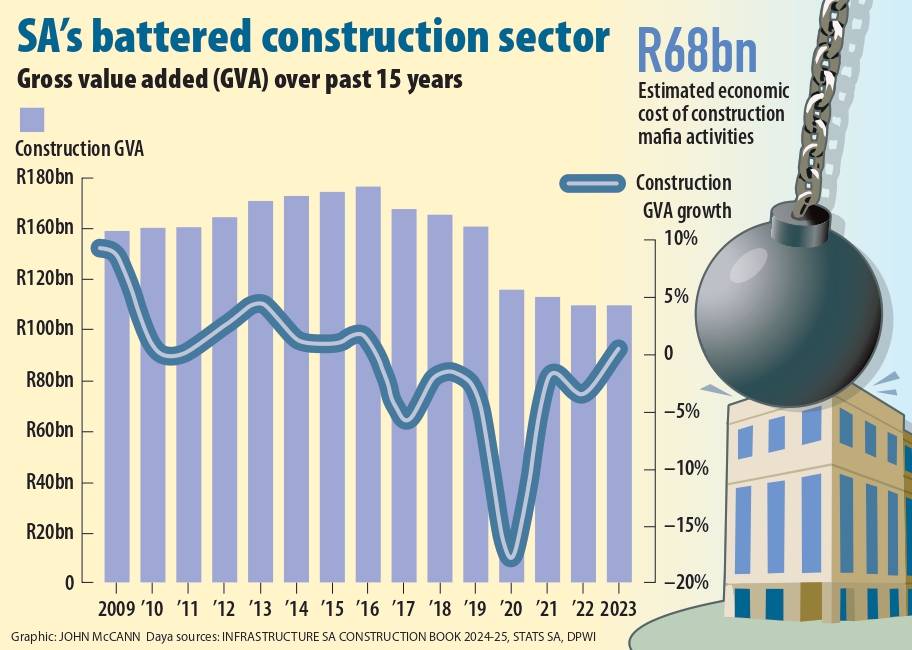
Mqenebe is one of many legitimate business people who have suffered at the hands of so-called business forums — the “construction mafia” — who, often armed with AK47s and other weapons, use the threat of violence to demand contracts or payments of up to 30% of the value of construction projects without doing any work.
The extortionists have now moved into the private sphere, where pensioners as well as other business sectors such as health, education and retail are targeted.
The construction mafia and extortionists were the subject of a heated debate in the National Assembly this week.
Police Minister Senzo Mchunu — who outlined plans to combat the construction mafia and crimes of extortion — concurred with MPs from across the political spectrum that this is “tearing apart the fabric of society” and leaving people living in fear.
Some legislators also alleged that the police are “embedded” in the illegal activities.
According to police and City of Cape Town reports, recent victims of the construction mafia, some of which were highlighted during the debate, have included:
• City of Cape Town official Wendy Kloppers was shot 16 times and killed while conducting an inspection at the Symphony Way housing project in Delft in February 2023.
• Three construction workers were shot and wounded at the same site a week before Kloppers’ murder after the city took a tough stance on extortionists. A petrol bomb was also thrown at the site.
• A construction worker was shot and killed on the Delft Main Road construction site in May 2023.
• Stefanutti Stocks coastal manager Matthew Horwill survived an attempted murder when an armed person opened fire on him when he arrived at the construction company’s head office in Pinetown in KwaZulu-Natal in June this year.
Mqenebe said he had filed complaints with the public protector, the police, the office of the premier in the Free State and the provincial department of community safety, roads and transport regarding the attack and the prevalence of illegal business forums in the province.
But, Mqenebe said, these have mostly fallen on deaf ears.
He said the men attacked him when he went to a site to join other business chamber members at a meeting with Danie van Rensburg — who, at the time, represented the contractors, Phezulu Plant and Down Touch Investments — and Sello Bokoro, the chief engineer at the Free State transport department, to discuss the awarding of subcontracts.
Mqenebe said he and the two chamber members arrived early for the meeting and the alleged members of the illegal “Nala Business Forum” — fashioning its name after the local chamber that is affiliated to the South African Chamber of Commerce and Industry — arrived 15 minutes before it was supposed to start.
Neither Van Rensburg nor Bokoro were present on site.
“While we are waiting, there comes another bakkie. It came through the security gate, with the three guys who were part of the illegal forum,” Mqenebe said.
Mqenebe said he had no idea how the men knew about the site meeting.
The two chamber members told the men that the meeting was to find out who had been awarded contracts. The men then threatened the members, who fled the scene.
“And then they went for me. They grabbed me. They called me ‘the difficult one’. They wanted to pull me out of the site office. They dragged me. My glasses fell. Then they started assaulting me with their fists, they kicked me,” Mqenebe recalled.
“They told me I’m the trouble one;
I want to take food out of their mouth, and they want to teach me a lesson today. I still live with the trauma of that incident that happened on 20??January 2020.”
Mqenebe opened a case of common assault against the three men, whose names are known to the Mail & Guardian, at the Viljoenskroon police station. But only one paid an admission-of-guilt fine, while the charges were dropped against the other two — without Mqenebe’s knowledge.
This news came as a shock to him when the police confirmed the status of the case in response to questions from the M&G on Wednesday.
Free State police spokesperson Captain Loraine Earle said three men had been charged with common assault at the building site but the cases against two of them had been withdrawn at the Viljoenskroon magistrate’s court.
“Mr Malale paid an admission-of-guilt fine of R300 on 6 July 2020,” Earle said.
Mqenebe said this “simply means someone corruptly withdrew our case”.
“In court they wanted us to amicably resolve it and we denied it. It is totally wrong that the NPA [National Prosecuting Authority] has withdrawn our case without our knowledge. I feel dumbfounded by the sentence as well,” he said.
Mqenebe said it also “pained” him that neither the Free State community safety, roads and transport department nor Phezulu Plant and Down Touch have provided him with an incident report regarding the assault, which would have enabled him to file a workman’s compensation claim with the department of labour.
Asked about the incident report this week, Van Rensburg said Mqenebe was “never employed by us or entered in any contract with us”.
“He attended a meeting with other subcontractors and was allegedly assaulted on the premises next door to our site camp,” Van Rensburg said.
Asked why the department of community safety, roads and transport had not yet investigated Mqenebe’s assault, irregular tenders and illegal business forums, spokesperson Hillary Mophethe said the department had investigated the allegations regarding illegal forums and obtained reports from its project manager, the contractor and the project steering committee.
She said Mqenebe had also been advised to open a case with the police. “In terms of sections 9 and 12 of Preferential Procurement Regulations, 2017, as well as Preferential Procurement Policy Framework Act (PPFA), 2000, which were applicable … the process of procurement of appointment of local subcontractors was in line with the legislative requirement.”
She said none of the businesses appointed were listed on the treasury’s restricted supplier database.
Mophethe said the department would not consider illegal business forums’ participation in projects.
The public protector’s spokesperson, Khulu Phasiwe, said Mqenebe’s complaint had been closed because he had not provided sufficient information about the companies contracted. “In most contracts, subcontractors are appointed by the main contractor and not by the departments. The information requested from the complainant would have enabled the PPSA [Public Protector of South Africa] to determine if in this instance the department had indeed appointed the subcontractors. There was insufficient information to refer the matter to the department or the SAPS [South African Police Service].”
But Mqenebe said he had provided the public protector with the identity numbers of his attackers and had expected that the office would have verified any links to construction companies.
The office of Free State Premier Maqueen Letsoha-Mathae could not be reached for comment.
Earle referred questions about Mqenebe’s report regarding the illegal forums to a national spokesperson, who had not responded by the time of publication.
In parliament this week, MPs urged the police to take strong action against extortion and the activities of the construction mafia, which Mchunu said were crimes mainly in the Western Cape, Eastern Cape, Gauteng and KwaZulu-Natal.
He said the modus operandi in the “heinous acts” of extortion was well known. “Most of them are individuals who do not want to work but rather choose to parade as armies of murderous parasites. That must be fought and rejected by society. They are often armed, operating in groups and instil fear and chaos. The relative silence of communities and low reporting is often due to these fears.”
Mchunu said the police had clashed with extortionists in Milnerton, Cape Town, during which four suspects were killed and four were injured, while two fled the scene.
He said his department and the SAPS have signed an agreement with the City of Cape Town to fight these and other crimes and would be signing similar deals with other provincial and local governments, starting with Gauteng and KwaZulu-Natal this month.
Art market: SA outlook is sunny:
The weather forecast for Africa’s busiest, buzziest and largest art fair, FNB Art Joburg, couldn’t be more perfect: Johannesburg will have one of those glorious clear spring weekends with no thunderstorms or last cold snaps as winter seems to have finally packed its bags.
The annual fair will have 28 galleries and project spaces exhibiting over 500 works from 100 artists in the Sandton Convention Centre until Sunday. These range from established blue-chip galleries representing Africa internationally as well as emerging, more experimental spaces.
“With such a large offering, mostly focused on African artists, now more than ever attending to the needs of the art economy from a local perspective that serves the curatorial and commercial integrity has become urgent and essential in ensuring that we as Africans own our art, our history and our futures,” FNB Art Joburg managing director Mandla Sibeko wrote in his foreword in this year’s catalogue.
When the fair was first established 16 years ago in 2008, there were a total of 55 contemporary art fairs in the world and only one on the African continent. Today, there are more than 350 global fairs every year.
It is expected that this year’s FNB Art Joburg sales may well exceed last year’s when most sold out and the selling points ranged from R5 000 to R20 million.
Asked to quantify the total asking prices for the works, the fair’s spokesperson said: “This isn’t something galleries are comfortable sharing.”
It is probably fair to say that none of the galleries will on Monday be packing up their stalls with empty pockets.
But, to use a weather metaphor, dark clouds have been gathering in the global art market in recent times. In the middle of last month the New York Times dramatically described it as a “sharp downturn” in the market.
This past weekend the Financial Times’ front page lead told us that “Sotheby’s sales slip as chill hits fine art market”. The piece said that the leading auctioneer has reported an 88% plunge in core earnings and a 25% decline in sales in the first half of the year, and that its arch-rival Christie’s was also “feeling the pain”. It had a 22% drop in auction sales in the same period.
“Weaker luxury spending in China is among the factors weighing on demand for fine art and affecting both Sotheby’s and historic rival Christie’s,” read the FT’s report. “One of Sotheby’s marquee auctions fell short of expectations in May, when the winning bid for a Francis Bacon portrait of his lover George Dyer missed the low end of its $ 30-50 million estimate.”
On Monday The Art Newspaper also reported about these declines in sales and sentiment, saying: “Pretty well everyone in the international art market agrees the trade is slumping. The most pressing question this autumn is whether the slump is a mere cyclical downturn or something more seismic.”
But one has to clarify that these slumps focus on the secondary part of the art market — the auctions selling second-hand art — and not the primary one, which is where the art fairs such as the FNB Art Joburg and galleries work.
As Marelize van Zyl, CEO and senior art specialist at Aspire Art — with Strauss & Co one of the two major art auctioneers in South Africa — explained: “The primary market is where the galleries operate. They represent artists and their careers. And that’s the first time a work comes to the market. That’s where careers are built.”
In the secondary market they work with “connectors”.
“So it’s the second time a work comes to market,” Van Zyl said. “It’s also when more valuable works come to market. More historical works, although we do very well in contemporary art as well.”
The art market can therefore be described as an inverse of the car market where the “used” art can sell for much more than new works.
“It is a cultural economy,” said Van Zyl. “We work with unique products.”
In March Aspire Art sold its fourth Marlene Dumas work for a spectacular R4 million. It was bought by a South African buyer — 60-70% of its buyers are local.
Perhaps apt for the state of the market, it is titled Existential Doubt. The painting is one of the celebrated artist’s earlier works, produced between 1972 and 1975. It was done before Dumas left South Africa for the Netherlands, where she now lives and works.
“We find it very interesting that she started a work and then would always revisit it, go back to it, add some elements and then take some elements away as well.
“It’s quite dark and gloomy,” Van Zyl explained. “But you see those stylistic elements of her much more recent work.”
But is that sale indicative of the health of the local market, as opposed to the global slump, as reported in recent weeks?
“We’ve certainly felt that this year was hard,” Van Zyl responded. “So we all had to work a little bit harder to keep on trading. I can only speak for our company. We’re much smaller and much more agile.”
Aspire Art adapted and changed its strategy. In its March live auction it brought the number of lots from the previous 300 down to 80 lots.
“And we’ve actually seen from last year that we had an increase in our sell-through value from 10-15%,” she said. “So if you bring less to the market, better quality, it’s good works … you will likely sell well.”
Macroeconomic and political factors, such as elections and instability, play a major role in the secondary market, because it is part of the luxury industry.
“I think when times are a bit uncertain, people will sit on their hands,” she explained.
And in these times, reputation is crucial, which is why Van Zyl is proud that Aspire managed to sell work as prestigious as Dumas’.
I asked her whether the downturn was cyclical and she agreed.
Van Zyl said they have seen “a lot of positivity” since June. “And with this positivity people are coming forward again. They are purchasing.”
She added: “I haven’t heard or seen of any doors closing, meaning that, you know, every entity that is still trading, they are still selling art. And that’s great. People are still making a living off this industry.”
Van Zyl said that while they are not thriving, they are surviving.
“Certainly for our business, our doors are open, we’re trading, and that is healthy.”
Submit and get free exposure here: Showcase Your Business | Advertise Your Special Offers.
