
Victims of R2.7bn BHI Trust ponzi scheme in the dark:

Investors in the estimated R2.7??billion BHI Trust Ponzi scheme are facing a bleak Christmas with no answers to whether they will ever be refunded their money, almost two months after the scheme went belly up.
The financial adviser they claim referred them to invest in the trust, Michael Haldane, and the directors of financial services provider (FSP) Global and Local, which he founded, have gone to ground, and are not responding to pleas regarding the whereabouts of the investments.
This comes after Investec and Allan Gray cut ties with Global and Local — which had been using their investment platforms to manage clients’ funds — when BHI Trust co-trustee Craig Warriner handed himself over to the police in mid-October.
Warriner told the Randburg magistrate’s court that he wanted to plead guilty to a charge of fraud for managing the fund “irresponsibly”.
Warriner also appeared in the Palm Ridge magistrate’s court on 29??November, where it emerged in court papers filed by the arresting police officer, Captain Ernest Khangale, that the BHI Trust and Warriner had received investments from 220 investors “without being issued with the necessary authorisation to act as a manager of a collective investment scheme or being a representative of an authorised FSP”.
“BHI Trust and the accused were operating a pyramid scheme wherein investors would request (recruit) other investors … when he was losing monies invested by the investors he would then use monies invested by new investors in order to pay out those old investors who wanted to withdraw from the scheme,” the papers said.
Khangale said an anonymous whistleblower alerted the Financial Sector Conduct Authority to the allegedly fraudulent scheme that BHI Trust and Warriner had run from January 2013 to August 2023. His BHI Trust co-trustee and investor, Christian Ashcroft, also opened a case of fraud against Warriner.
“An investigation was then conducted, and it was established that the accused through BHI Trust had defrauded almost 220 investors, an amount estimated to be R1??182??906??735,” Khangale alleged.
Warriner is facing charges of fraud and the Directorate for Priority Crime Investigations (the Hawks) and the police have confirmed that two further cases of fraud have been opened in connection with the collapse of the BHI Trust.
Asked to comment on the status of the investigations this week, Hawks spokesperson Brigadier Thandi Mbambo said: “The main case relating to the BHI Ponzi scheme was in court on 29 November 2023 and postponed to 20 March 2024. The one [fraud case] opened in Sandton … will be an additional charge to the main charge.”
Forensic investigator Bart Henderson, who says he is sitting with 200 cases of investor victims referred to him, believes the sum of money people have lost is much higher than the R1.2??billion mentioned in court and that there is a bigger picture involving companies abroad. He believes police investigations are moving at a slow pace.
“There’s a one-dimensional view of the BHI matter centred around Warriner’s confession. This is an extremely limited and narrow view and short-sighted,” Henderson said.
In a bid to expedite the investigation to preserve victims’ investments, which can be done through a preservation order in terms of the Proceeds of Organised Crime Act, Henderson said he had written an “urgent tip-off and a complaint” email to Sandton police station commander Brigadier Egen Moodley alerting him that he has files of evidence.
The letter highlighted connections between financial adviser Haldane, Rubicon Administration and Rubicon Trust and international firms including BHI International, Wasabi Investments and Drake Fund Advisors.
He said the names of officers representing these entities shared one name in particular, Kratrinos (Kaddy) Cost, who is directly associated with Haldane through Rubicon Administration, which administered the BHI Trust and Rubicon Trust, which Haldane founded.
“This structure is replicated by an offshore structure in the form of a BHI International, located in the British Virgin Islands. In this structure are companies sharing the exact same address but with different company names,” Henderson said.
In a United States Securities and Exchange declaration in March, Global and Local declared funds under management of about R2.4??billion. But in September the company declared R5??billion under management in an investor pack advertised in South Africa.
“Either Global and Local have misled the US SEC, or weren’t required to list the R2.6??billion investment under advisement omitted, to the SEC. It’s important to establish the actual size of investor funds under management to establish how much was lost through BHI, how much is left, and precisely where these funds are,” Henderson said.
He reported the matter to the US authorities last week and received an acknowledgement “submission number”.
Global and Local attorney Heetesh Patel had not responded to questions directed at the company, Cost and Haldane at the time of going to print.
Global and Local earlier distanced itself from BHI Trust. Managing director Mauro Forlin and Haldane recently said in a statement they were transferring the company’s client portfolio to GCI Wealth, a “strategic move” aimed at upholding superior financial advisory services “amid recent industry upheavals”.
“This transition underlines our dedication to our clients’ financial security and our confidence in GCI Wealth’s professionalism. We trust GCI Wealth to uphold the dedication and integrity our clients expect,” Haldane said.
But Global and Local clients who spoke to the Mail & Guardian this week said they would not accept advice from anyone recommended by the company.
Catherine Taxer, who entrusted Haldane with at least R2??million in investments since 2009, said she had received a call from a GCI Wealth agent who advised her that Global and Local would receive revenue when it took over her investments.
“I don’t want to have anything to do with anybody that has ties with Allan Gray or with Global and Local. Where do they come from?” Taxer said.
Another investor who declined to be named said he had trusted Haldane because he had been referred by family and friends who had used his services for years, and invested R7??million with BHI Trust through Global and Local in 2023. But now, he has no idea how to withdraw his money as Haldane is not responding to calls and emails.
He said a director of Global and Local had advised him that he could not speak about the investment because “it is going to jeopardise our case” but investors were advised in an email to withdraw their funds from the BHI Trust after Warriner’s arrest.
But Cost, who sent out emails on behalf of BHI Trust, advised that the fund had been “frozen”.
“You can email Kaddy [Cost] but you won’t get anything from him, you can’t get hold of anyone. As investors we have no one to talk to because there is a barrier of attorneys,” the investor said.
“Why would we go to GCI when Global referred them and they have basically screwed us and it is business as usual? It is terrible. People are saying we have lost everything we had so what is GCI going to do for us?”
Investor and attorney Werner Cawood filed an urgent application for the liquidation of BHI Trust in the Johannesburg high court, which granted an order for its provisional liquidation in October.
The post Victims of R2.7bn BHI Trust ponzi scheme in the dark appeared first on The Mail & Guardian.
The long story of #RhodesMustFall:
In 2003, Olive Schreiner (1855–1920), perhaps best known for her novel The Story of an African Farm (1883), was posthumously awarded South Africa’s Order of Ikhamanga in Gold.
The national award highlighted her “commitment to the struggle for human rights and democracy”. In 2020, reflecting on this commemorative recognition and the centenary of Schreiner’s death, Jade Munslow Ong evoked the idea of Schreiner as an early #RhodesMustFall proponent.
There is much to be said for exploring the resonances between Schreiner’s strident public censure from the late 1890s of Cecil John Rhodes’s capitalist imperial project and the #RhodesMustFall student movement in South Africa more than a century later. In fact, soon after the emergence of this decolonial movement scholar Lucy Graham compared it with Schreiner’s anti-Rhodes activism.
In March 2015, in a moment that catalysed the protests in Cape Town and internationally, University of Cape Town student Chumani Maxwele, the son of a miner and domestic worker, threw excrement at the statue of Rhodes on campus, calling out to the gathering crowd: “Where are our heroes and ancestors?” Weeks of campaigning followed to remove the statue. Its white-supremacist symbolism, protesters argued, was an “embodiment of black alienation and disempowerment” over the centuries into the present day.
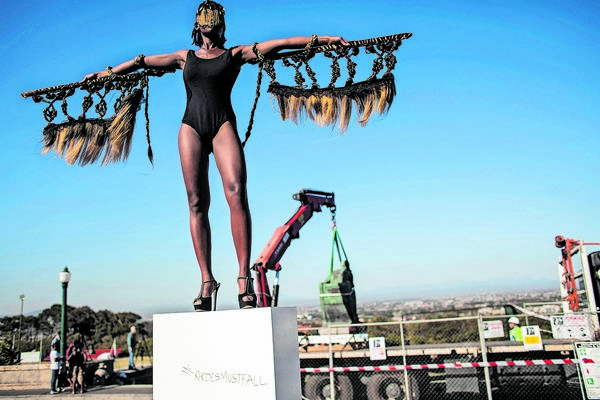
An important expression of #RhodesMustFall’s activism was to use creative forms to deliver its messages as Schreiner had done more than a century before, Graham notes. In April 2015, to mark the statue’s removal, artist Sethembile Msezane choreographed a performance piece in which she depicted the legendary Zimbabwean Chapungu bird bearing witness to the symbolic fall of Rhodes. Highly conscious of Rhodes’s “wrongful appropriation” of this emblematic bird from Great Zimbabwe to represent his imperialist creation of Rhodesia, Msezane could not let this historic moment of figurative encounter and retributive justice pass.
Elevated on her own plinth as the Chapungu bird, she lifted the artificial wings strapped to her arms in a profound gesture of ascent as Rhodes’s statue was unceremoniously unseated. In claiming this public ceremonial space, Msezane reaffirmed the histories and lived realities of pre- and anti-colonial Zimbabwe and Africa more generally — not least of its women marginalised by the racial and gender hegemonies of colonialism. All too aware “that South Africa’s memorialised public spaces are barren of the black female body”, Msezane offered a highly attuned, historically significant response to #RhodesMustFall.
While #RhodesMustFall made searing socio-political and economic connections in the present and precipitated an era-defining movement, it did not at the time specifically link its 21st-century protest action to the vocal, multi-sited anti-Rhodes activism of the past, including that of Schreiner, as Heather Hughes observes. Counted among Rhodes’s detractors during his lifetime, for example, was John Langalibalele Dube, educationist, journalist and missionary, who in 1912 would assume presidency of the nascent African National Congress (loosely becoming part of Schreiner’s network).
When Dube was studying and travelling as a young man in the United States during the 1890s, he wrote in the Los Angeles Times about the deadly hand of Rhodes in the region, registering a sense of how it implicated black people across the region. He inscribed the collective “us” into his analysis and invoked the shared status of oppression owing to race: “Rhodes and the other officials of the South Africa Company, we have found by fearful experience, are trying to put all they can in their pockets by killing and plundering us.” Dube railed against the violent 1896-97 seizures by Rhodes and his British South Africa Company of Shona and Matabele land north of the Limpopo, with brutal crackdowns on resistance.
Indeed, representatives from across the black diasporic world, as well as those from all backgrounds in Britain and the Empire, levelled criticism against Rhodes just as others lauded him. At the turn of the new century, the inaugural 1900 Pan-African Conference in London petitioned Queen Victoria about the “degrading and illegal compound system of labour in vogue in Kimberley and Rhodesia” attributed to Rhodes’s racial capitalism. Prominent black intellectual WEB Du Bois, leader of the African American delegation to the 1900 Conference, was to have a direct influence on Schreiner with his exposition of the “colour line” becoming the overarching issue of the 20th century.
Schreiner, who keenly observed socio-political developments on her return to South Africa from Britain in 1889 and who interacted with several black leaders and thinkers over time, became one of most vociferous critics of Rhodes after her earlier, if short-lived, regard for the scope of his knowledge which she had experienced first-hand in Cape social circles.
However, Rhodes’s support for the “Strop Bill”, which sanctioned the flogging of black servants and workers under contract in the Cape, presented a stark turning point for her. As she wrote to her sister Ettie Stakesby-Lewis, she “accepted no invitation to his house or had anything to do with him” once his brutal human dealings, hard-line segregationist policies, and networks of influence and corruption became irrefutably clear. “The perception of what his character really was in its inmost depths was one of the most terrible revelations of my life,” she commented.
In addition to public speeches, many press pieces, and her pamphlet The Political Situation (1896), Schreiner took Rhodes on through her piercing book-length allegory, Trooper Peter Halket of Mashonaland (1897). It exposed his violent incursions to annex territory and resources at great human cost. “What an accursed spite it is that the two people of genius which South Africa has produced should be in opposite camps,” wrote WT Stead, editor of the prominent British periodical Review of Reviews, who despite his great regard for Schreiner touted Rhodes’s grand vision until he later reversed his position.

The first edition of Trooper Peter Halket, featuring the chilling photographic frontispiece of three executed black men hung as “rebels” from a tree, sent shockwaves across London, the British Empire and beyond. We know that Cape African newspaper editor John Tengo Jabavu visited Schreiner on his return from investigating the Rhodes-backed atrocities, corroborating accounts of the colonial violence north of the Limpopo.
Published at the same time that the British Parliamentary Sub-Committee was investigating Rhodes’s role in the scandalous 1895-96 Jameson Raid on the mineral-rich Transvaal Boer republic, an act that would contribute to the triggering of the South African War (1898-1902), Trooper Peter Halket injected further energy into the public debate around the mining magnate-cum-politician’s commercial exploits and complicities. Rhodes was not ultimately indicted for the bloody Mashonaland and Matabeleland invasions, but was forced to resign as Prime Minister of the Cape owing to his association with Jameson.
Schreiner’s horror over Rhodes’s actions was such that she wrote later of Trooper Peter Halket as being her most important, if not her best, book. She wrote that the allegorical exposé would offer her a measure of “comfort” on her deathbed. It came at a great cost, however. Rhodes’s backlash attempted to cripple her financially (“get his teeth fast into us”) through a lawsuit his associate took out against Schreiner’s husband Samuel “Cron” Cronwright. Rhodes’s vengeance took other forms too, including attacking Schreiner in the white press and orchestrating hate mail.
In her time, Schreiner’s denunciation of Rhodes was no less public condemnation and exhibition than #RhodesMustFall activism has been in the contemporary period. Furthermore, Schreiner’s emphasis more than a century ago on the extent to which Rhodes both enabled and emerged from a system has been strikingly prescient of #RhodesMustFall’s focus on the structural power of coloniality.
“If [Rhodes] passed away tomorrow,” Schreiner wrote in 1897, “there still remains the terrible fact that something in our society has formed the matrix which has fed, nourished and built up such a man!”
While Rhodes undoubtedly “shaped the world from beyond the grave”, to borrow Hedley Twidle’s words, he could not thwart his detractors then or now. Interrogations of Rhodes’s legacy, and the systemic nature of white privilege and “institutional colonialism”, show no signs of dissipating. The 21st-century #RhodesMustFall campaign has powerfully inspired other Fallist struggles, including #RMFOxford, while forging deep-seated solidarities with the #BlackLivesMatter social justice movement in the US and around the world.
In a sense, those today who take on entrenched exclusionary structures and their spectres join intellectual-activist ancestors including Schreiner in profoundly recasting visions of society to embody and empower all.
• Olive Schreiner: Writing Networks and Global Contexts is edited by Jade Munslow Ong and Andrew van der Vlies and published by Edinburgh University Press.
• Janet Remmington is a scholar, writer and publisher. She holds research associate positions at the University of the Witwatersrand and the University of York.
The post The long story of #RhodesMustFall appeared first on The Mail & Guardian.
SA water woes must not be ‘exaggerated’, says Mchunu:

The minister is adamant the country is not experiencing a crisis, despite about half the water in our systems being unsafe for drinking
The post SA water woes must not be ‘exaggerated’, says Mchunu appeared first on The Mail & Guardian.
Submit and get free exposure here: Showcase Your Business | Advertise Your Special Offers.
