Warning Bell: Trade union threatens strike action at machinery maker:
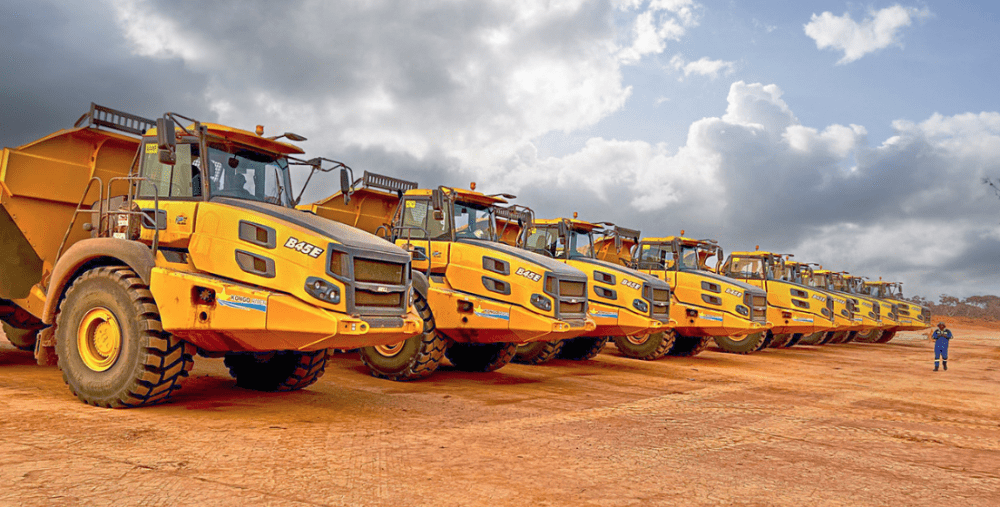
JSE-listed heavy machinery manufacturer Bell Equipment could soon face a “total shutdown” at its Richards Bay and Boksburg plants, with workers accusing management of discrimination.
According to a statement released by the National Union of Metalworkers of South Africa (Numsa) on Tuesday, Bell Equipment workers are demanding they receive a R2 000 housing allowance and a R1 000 transport allowance. They are also demanding that labour broker workers be in-sourced.
Richards Bay-headquartered Bell Equipment — which, according to its most recent integrated report, employs 3 071 workers in South Africa — has operations in North America, Europe, Asia and Australia. In April, the company reported a 63% increase in its profit after tax, which increased from R294.3 million in 2021 to R478.9 million in 2022.
In its integrated report, Bell noted that the increased cost of doing business in South Africa directly affects the company’s competitiveness.
Among the listed factors pushing up Bell’s South African operational costs was “pressure from organised labour for above inflation wage increases” and “disruptions to business across the value chain due to strikes”.
In its statement, Numsa accused Bell chief executive Leon Goosen of being “greedy” and discriminating against workers. According to Bell’s integrated report, Goosen’s salary increased 31% from R5.1 million to R6.715 million in 2022.
“The management has shared the profits through bonus pay out but only to management and white collar workers in the office,” the statement reads.
“Not a cent was given to so-called ‘blue-collar’ workers, who, by the way, are actually the ones who are responsible for the positive financial performance which the company achieved … Only a crippling strike can remind management who the real creators of wealth are!”
According to the statement, the union and management will meet at the Commission for Conciliation, Mediation and Arbitration on Tuesday. “If they refuse to put a better offer at that meeting, then we will request picketing rules, as well as the strike certificate from the commissioner so that we can mobilise for a total shutdown of Bell equipment,” Numsa said in its statement.
“We urge the management to come to the negotiating table with an offer to prevent a strike.”
In response to the Mail & Guardian’s request for comment, Bell Equipment categorically denied the allegations levelled against its management by Numsa, noting that they are “of a personal nature”.
The company added that it is following the formal process, which is currently with the Metal and Engineering Industries Bargaining Council.
“This is the appropriate forum for resolving any disputes and we will not argue the merits of the case via the press. We remain committed to upholding our values of fairness and transparency and are confident that the formal process will bring about a just resolution.”
– Warning Bell: Trade union threatens strike action at machinery maker | The Mail & Guardian
VIP officers in assault video are part of Mashatile security detail:

The VIP protection unit members caught on video assaulting young men on the side of the N1 in Johannesburg are part of the security detail of Deputy President Paul Mashatile.
The Independent Police Investigative Directorate (Ipid) said the victims were military trainees.
Mashatile’s spokesperson, Vukani Mde, told the Mail & Guardian on Tuesday that the deputy president was not in the vehicle when the assault took place.
“The deputy president condemns the behaviour and finds the video very disturbing,” said Mde. He added that Mashatile’s office had been in contact with the South African Police Service (SAPS).
The video clip of the eight officers assaulting the seemingly unarmed trainees — one of whom was rendered unconscious after a kick to the head — went viral on social media on Monday.
Shortly after speaking to the M&G, Mde released a statement in which he said Mashatile “abhors any unnecessary use of force, particularly against unarmed civilians”.
“The national commissioner of the SAPS, General Fannie Masemola, has promised a thorough investigation of the incident and articulated the conduct expected of police officers very well.
“Members of the SAPS are meant to uphold and protect the fundamental rights of every person and exercise the powers conferred upon them in a responsible and controlled manner,” he said.
SAPS national spokesperson Brigadier Athlenda Mathe said the police were obtaining statements from the victims and that an “internal departmental investigation is underway”.
Ipid national spokesperson Robbie Raburabu told the M&G that the victims of the alleged assault were military trainees, who had to get permission from their commander before opening a case against the VIP officers.
A case will not be opened with the military police because “we [Ipid] have a mandate over the [VIP] officers”, said Raburabu.
He said the officers would be charged with assault after statements were taken from the victims, and their injuries determined.
The incident was captured on video by passing motorists and sparked widespread reaction from the public, opposition parties and civil rights organisations. The so-called blue-light brigade has, over the years, become notorious for bullying tactics on the roads.
The director of civil rights lobby group Action Society, Ian Cameron, reiterated the need to stop the use of blue-light brigades.
“It [should] have stopped long ago. It has continued for two decades and it is only getting worse,” said Cameron.
He said incidents of altercations between blue light officers and civilians took place “frequently”, and it was mere coincidence that the latest was caught on camera.
The Democratic Alliance’s spokesperson on the police, Andrew Whitfield, has condemned the incident, and called on Police Minister Bheki Cele to arrest the “thugs in 24 hours”.
In 2011, the Justice Project South Africa launched a petition to ban blue lights for everyone except marked emergency and law enforcement vehicles.
– Warning Bell: Trade union threatens strike action at machinery maker | The Mail & Guardian
Mining companies eye the last unspoilt strip of the Western Cape’s west coast:

The last, relatively pristine section of Western Cape coastline between the Olifants River and the Northern Cape border is threatened by two new mining-related applications.
The applications to the Department of Mineral Resources and Energy (DMRE) are for prospecting rights on the farm Karoetjies Kop 150, which extends six kilometres inland and 15km along the coast north of the Soutriver.
Kotze West Coast Mining (Pty) Ltd wants to prospect for diamonds along the coastline, targeting places where diamond giant De Beers had excavated huge exploration trenches during the 1970s.
Nekwana Trading Enterprise (Pty) Ltd wants the inland prospecting rights as it eyes the possibility of extracting heavy minerals, kaolin and gemstones.
Environmentalists and residents have raised the alarm over a “tyranny of small decisions”, where numerous prospecting and mining applications and other development activities are individually approved by the government, without a proper assessment of their cumulative impact on the environment.
In its acceptance letter to Nekwana, DMRE says the company is required to “consult” with the department’s regional office or the diamond prospector about operations on the same property. Yet there is no requirement for a combined impact assessment of the two operations.
Professor emeritus Merle Sowman, former head of Department of Environmental and Geographical Science at the University of Cape Town, has repeatedly called for a strategic environmental assessment of the cumulative impacts of the expanding mining footprint along the entire West Coast.
She has warned that applications are being assessed on an individual basis without the government understanding the overall impact and net effect of all its various approvals.
Sowman says an overall, long-term and strategic decision-making process to guide where and when human activities can occur in South Africa’s ocean areas is underway, as required by the Marine Spatial Planning Act, which came into effect in 2021.
Yet because so many approvals have already been given for prospecting and mining applications, as well as other coastal developments, she says, an overarching strategic environmental planning process to facilitate sustainable development in the west coast will be undermined.
“It’s very worrying. There is massive pressure to allow more mining because the government sees this as economic growth potential, but no one is seeing the big picture,” she says.
Nekwana’s application
Nekwana Trading Enterprise (a company with a Polokwane, Limpopo postal address) wants to prospect for sillimanite, monazite, manganese ore, leucoxene, kaolin (clay) and garnets.
In its documentation, the company states that part of the prospecting work will involve drilling operations with boreholes limited to a depth of 20 metres. Twelve boreholes will be drilled initially to test target areas with up to ten or so more boreholes, depending on initial results.
The company says mining already contributes to the economies of surrounding towns, such as Nuwerus, Bitterfontein, Lepelsfontein and Rietpoort, and it will attract foreign investment through transportation and beneficiation. It says it will improve social cohesion for local communities.
The company says mining operations will boost local business and SMMEs and reduce youth and general unemployment.
It says a one kilometre “buffer zone”, where no drilling or activity will take place, will be placed around the river estuary and coastline.
Its final Basic Assessment Report and Environmental Management Programme documentation, including public comment, was submitted to DMRE on 19 May.
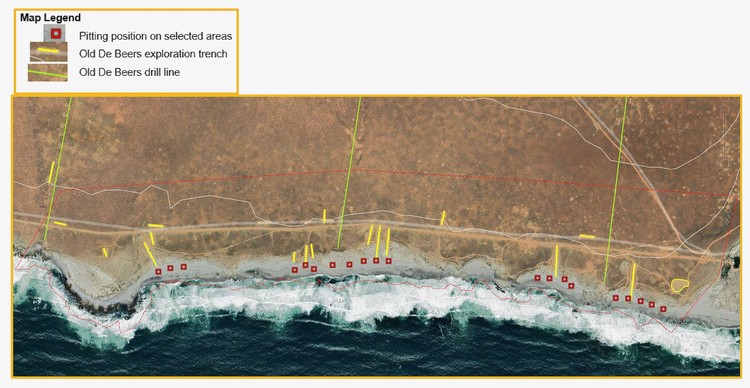
Proposed select target areas for new diamond prospecting, marked in red, at Karoetjies Kop 150. The yellow lines show old De Beers exploration trenches dating from the 1970s. Source: Kotze West Coast Mining (Pty) Ltd, Draft Basic Assessment Report and Environmental Management Programme.
Kotze West Coast Mining (Pty) Ltd’s application
Kotze West Coast Mining (Pty) Ltd, based in Koekenaap, wants to prospect for “general” and “alluvial” diamonds on 296 hectares and the adjacent surf zone.
Its application was accepted in April. A draft Basic Assessment Report and Environmental Management Programme was released in June to interested and affected parties for comment, closing 15 July.
Kotze West Coast Mining (Pty) Ltd says it is applying for the area where De Beers/West Coast Resources held diamond prospecting rights in the surf zone – up to about 32 metres out to sea from the low water mark, and an average 800m wide coastal strip.
In December 2022, De Beers/West Coast Resources rights lapsed, and Kotze West Coast Mining (Pty) Ltd took the opportunity to apply for a new prospecting right over a small portion of the historic right.
“The only land use [in the area] is uncontrolled recreational activities with ad hoc campsites during the crayfish season … The environmental impact will be the same as for the informal campsites,” argues Kotze West Coast Mining (Pty) Ltd.
It says there will be no prospecting during the summer and Easter holidays and all excavations will be made safe to allow for open access during these periods.
“The presence of an authorised and environmentally responsible company on site will also help to mitigate the problem of illegal diggers, crayfish poaching, littering, illegal hunting, and plant (firewood) collection, a common occurrence along the west coast,” Kotze West Coast Mining (Pty) Ltd states.
According to the company, the preliminary evaluation will involve 20 sample pits with a footprint of 11 by eight metres and 6.5-metres deep. The pits will be filled and rehabilitated after the assessment.
If the results are promising, bulk sampling will be done from much bigger trenches, but this will involve additional authorisation, including a different environmental impact assessment and specialist studies.
Environmentalists voice concerns
Mike Schlebach, managing director of not-for-profit organisation Protect the West Coast (established in 2020) writes on its website that the entire West Coast is in “danger of becoming one massive mining site, all the way from Lambert’s Bay to the Namibian border” – more than 500km of coast.
Environmentalists say that where prospecting is approved, mining permits are inevitable if the value of deposits is deemed profitable.
Communications specialist Miles Masterson wrote on the website: “While not quite as disruptive as full-scale mining operations, the prospecting activities, such as collecting sediment samples and conducting heavy mineral separation, may involve the digging up and disturbance of coastal ecosystems and habitats. Moreover, given the mineral-rich quality of the area, the likelihood of these prospecting activities leading to actual mining is extremely high … in this pristine, untouched coastal zone.”
Schlebach describes coastal zone mining as “an outdated and destructive form of mining, which rips up beaches to extract minerals for everyday use such as cosmetics with little to no rehabilitation”.
“It means the loss of heritage sites, the degradation of biodiverse areas and fragile ecosystems, the pollution of the surrounding marine environments, the loss of livelihood to local fishers and a general decline in nearby communities.”
Allen Lyons, a retired geologist and former chair of the Strandfontein Ratepayers Association, says, “It’s a bit like a feeding frenzy, and we are not winning any battles. It’s also a very expensive process, and by the time any of our appeals reach the minister’s desk, the fight is usually already lost.”
This article was first published by GroundUp.
– Warning Bell: Trade union threatens strike action at machinery maker | The Mail & Guardian
Submit and get free exposure here: Showcase Your Business | Advertise Your Special Offers.