‘We told the non-South Africans at the clinic to get out’:
It’s been just over a week since Teresa Nortje and members of March and March started blocking undocumented foreigners from using public healthcare services at a KwaZulu-Natal hospital.
Every day, Nortje, a grade one teacher and the chairperson of the anti-immigration movement, and other members, guarded the entrance of Addington Hospital’s clinic, checking IDs. She claimed the healthcare facility was a “hotspot for foreign nationals”.
Nortje says that this controversial campaign, which calls for South Africans to be prioritised at public healthcare facilities, and is being run in concert with anti-migrant movements such as Operation Dudula, is fast gaining ground.
It’s “taking flame” at public clinics and hospitals all over South Africa, she said.
“The movement is actually working 100%. Compared to approximately 500 people going to this clinic last week, it’s come down to 200. On Sunday, I think there were four patients that actually visited the clinic and they were only South Africans,” Nortje said.
“We stopped the undocumented foreigners, even the ones with asylum papers, from entering the hospital. The amount of foreign nationals coming to this clinic is coming down. The core of the problem is that they are taking resources away from South Africans.”
She claimed undocumented migrants are “draining” public healthcare resources meant for South Africans.
“An undocumented foreigner is not paying tax so, we as taxpayers, we are now paying for them to see the doctor for free and then they get medication free of charge whereas our South African citizens, that are paying taxes and that can use these clinics, they are not getting medication.
“Everybody has the right to medical assistance, we do agree with that, but not undocumented foreigners.
“When we are in their countries and we don’t have legal documentation, we get locked up and deported … This is not a banana country where you can get everything for free.”
March and March is “not implementing xenophobia at all”, she said. “That is why we are standing here peacefully …
“The staff are immensely grateful. They say they are overworked and overwhelmed … and now they can actually breathe and take breaks.”
Nortje said that she had received death threats since the campaign unfolded but, “I’m not going to back down because I’m standing up for my country”.
The KwaZulu-Natal department of health has condemned “in the strongest possible terms”, the actions of individuals and organised groups who take the law into their own hands by targeting health facilities and obstructing access to services.
South Africa is governed by the Constitution and the rule of law, and any grievances, no matter how serious, must be addressed through the proper legal and democratic channels, the department’s spokesperson Ntokozo Maphisa said.
“At the same time, we unequivocally condemn undocumented foreign nationals who unlawfully cross into South Africa with the sole intention of unduly accessing our public health services,” he added.
While the province’s health institutions are committed to upholding basic human rights and ethical healthcare standards, the “increasing and unauthorised influx of undocumented individuals continues to place significant pressure on our already strained and underfunded public health system”.
Maphisa said that, as much as the department is concerned about the “undue burden” placed on the system by undocumented migrants, it strongly rejects unlawful actions that prevent any sick individual from receiving medical assistance.
“No member of the public or structure has the legal or moral authority to block others from accessing healthcare. These illegal actions are not only unconstitutional but they also pose a serious risk to public health.
“Preventing individuals from entering the healthcare system undermines efforts to detect, control and treat infectious diseases that could otherwise spread rapidly within our communities.”
Blocking access to health services can inadvertently fuel uncontrolled outbreaks, including the spread of unfamiliar or imported viruses.
“Ensuring that every ill person is assessed and managed by health professionals, regardless of their nationality, is a fundamental part of South Africa’s disease prevention and public health strategy,” Maphisa said.
The department added that health facilities are not battlegrounds for political or social disputes.
“Disrupting services endangers lives, particularly those of vulnerable South Africans in critical condition, and undermines the very essence of public healthcare delivery.”
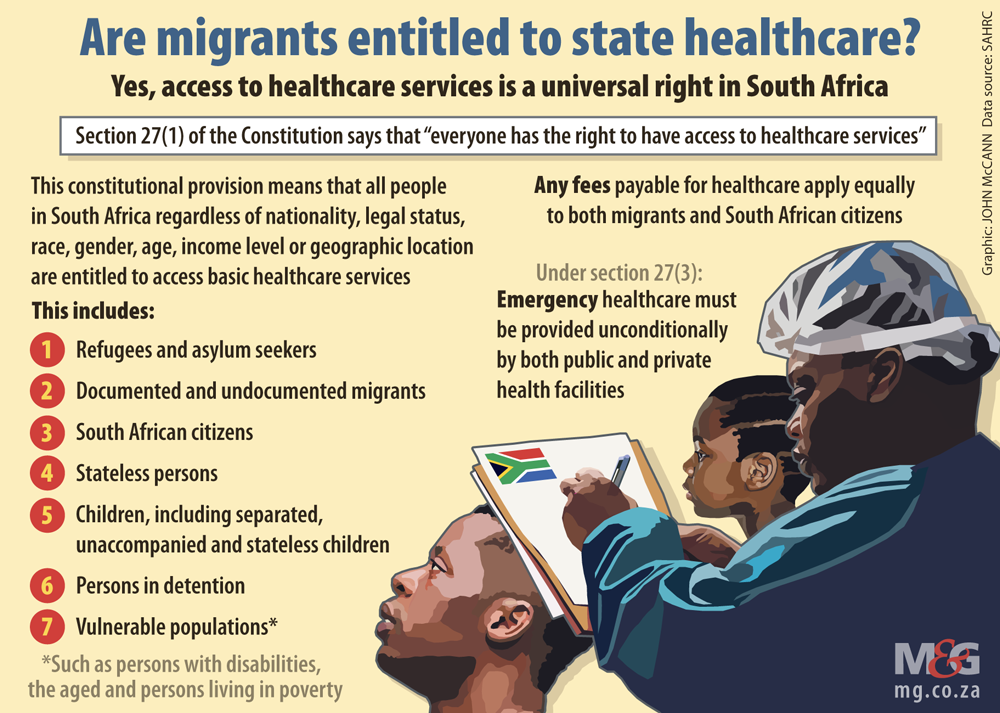
Section 27 of the Constitution guarantees that everyone has the right to access healthcare services, including reproductive healthcare, and that no one may be refused emergency medical treatment.
The National Health Act ensures access to primary healthcare services for all individuals in South Africa, regardless of immigration status, while the Refugees Act protects the rights of refugees and asylum-seekers to healthcare services and prohibits denial of emergency medical care.
According to the Immigration Act, while healthcare facilities are permitted to inquire about legal status, this should not hinder the provision of care, especially in emergencies.
The South African Human Rights Commission and the government have condemned the blocking of foreigners from healthcare services at public facilities.
When the Mail & Guardian visited the White City Clinic in KwaThema, near Springs on Gauteng’s East Rand on Tuesday, members of Operation Dudula loosely referred to the publication’s photographer Delwyn Verasamy as a Pakistani shop owner, saying they did not allow “bo?my?friend” into the facility.
After learning that Verasamy is a South African citizen and a journalist, they allowed him into the clinic.
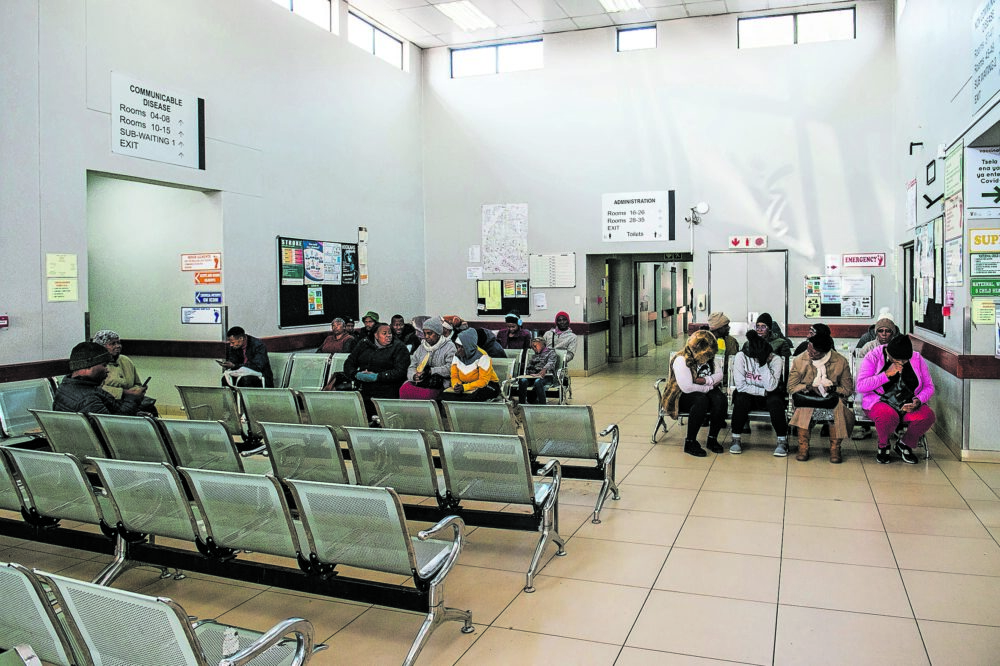
The waiting area appeared far less crowded than on previous visits, with long queues outside and some turned away because there wasn’t enough time to attend to them.
The nurses, who requested anonymity, said that since Operation Dudula’s arrival at the facility two weeks ago, patient numbers had dropped, providing some relief for the staff. Previously, one nurse would see at least 70 patients daily, but that number had now halved.
“Before, we would have more than 300 patients; now it’s half that. We work from 7.30am to 4.30pm and, in many cases, people had to go back home. The City of Ekurhuleni does not pay us for working after hours, and if we do and get injured, they will ask what we were doing after hours — so the responsibility lies solely with us,” one said.
The nurses expressed frustration working with foreigners, highlighting communication difficulties.
“Some don’t speak any of the official languages and it becomes even more difficult to understand what they want or need.”
They were concerned about foreigners misusing passports and obtaining medication from multiple clinics. “In one instance, you’ll find them using one passport, replacing the photo but keeping the same number, and usually the passports are brand-new.
“There was a pregnant woman who delivered a baby at one of the local hospitals. Two days later, a different person showed up at the same hospital using the same passport to also deliver a baby. The nurse noticed it was the identical passport processed two days earlier — that’s the reality of what we deal with.”
They mentioned that some foreigners use random residential addresses when they register for services.
“On their way to the clinic, they pick any house nearby and use that as their address of residence. While in the queue, one patient gave the address of a neighbour of the security guard and the guard had to intervene and said the patient was lying.”
“The other issue is they go to one clinic, receive specific medications, and the next day go to another clinic for the same medication. Our systems aren’t linked, so there’s no way to track that the patient already got it.”
The nurses said that among the medications most often requested by foreigners were antiretrovirals and, because of the high demand, stock sometimes runs low.
Mandla Ndlovu, a community member and patient, said it usually took him three hours to get his monthly medication — but this week, it took just 20 minutes.
“The work done by Operation Dudula should be commended and supported by community members,” he said. “I will join them in support because it’s frustrating to come and sit at the clinic while people who are not legal in the country get priority.”
The account PSAFLIVE on X has been sharing daily videos from various clinics guarded by Operation Dudula, purporting to show how many fewer patients there were without foreigners.
The M&G visited another facility in the township, the KwaThema Community Health Centre. It was not crowded and Operation Dudula members were nowhere to be seen.
A staff member said members of the movement had approached the clinic, but senior management refused to allow them inside, saying the facility would continue serving everyone — including foreigners.
“This was about a week ago … they haven’t come back since then,” the staff member said.
Operation Dudula member Dimakatso “Commander Tiger” Mokoena said the organisation had been stationed at the White City Clinic for at least two weeks and had seen a significant decline in patient numbers since its arrival.
On the first visit, it had ordered non-South Africans to “get out” and half the people had left, Mokoena said: “This shows foreigners are using our resources — resources meant for our people. We fought for our country and they must go back home and fight their own governments.”
“We are saying as Operation Dudula that it’s about time South Africans stand up and fight for what is ours. South Africa is for South Africans; everyone must go back to their country and fix their own country as we are doing. What we are doing is trying to fix our country.”
She vowed that Operation Dudula members would camp at the clinic “for as long as it takes”, adding that residents had joined them in support because they saw it as a “noble cause”.
Undocumented foreigners are “straining the budget and straining the healthcare workers because they are overwhelmed”, Operation Dudula president Zandile Dabula said.
“Even where Dudula is not involved, communities organise themselves and go to these clinics and hospitals themselves because I think people are gatvol … They can see that there is a problem and nobody is addressing this issue.
“We’ve been at the clinics for the past two weeks but we still don’t see any immigration officer or police at these facilities to make sure that healthcare is servicing people who are documented. Or rather, if those people are undocumented and they received medical attention, they need to be handed over to the law enforcers … This means that there is just no will to deal with this matter.”
South Africans “are on their own”, she claimed. “If the people that we think are the leaders of this country are not doing anything then, unfortunately, communities will stand up and organise themselves and take over.”
Abdeslam Habiballah, chairperson of the African Diaspora Forum, is “fed up” that migrants are blamed for the country’s problems.
“Recently, a group of people in the form of a mob attacked foreign nationals who are benefiting from South Africa’s healthcare alongside South Africans,” he said.
“It is a provocative action somehow to queue with South Africans while priority is for South Africans. I saw South Africans chasing away foreign nationals from the queue.
“It is hurtful to see pregnant women returning home to give birth at a place where men and women are together in one small room.”
Among the key findings of a 2022 report by the Institute for Security Studies was that South Africa’s socio-economic problems are not caused by immigrants but by poor governance and corruption.
“Many politicians, public officials and other high-profile people regularly make anti-immigrant statements that fuel xenophobia,” the report said.
Inadequate attention was being given to implementing proactive programmes that address xenophobia.
The number of migrants in South Africa is “grossly exaggerated”. There are about 3.95 million migrants, comprising about 6.5% of the population, in line with international norms. Immigrants contribute positively to the country — about 9% of GDP — and boost employment because every working immigrant creates two local jobs.
Loren Landau, a professor of migration and development at the University of Oxford and a research professor at the African Centre for Migration & Society at the University of the Witwatersrand, said foreigners could not be blamed for problems.
“We have to start from the position that yes, there is an absolute shortage of resources for South African citizens and that they have reason to expect that they should have education, healthcare, housing, jobs etcetera. There are many reasons why they don’t have those things. Foreigners are not among them.”
Referring to “political instrumentalisation”, Landau said it was not clear what the long-term plan was for groups such as Operation Dudula and March and March. The details of “who is behind them, who is financing them, etcetera” remain murky.
“There’s clearly a political agenda there with their members … but then there is also a kind of rechannelling of people’s genuine anger and frustration. What we do see is South Africans are fed up with a lot of things with good reason. And this [xenophobia] is giving them a name for these reasons that is simple, coherent and embodied,” he said.
“There’s a lot of frustrations with everyone; with the ANC, with [former president Jacob] Zuma, with Helen Zille [chairperson of the Democratic Alliance’s Federal Council]. This [xenophobia] is intuitive — even if it’s incorrect — and it’s very powerful that an outsider has taken something that belongs to you.”
There is anger among South Africans and they don’t have a place to put it, Landau said. They have lost faith in political parties, which have no real plans to turn around the economy. “The work that we’ve done with people who are in these [anti-migrant] movements; some of them are … just playing the game. Others genuinely feel that they are fighting for what they fought for in the 1980s and 1990s, which was a fairer society where black South Africans get their due. We shouldn’t ignore that many people feel that that’s what they are genuinely doing.”
Blaming foreign nationals, however, is disingenuous.
“This is a convenient way to paper over the deep failings of education, healthcare, housing and water … These are absurd sort of fantasies but they’re simple ones that anyone can intuitively understand. Whereas if you want to go back in and look at cadre deployment, key performance areas, bad management and corruption, those are complicated stories. They don’t have the same emotional pull,” Landau said.
He noted xenophobia in the public healthcare system where people were refused treatment was not new.
“But it’s much more systemic now; it’s much more integrated between politics and institutions and it’s completely normalised … Whether it’s attacks against foreigners or anything else, when people are very angry and they don’t have an institutionalised way to channel that, that’s when violence and protests erupt.
“If I were a politician I would be quite worried.”
International anti-corruption court can restore human dignity in Africa:
The right to human dignity is core to a basic understanding of rights and obligations. It is enshrined in the Constitution as a foundational value and as a fundamental right. Chapter 1 of the Constitution specifies human dignity as a founding value of the democratic state, while Chapter 10 guarantees everyone the right to have their dignity respected and protected.
The right to dignity means every single one of us possesses an inherent quality that is intrinsic to our being, and there is an obligation on the state to enshrine and protect that right. Notably, the constitutional court has anchored some of its critical judgments that have defined South Africa’s post-apartheid democracy on an understanding of what the right to human dignity means. These cases have touched on a broad range of issues including the abolition of the death penalty, the characteristics of reproductive rights, sanctioning homophobic hate speech, and the right to family unity in immigration matters.
The notion of human dignity is both a fundamental rule of law principle and has broader implications related to ubuntu and restorative justice. Following the democratic transition the Truth and Reconciliation Commission (TRC) was intended to usher in a new era of democratic accountability. Amnesty would be granted for those who came forward and spoke the truth, and prosecution and sanction would follow for those who refused to walk through the commission’s open doors. The TRC, largely, did not achieve its restorative ideals. Political cases were suppressed, reparations have not followed and wide-scale prosecutions did not take place.
Fast forward 20 years, the Zondo commission on state capture is plagued with the same risks in ensuring that the crimes of grand corruption, kleptocracy and state capture are punished. The commission has shown us the systemic failures in the state, where corrupt elites have enriched themselves at the expense of the people, creating widespread poverty and inequality. The Zondo commission, like the TRC, showed great promise of what a democratic society, based on principles of constitutionalism and the rule of law, could look like. This would include the right to human dignity. Too often, our history has had bitter endings as the ultimate victims of mass atrocities are our citizens who never receive justice, as was the case with the crime of apartheid, as well as looted state assets.
State capture was a crime against the dignity of the nation. Kleptocrats who abuse power to seek personal enrichment of themselves, their families and cronies can be viewed as akin to those who commit treason. Acts of self-interest are in direct contradiction with the interests of society.
Private unelected persons, such as the Guptas, the Watsons and others, in collusion with state actors, siphoned off billions of rand from the government in various nefarious deals. These schemes largely involved capturing public procurement, diverting profits from those contracts and, in many cases, laundering the money offshore. Now we have the historical record, the findings and the recommendations. Where are the prosecutions? How much money has been stolen, how much has been traced, and how much has been recovered?
It has been reported that the work of the Asset Forfeiture Unit and the Special Investigating Unit has recovered R11 billion for the state as of 2025. These funds were alleged illicit funds associated with state capture. This figure was recovered through a variety of actions, including cancelled contracts, freezing orders and acknowledgement of debt agreements. There have been some high-profile matters such as the ABB settlement for corruption at Eskom, described by the National Prosecuting Authority (NPA) as punitive reparations for an amount of R2.5 billion. This has been paid into the Criminal Asset Recovery Fund fund.
Frustration remains that the criminal justice system in many countries is unable to deal with the weight and magnitude of high volume, multi-actor, multiple jurisdiction transactions. These are often linked to racketeering, money laundering, and corruption involving public officials, private persons, and organised crime. Dubai, for example, has become a notorious destination that harbours criminals such as the Guptas and provides a haven for stolen assets, complicating prosecution of crimes across borders.
Even with commissions of inquiry, findings and recommendations, cases are slow to be lodged within national systems. This may be characterised by the independence of the prosecution services and judiciary, but they are fundamentally constrained when it comes to delivering quick and effective justice. Over the years, troves of information have been leaked pointing to how certain kleptocratic networks function, but prosecutions and stolen asset recovery have been meagre.
In global systems, where no single jurisdiction can be relied upon to have the political will and modalities to go after kleptocrats and their stolen assets, we need alternative solutions. Presently, there is no international institution to hold kleptocrats accountable when the countries they rule are unwilling or unable to do so. The case for establishing an international anti-corruption court (IACCourt) has been mooted as a feasible solution to address the constraints of domestic systems. Such a court would fill the enforcement gap in the international framework.
Countries who ratify the IACCourt treaty will give the court jurisdiction to prosecute the core United Nations Convention against Corruption crimes — bribery, embezzlement, obstruction of justice, misappropriation and money laundering. Constituting a fair and effective forum for the prosecution and punishment of kleptocrats and their collaborators. It would also deter others tempted to emulate their example, and recover, repatriate, and repurpose ill-gotten gains for the victims of grand corruption. As these crimes are often transnational, both source and destination countries for the proceeds of crime and corruption will have potential interest in the case.
Corruption erodes human dignity by depriving citizens of vital services like healthcare, education, and justice, especially affecting vulnerable communities in Africa. The IACCourt will hold corrupt officials and corporations accountable, restoring dignity through global accountability. By targeting high-ranking offenders and establishing an impartial framework, the court can address corruption where national systems are compromised, promoting justice in weakened states.
The IACCourt would complement regional efforts, such as the African Union’s Convention on Preventing and Combating Corruption (AUCPCC), strengthening Africa’s commitment to good governance. By offering a platform to prosecute transnational corruption cases, the IACCourt can foster stronger, more transparent governance, helping restore dignity and prosperity across the continent.
Particularly through its asset recovery jurisdiction, the IACCourt will create a forum where stolen monies can be recovered and repatriated based on the demands of a particular case. Asset recovery is a critical strategy in the fight against corruption, but too often assets that are recovered, are then returned into a corrupt fiscus.
The recovery of stolen assets must be linked to a notion of repatriation that has restorative justice values and provides direct benefits to victims of corruption. Repatriation would mean returning the stolen assets to their rightful place, ensuring that they are used for the benefit of the people who were harmed by the corruption. The vision of an IACCourt is that the recovery of stolen assets will return our human dignity, assaulted by corruption, by ensuring recovered funds are repatriated in a transparent and directly accountable way to the direct benefit of communities.
As we commemorate the African Union’s Anti-Corruption Day, focusing on the theme of Promoting Human Dignity in the Fight against Corruption, the establishment of the IACCourt could significantly contribute to this vision. The IACCourt aligns with the call for accountability and justice. It offers a platform to prosecute high-ranking corrupt officials and recover stolen assets, ultimately restoring human dignity to the communities that have been deprived by corruption. By filling gaps in the current legal system, the IACCourt provides an opportunity for Africans to stand up for their rights and dignity, as we work together to combat corruption across the continent.
Karam Singh is the deputy director of Integrity Initiatives International, and Ruth Kolevsohn is the executive director of Good Governance Africa’s group governance programmes.
Qatar must rethink the US’s Al Udeid Military Air Base:
The assassination of one of Iran’s highest-ranking generals and commander of Al Quds Force, part of the Islamic Revolutionary Guard Corps, Qasem Soleimani, opened an unprecedented form of conflict in the Gulf region.
Soleimani was killed in Iraq on 3??January 2020 by an US drone strike while travelling to meet Iraqi Prime Minister Adil Abdul Mahdi. Iran retaliated by targeting US military facilities in Iraq. Days after the assassination, it fired more than a dozen ballistic missiles at two Iraqi air bases housing US forces. According to The Times of Israel, Israel aided the US in that operation.
The leader of Hamas, Ismail Haniyeh, was killed by Israel in the Iranian capital Tehran after attending the inauguration of President Masoud Pezeshkian, another violation of the sovereignty of Iran and international law. The killing of Haniyeh in July 2024 came on the heels of the killing of a number of Iranian diplomats at Iran’s embassy in Damascus, Syria, on 1 April 2024. Israel — with the support of the US — has continued to assassinate Iranian officials inside Iran at will.
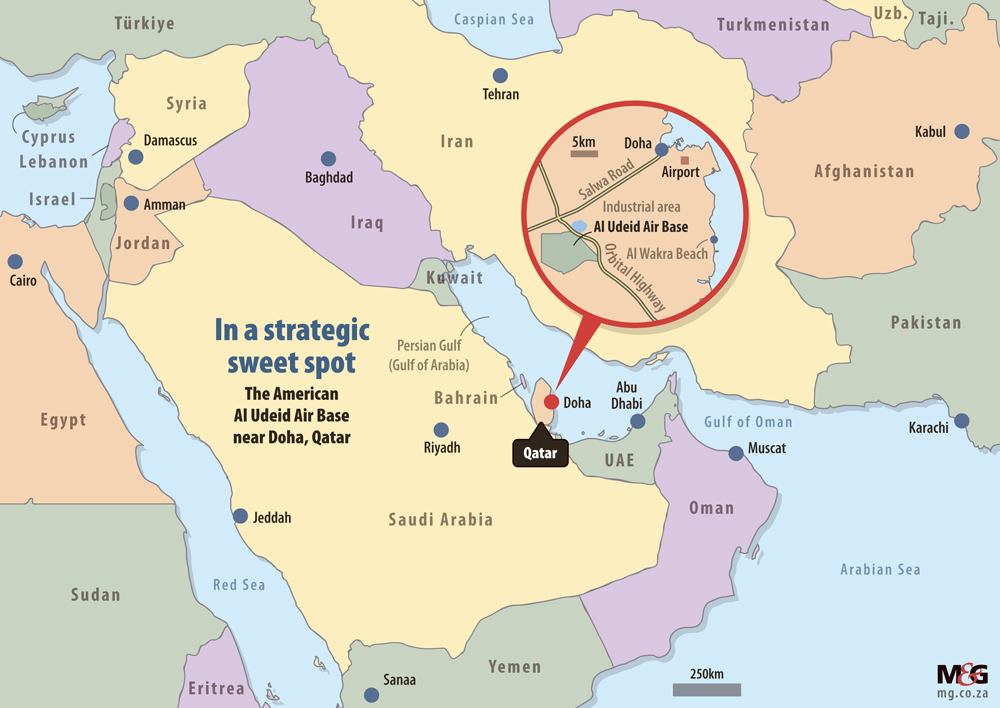
Qatar had joint military operations with the US during the Operation Desert Storm in Iraq in 1991. After the operations, Qatar and the US signed a defence cooperation agreement. This was expanded in 1996 to include the building of Al Udeid Military Air Base at a cost of more than $ 1 billion. It is the largest US military base in the Middle East.
Iran attacked Al Udeid in retaliation for the US’s attacks on the Iranian nuclear sites in Fordo, Natanz and Esfahan in June 2025. Although the strikes were downplayed by the US and Qatar — indeed they seemed to have been choreographed — they exposed a new fault line in future US-Qatar military cooperation. The question on the minds of many Qataris is: “What will happen next time the US decides to attack Iran — will Iran retaliate by attacking Qatar again?”
Notwithstanding the repeated mantra of “a friendly, brotherly love and appreciation” between Qatar and Iran, the biggest threat to Qatar’s security and political stability now, and in the near future, is a possible Israeli-US war against Iran. The targeting of Iran by Israel and the US presents a new security threat in the region.
Al Udeid has served as “a symbol of protection for the State of Qatar against potential attacks and other forms of hostilities”. However, when put to the test, Al Udeid has failed to meet those expectations. Besides Iran’s recent attacks on US military installations in Al Udeid, when Saudi Arabia, United Arab Emirates (UAE), Bahrain and Egypt led a blockade against Qatar in 2017, there was no forewarning from the US, Al Udeid’s touted superior military intelligence notwithstanding.
According to Qatar’s defence minister Khalid al Attiyah, “Actually, it was not a mere intention. There was a plan to invade Qatar.” The “plan was set into two phases, imposing the siege with the aim of creating an overall state of panic, which would have a direct impact on the Qatari street, then executing a military invasion”.
Possible future conflicts involving the US and Iran have raised serious concerns about the safety of the US’s assets and personnel in the region. It has also triggered a debate, particularly in the US media, about the viability of, and rationale for, the country’s continued involvement in Israel’s wars in the region.
Leading supporters of President Donald Trump’s Make America Great Again movement, such as executive chairperson of Breitbart News Steve Bannon, and right-wing journalist and social media influencer Tucker Carlson, have questioned “the US’s continuing blind support of Israel’s wars in the Middle East”.
Carlson, a known Trump supporter and right-wing voice, has been the loudest. He has been “urging the US to stay out of Israel’s war with Iran”. Bannon and Carlson are part of a broader effort to overturn the “GOP’s [Grand Old Party] hawkish consensus on Israel”.
Despite Trump’s unwavering support of Israel, the US president has been critical of Israeli Prime Minister Benjamin Netanyahu’s warmongering strategy in the region. Trump has entered into lucrative business relationships with countries in the Persian Gulf region recently and Netanyahu stands to disturb those relationships.
The US and the UAE have agreed to turn Abu Dhabi “to a site of the largest artificial intelligence campus outside the US”. The US will allow “the UAE to import half a million Nvidia semiconductor chips, considered the most advanced in the world in artificial intelligence products”.
According to The Guardian, Saudi Arabia has struck a similar deal for semiconductors, obtaining the promise of the sale of hundreds of thousands of Nvidia Blackwell chips to Humain, an AI start-up owned by a Saudi sovereign wealth fund.
Indeed, given these interests and the strengthening relationship between the US and the Gulf countries, the US has much more to lose if it continues to blindly support Israel’s wars.
The relationship between Iran and the state of Qatar is very strong — they share gas exploration sites in the South Pars-North Dome area. Located in the Persian Gulf, they are by far the world’s largest natural gas fields.
There is also a people-to-people relationship between Qatar and Iran dating back to time immemorial.
The next attack on Iran by the US or Israel could escalate and spread the war to Qatar. The US managed to move its assets from Al Udeid to other locations in Qatar before Iran’s attacks last month. What guarantees does Qatar have that Iran won’t go after those locations in future? There is a possibility that, if attacked, Iran will once again retaliate. What will happen then? Retaliatory attacks could go beyond a mere violation of Qatar’s airspace and sovereignty — they could cost Qatari lives.
The State of Qatar has to take serious decisions regarding Al Udeid if it wants to maintain its future relationship with Iran and other countries in the region. It must close Al Udeid. It has more valid reasons to do that now that the threat in the region has morphed. Consequently, Qatar needs to consider new defence infrastructure. Al Udeid presents more political and diplomatic challenges than opportunities.
Thembisa Fakude is a senior research fellow at Africa Asia Dialogues and a director at the Mail & Guardian.
Submit and get free exposure here: Showcase Your Business | Advertise Your Special Offers.