What does it mean to forgive? A play asks, 30 years after the TRC:
Thirty years after the start of South Africa’s Truth and Reconciliation Commission (TRC), Under the Shade of a Tree I Sat and Wept arrives not to commemorate but to question.
In collaboration with the Kosovo-based Qendra Multimedia, the production draws an unlikely but deeply resonant parallel between the TRC and Kosovo’s Movement for the Reconciliation of Blood Feuds. The latter was a grassroots initiative in the early 1990s that saw more than 1 200 blood feuds resolved through acts of public forgiveness.
On paper, the comparison feels almost improbable. One is a state-sanctioned process emerging from the end of apartheid; the other, a community-driven movement rooted in centuries-old customary law. But in playwright Jeton Neziraj’s hands, the two become mirrors, reflecting not just each other but the fragile, often contradictory nature of reconciliation itself.
The play doesn’t offer easy answers. Instead, it asks a deceptively simple question: Why do people forgive?
For Neziraj, the origins of the work are as intimate as they are historical. It began, he tells me, with a meeting. “An old man wanted to have a coffee,” he says, recalling the encounter in Kosovo in 2024. The man had sought him out to talk about the blood feud reconciliation movement, frustrated that it had slipped to the margins of public memory. As he spoke, recounting his involvement in the process, he began to cry.
“That moment was it,” Neziraj says. “It was a crucial moment.”
The emotions of that encounter which were raw and unresolved decades later, became the spark. For Neziraj, it was a reminder that history is not something fixed in the past but something that continues to reverberate through the present, often in ways that remain unexamined.
In Kosovo, the reconciliation movement had once mobilised hundreds of thousands of people, with families publicly forgiving the killers of their loved ones in an effort to halt cycles of retaliatory violence. But the outbreak of war soon after eclipsed the acts of collective courage, burying them beneath the larger narrative of conflict.
“Somehow nobody really wanted to go back anymore,” he says.

The play, then, becomes an act of return. A way of excavating what was left behind. The connection to South Africa emerged almost organically.
In searching for a “mirror” through which to examine Kosovo’s experience, Neziraj and his collaborators turned to the TRC, a process globally recognised, extensively documented and yet deeply contested.
When Neziraj first visited Johannesburg in 2020, he connected with Greg Homann, the artistic director of the Market Theatre, and the seeds of a collaboration were planted. What followed was a years-long process of research, exchange and ultimately co-creation, bringing together performers and creatives from South Africa, Kosovo and across Europe.
The result is a production that feels as global as it is specific. On stage, seven performers move fluidly between languages, geographies and identities, embodying stories drawn from both contexts. A South African actor might inhabit the voice of a Kosovar witness; a European performer might step into the shoes of an apartheid-era figure.
The effect is initially disorienting. But as the play unfolds, the logic becomes clear: they are not characters in the traditional sense but vessels for testimony.
“We didn’t want to create boundaries,” Neziraj explains. “The focus of the play is much more important than trying to make distinctions.”
The approach is central to the play’s form, which resists conventional narrative structure in favour of something more fragmented, more porous.
Neziraj estimates that more than 70% of the material is drawn directly from archival sources, interviews and historical records. The rest emerges from the rehearsal process itself, shaped by the actors’ responses to the material, their own reflections and moments of improvisation.
Layered on top of this is a third element: fiction. Small, sometimes playful interventions such as a seemingly incongruous scene or a sudden shift in tone that disrupt the weight of the testimonies without undermining them.
The result is a kind of theatrical collage, where past and present, fact and interpretation, constantly bleed into one another.
At times, the actors step out of their roles entirely, debating the material they are performing, questioning its meaning or even its validity. It’s here that the play’s meta-theatrical dimension comes into focus.
“Our idea was not just to bring those historical initiatives to the surface,” Neziraj says, “but to bring them into dialogue with this time.”
That dialogue is perhaps most striking in the way the play handles the question of forgiveness.
In South Africa, the TRC framed forgiveness within a moral and in many ways, spiritual framework, influenced by figures such as Desmond Tutu, who positioned reconciliation as both an ethical imperative and a pathway to national healing.
In Kosovo, the motivations were different. “There, religion was almost non-existent in the process,” Neziraj explains. “It was inspired by the idea of national unity and the fear of war that was approaching.”
Faced with the prospect of widespread conflict, communities chose to resolve internal divisions, recognising that survival would depend on collective solidarity.
“If you are not reconciling,” he says, “what kind of chances do we have to survive?”
In both cases, forgiveness emerges not as a purely personal act but as a social strategy.
A way of reimagining the future in the face of overwhelming violence.

Watching the play in Johannesburg, it’s difficult not to feel the weight of its questions pressing in from all sides.
The TRC, for all its achievements, remains unfinished business. Many cases were never prosecuted. Many stories were never fully told. The promise of reconciliation, for many, feels incomplete.
By placing South Africa’s experience alongside that of Kosovo, the play refuses the comfort of exceptionalism. It suggests that the challenges of reckoning with the past, of balancing truth, justice and forgiveness, are not unique but shared.
At the same time, it resists cynicism. If anything, it insists on the radical possibility that, under certain conditions, societies can choose a different path.
“Forgiveness from a weakness was turned into a social value,” Neziraj says.
But perhaps the most provocative question the play poses is not about the past but the present.
What values, it asks, are we producing now?
If earlier generations, in moments of crisis, were able to generate processes like the TRC or the blood feud reconciliation movement which were imperfect and contested but undeniably transformative, what are the equivalents today?
“Are we producing any kind of values,” Neziraj asks, “or shall we maybe recognise them and inspire ourselves with those values that have been generated?”
It is a question that lingers long after the final scene.
As the lights come down, there is no neat resolution. No cathartic release. Just the quiet persistence of unresolved thought.

In a world increasingly defined by division, by competing truths, by the erosion of shared narratives, Under the Shade of a Tree I Sat and Wept doesn’t pretend to offer solutions.
Instead, it offers something both more modest and more demanding: an invitation to sit with discomfort, to listen across differences and to seriously consider what it might take to forgive. And, more importantly, what it might take to build something from that forgiveness that lasts.
Economic Freedom Fighters leader Julius Malema is set to challenge his five-year prison sentence after being granted leave to appeal, triggering a legal process that will focus on whether the punishment imposed for discharging a firearm at a political rally was appropriate, even as his conviction remains.
Malema was granted leave to appeal his sentence but not his conviction following a ruling by magistrate Twanet Olivier in connection with a 2018 incident in which he was filmed firing a rifle into the air during the party’s fifth anniversary celebrations in Mdantsane in the Eastern Cape.
The court found that there were reasonable prospects that another court could arrive at a different conclusion on sentence but not on the question of guilt. This effectively narrows the scope of the next phase of litigation to the appropriateness of direct imprisonment, rather than the lawfulness of the conviction itself.
Within minutes of the ruling, Malema’s legal team, led by advocates Tembeka Ngcukaitobi and Laurence Hodes, moved to secure leave to appeal. The application was partially successful, opening the door to further proceedings in a higher court, where the proportionality of the sentence will be tested against the trial record.
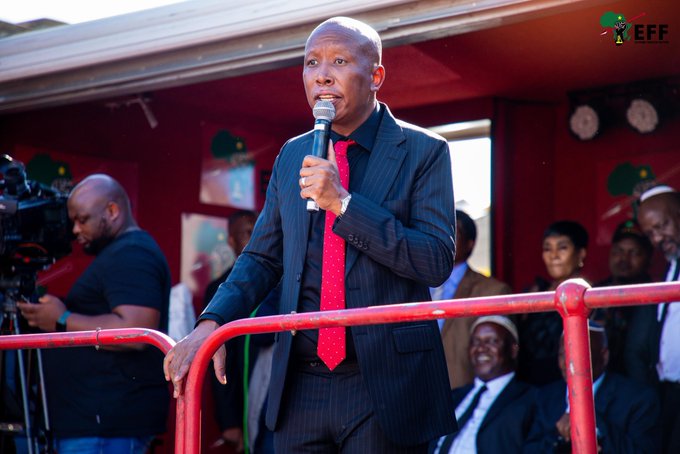
Addressing supporters and the media outside the KuGompo City regional court, Malema rejected the outcome and directed sharp criticism at Olivier, alleging that the judgment was neither independently authored nor free from external influence.
He further accused the magistrate of bias and suggested that her conduct should be reported to oversight bodies.
“It’s not her judgment. It is a sponsored judgment,” Malema said. He added that what he described as an “invisible hand” had shaped the outcome of the case.
“She is the most incompetent magistrate. We suspect she doesn’t write her own judgments. You are dealing with an invisible hand that is controlling the proceedings of the court.
“We must make sure that she gets reported to the magistrates council because the prosecutor knew about the judgment before she could read the judgment. “We did not even have to pay for bail; they just said free bail, go home.”

Malema characterised the prosecution as politically motivated and framed the case as part of a broader attempt to weaken him ahead of the 2026 municipal elections. He maintained that pursuing an appeal was a lawful exercise of his rights and did not imply a lack of remorse.
The EFF echoed these sentiments in a statement, describing the sentence as disproportionate and inconsistent with both the facts and the broader context of the incident.
The party said the matter had unfolded in a highly politicised environment and accused the National Prosecuting Authority of demonstrating what it called a suspicious appetite for imprisonment in a case where no physical injuries were reported.
According to the party, the discharge of the firearm occurred in a celebratory context during a political gathering and there had been no intention to cause harm. It further raised concerns about procedural issues, including the handling of evidence and alleged that the prosecution sought to make an example of Malema.
In delivering sentence, Olivier rejected the defence’s framing of the incident and emphasised that the court was guided by the evidence before it rather than political considerations. She said the circumstances under which the firearm was discharged were of serious concern, particularly given the planning involved.
“What was of great concern to the court was that an event was planned and what appeared to be a unique picture of the event ended up being an offence,” she said.
The magistrate found that the conduct was not impulsive but formed part of a premeditated sequence of actions. She said it required forethought to determine how and when the firearm would be obtained and discharged. “To reason otherwise is nonsensical,” Olivier said.
She rejected the argument that the shots were fired as part of a celebration, holding that the decision to act unlawfully had been taken in advance and with awareness of its illegality. “Such acts can never be condoned by the courts. The action cannot be justified as celebratory shots,” she said.

Olivier further stressed that the offence could not be justified within any broader political context. She said the proceedings concerned an individual accused, not a political organisation and that political arguments raised during the trial did not form part of the evidentiary record.
“It is not a political party that has been convicted, it is an individual,” she said, adding that the judiciary would not be intimidated by politically charged statements.
The court’s findings were based on the testimony of 19 witnesses and other evidence placed before it. Olivier said the matter had been decided on the facts and not on any external considerations.
For the state, advocate Joel Caesar argued for a custodial sentence of up to 15 years, submitting that the discharge of a firearm in a crowded public setting constituted a serious offence requiring a deterrent response, particularly when committed by a public figure.
Although the court imposed a lesser sentence, Caesar said he considered the outcome to be fair.
He opposed the application for leave to appeal, arguing that there was no reasonable prospect of another court reaching a different conclusion and that an appeal would amount to an unnecessary use of judicial resources.
“There is no reasonable prospect of success on appeal. Another court would come to the same conclusion,” Caesar said.
Ngcukaitobi, however, argued for a non-custodial sentence, submitting that there had been no intention to cause harm and that the incident occurred within the context of a political rally. He said the test for leave to appeal was whether another court, faced with the same facts, could reasonably arrive at a different conclusion.
“The question is whether another court, looking at the same facts, could come to a different conclusion,” he said.
Ngcukaitobi maintained that the prospects of success on appeal in respect of sentence were strong, adding that several grounds advanced by the defence had not been meaningfully opposed by the state.
Legal analyst Ulrich Roux said the appeal court would be confined to the trial record in determining whether the sentence should stand. He said the central issue would be whether a different court could reasonably impose a lesser penalty on the same set of facts.
Roux noted that the state had presented strong evidence during the trial, including ballistics analysis confirming that live ammunition had been discharged. This, he said, was inconsistent with Malema’s version that he had handled what he described as a toy gun.
He added that the defence argument regarding the absence of DNA evidence linking Malema to the firearm appeared to conflict with his own admission during the trial that he had handled the weapon.
“It is all on paper. You cannot rely on the demeanour of witnesses or how they performed under cross-examination,” Roux said.
According to Roux, the appeal proceedings would not revisit factual disputes as in a trial but would instead assess whether the sentence imposed was reasonable in light of the established facts and applicable legal principles.
Other legal analysts have similarly indicated that while the threshold for overturning a conviction is high, appellate courts are more willing to intervene on a sentence where it is found to be disproportionate or not aligned with precedent.
This places the focus of the forthcoming appeal squarely on whether direct imprisonment was justified, or whether an alternative sanction such as a suspended sentence would better serve the interests of justice.
Inside the courtroom, there was little visible reaction from Malema’s family members and senior party leaders when the sentence was delivered. Many remained quiet as proceedings concluded.
During a break, some party leaders and family members sang “bizani i fire brigade kuyasha”, loosely translated as “call the fire brigade, it is on fire”.
Malema briefly addressed photographers, asking how many pictures they wanted before indicating fatigue with the process.
Outside court, supporters gathered in numbers and continued to chant struggle songs. While vocal, many did not appear surprised by the outcome.
EFF national chairperson Godrich Gardee said the party was prepared to pursue further legal avenues should the appeal process not succeed. He said contingency plans included approaching the high court urgently and, if necessary, escalating the matter to the Constitutional Court.
“We are ready to trigger plan B and we are also ready to trigger plan C,” Gardee said.
EFF representative Nkululeko Dunga framed the outcome as part of a broader political struggle, saying the party would continue to challenge the ruling through legal channels.
The Democratic Alliance’s Geordin Hill-Lewis welcomed the sentence, saying it underscored the seriousness of firearm-related offences and reinforced the principle that no individual is above the law.
“Gun violence is out of control in South Africa, so any crime involving illegal gunfire is extremely serious,” he said. He added that strong consequences for such offences were necessary to deter similar conduct and restore public confidence in the rule of law.
After the proceedings, Malema was released without bail. His supporters gathered outside the court, chanting his name and welcoming him as he addressed them. He reiterated his criticism of the magistrate, alleging incompetence and bias and said he would not be going to prison in the near future as the legal process continued.
The case is now expected to proceed to an appellate court, where the central question will be whether the sentence imposed by the lower court was appropriate in the circumstances.
With the conviction upheld and only the sentence under review, the outcome of the appeal will determine whether Malema faces imprisonment or a reduced penalty, ensuring that the matter remains before the courts for the foreseeable future.
EMPD and the missing R14m lithium:
The Madlanga Commission of inquiry has heard evidence of an alleged rogue operation by Ekurhuleni Metropolitan Police Department (EMPD) officers in which lithium-bearing rocks worth about R14 million were confiscated from a Rosebank residence and later went missing in police custody.
Suspended EMPD deputy chief Julius Mkhwanazi denied being involved in the operation, which is alleged to have been carried out by EMPD officers acting outside their jurisdiction.
He told the commission under cross-examination this week that he had no knowledge of the whereabouts of the seized material. However, Mkhwanazi conceded that he was in the vicinity during the search-and-seizure operation, saying he had parked outside the property.
Mkhwanazi is accused of instructing EMPD Constable Keisha Stols and Constable Adrian McKenzie to search the home of a suspected minerals dealer.
In her affidavit to the commission, Stols said she and McKenzie were accompanied by a civilian during the February 2023 operation. She detailed how the EMPD first visited Rosebank police station and then proceeded to the flat in the area.
“In the presence of the [suspect], [we] searched his bedroom. Inside his clothes cupboard, we found the purple rocks. We asked him what they were and he informed us that it was lithium. We asked him for his permits to be in possession of the rocks, as well as his permits to sell. The white male was unable to produce [documents],” said Stols.
The lithium rocks subsequently went missing. McKenzie was later arrested after R40 000 worth of the metal was later found in his vehicle.
Thulani Magagula, the assistant director of the Independent Police Investigative Directorate, said that in related civil litigation only the lithium recovered from McKenzie’s vehicle had been accounted for.
In another affidavit, Ettiene van der Waars, the civilian who accompanied Stols and McKenzie, said the lithium rocks were handed to the vehicle parked outside the residence, where an unknown JMPD officer was seated, allegedly with Mkhwanazi.
“After a while, we left with the boxes and Constable Stols gave the male an SAPS [South African Police Service] seizure form. We met the JMPD [Johannesburg Metropolitan Police Department] officer and Constable Stols and Constable McKenzie handed the JMPD officer the SAPS seizure form and rocks,” Van de Waars said.
Commissioner Sandile Khumalo said the absence of a witness statement and the disappearance of the lithium created the impression that Mkhwanazi might have directed EMPD officers to carry out what amounted to an armed robbery. Mkhwanazi said the matter was under investigation.
Under questioning from evidence leader Mahlape Sello, he conceded that the operation was not a formal joint operation. He said officers often worked beyond their jurisdictions.
“When members are operational, they tend to do work beyond but sometimes they do work with other investigation officers. I agree with you,” said Mkhwanazi.
Sello pointed to Mkhwanazi’s contradictory statement that he was not at the scene and then later stating he was accompanying chief inspector Gerald Maseko, which made the operation questionable. Mkhwanazi has denied that he did not know the unnamed JMPD officer.
“My concern is that in your attempt to legitimise the conduct of Stols and McKenzie, you concocted this story of a joint operation and in order to persuade the commission, you selected the one person who, unfortunately, has since passed on, therefore cannot speak for themselves. I find that truly concerning … You did so because you knew …chief inspector Maseko would not be around to contradict this story and so you could lay this at his doorstep.”
Khumalo also pressed Mkhwanazi on what he described as a pattern of behaviour between him, Stols and McKenzie, suggesting inconsistencies in their accounts across multiple incidents, including the Rosebank case and a separate Brakpan matter.
“There’s a pattern of behaviour between you, Stols and McKenzie … that’s my observation.
“And my question is: Why are the three of you always protecting each other? Only giving the authorities what you think they need to know and when you are confronted with evidence, only then do you give the full information.”
Submit and get free exposure here: Showcase Your Business | Advertise Your Special Offers.