Why newspapers are all the rage:
Despite never having listened to any of their music, the name of the band Rage Against the Machine has always appealed to me. Particularly the “rage” bit. And particularly at this juncture in my career as a member of the Mail & Guardian’s production department.
Unfortunately “rage against the seemingly inevitable death of newspapers” just isn’t as catchy as the original. But this is the reality that I have been refusing to acknowledge for a number of years now.
My days are numbered. At the age of 64 and with many years of uninhibited alcohol consumption, enthusiastic smoking of (now almost legal) substances and dabbling in an assortment of mind-bending chemicals, this should come as no surprise.
But it is the imminent death of my newspaper career that is my real concern. Having a job in the media industry, especially print, is about as secure as a white rhino whose job it is to provide photo opportunities for tourists while avoiding the attentions of poachers lurking in the bush of the Kruger National Park. My job is becoming obsolete and soon my taxidermied head will appear in a display of species that no longer exist, perhaps between the panda and the penguin.
Newspapers are just not an essential part of people’s lives anymore. Online news has been touted as the alternative but not enough people are prepared to pay for this service. A single sentence of no more than 20 words that is for free on a phone is all that many people want.
Those 20 words can be full of ill-informed opinions and complete fabrication, but what does it matter when the next day that will be overtaken by a whole new flood of nonsense?
But I have gone too far. It is safer when venturing into the world ruled by Donald Trump’s “tech bros” to leave the expressing of strong opinions to a fictional character.
South African police detective Benny Griessel is the protagonist in a great series of novels by South Africa’s foremost crime writer, Deon Meyer.
Griessel’s partner (against crime) is the quintessential Kapenaar Vaughn Cupido, who in the latest instalment, Leo, says: “Partner, opinions are like arseholes, everyone has one. And they usually stink. The only difference now, with social media, is that we all have to smell it together. Welcome to Selfie City, we’re dinosaurs, let’s just suck it up.”
From this it is obvious where my “rage” should be directed. The vast majority of the world’s population that has lost the habit of buying newspapers sounds like an easy target. But this just leaves one feeling like a dolphin trying to pick out a single sardine from the shoals that swim up the KwaZulu-Natal coast in winter.
A far easier target is the embattled media owners and managers who, for years, have clung to the belief that digital is the future while the neglected print publications continue to provide much-needed income through advertising, even though the sales figures continue to plummet.
My rage bubbles on, and all I can do is continue doing what I know and love the best: making the pages of the newspaper look as good as possible using the stories, pictures and graphics provided by the shrinking but dedicated and talented team of M&G staff members.
The highlight of the week is finding the right combination of words and images to make the front page as exciting and enticing as possible. In this, my second stint at the M&G, I have been responsible for designing the front page since 2010.
Fortunately this coincided with Jacob Zuma’s rise to prominence and infamy. He was the gift that keeps on giving for newspaper headline writers and page designers.
One of my all-time favourites is the front page in the week that Zuma was finally carted off to prison. A perfect combination of cheeky headline and cracking illustration from resident cartoonist Carlos Amato.
Whatever skills I have in this job come from that inscrutable master of newspaper design, Irwin Manoim. As co-founding editor of the Mail & Guardian, he was responsible for many iconic front pages that reflected the most turbulent and pivotal period in the country’s history.
One of the most memorable was the “Save the Wail” front page. What the Weekly Mail, as it was then known, needed saving from was the brutal crackdown including media censorship of 1986.
Nothing can compare to the scary, violent, exhilarating times of the 1980s, but the present circumstances are certainly alarming and threatening to the existence of the M&G, so sometimes it is tempting to revisit the Save the Wail theme.
In the meantime with salary increases a dim memory, drastically reduced capacity and comrades falling all around us, the hardy fools in the media everywhere carry on. Just as the M&G soldiers on.
And at the end of another exhausting, stressful week we can say: “The Mail & Guardian is still a newspaper.”
Christian Stephen is the production editor of the Mail & Guardian.
SA opts for quiet diplomacy over impossible mission to Washington:
The government this week redoubled its diplomatic efforts to forge common purpose with G20 nations as US President Donald Trump signalled he would continue to stigmatise and sideline South Africa.
Trump repeated his claims that the government is fuelling race hatred at home and human rights violations abroad, and the embassy in Pretoria had to issue a statement firming up his surreal offer of political shelter for Afrikaners.
President Cyril Ramaphosa has continued to mull over sending ministerial envoys to Washington to counter Trump’s narrative and mitigate the crisis, after briefing leaders of coalition partners in the government in this regard hours before his State of the Nation Address.
But there has been a realisation that embarking on such a mission too early would be a pointless, potentially embarrassing endeavour.
Facts, an insider noted, are incidental to Trump’s actions and interlocutors in Washington in short supply even before he directed Secretary of State Marco Rubio to reform the foreign service to enforce his “America First” foreign policy. Offices at the Bureau for African Affairs were emptied weeks earlier.
With no hope of a rapid detente, International Relations Minister Ronald Lamola has been discreetly reaching out to his counterparts, deliberately extending beyond South Africa’s friends in the Global South and its strategic partners in Brics.
The minister spoke to Canada’s foreign minister, Melanie Joly, and was hoping to talk to France’s Jean-Noel Barrot and Germany’s Annaleana Baerbock before the end of the week.
Officially, Lamola is networking in the context of South Africa’s year-long presidency of the G20, and seeking support for an agenda that calls for a “paradigm shift” to address underdevelopment, inequality and the climate crisis, themes that are anathema to Trump.
Rubio found in this further proof of “anti-Americanism” and cause to announce on social media that he will skip the summit of G20 foreign ministers that Lamola is hosting in Johannesburg next Thursday.
It will be followed five days later by a meeting of G20 finance ministers and central bank governors in Cape Town, where the attendance of the US treasury secretary Scott Bessent increasingly appears in doubt.
But Lamola is also trying to form alliances that protect South Africa’s aspirations to become a trusty middle partner in a fairer multi-lateral order, at a moment when fissures deepen and no one can expect to escape fallout.
Canada is the first victim of Trump with punitive tariffs on aluminium imports, and Europe had its first encounter with Vice-President JD Vance this week at a Paris summit on artificial intelligence where he staked the US’s claim to dominance in the field and refused to sign an agreement to align on developing and regulating the technology.
So far, the department of international relations has found succour from EU diplomats who released a one-minute video on X on Tuesday in which they reiterated their commitment to a politics of constitutionality, equality, solidarity and sustainability.
The EU’s deputy ambassador to Pretoria, Pencho Garrido Ruiz, said the bloc shared with South Africa a belief in these principles, adding pointedly: “You can rely on the European Union during the G20 this year, during 2025, and beyond.”
The message came after European Council president Antonio Costa said the EU was committed to deepening ties with South Africa, as a “reliable and predictable” partner.
“I expressed the EU’s full support to South Africa’s leadership of @g20org and its ambition to strengthen multilateral cooperation and the Pact for the Future to address the most pressing global issues,” Costa said in a post on X after a phone call with Ramaphosa.
Costa has since met Canadian Prime Minister Justin Trudeau in a similar gesture of solidarity.
The EU’s endorsement was a big comfort, said a senior diplomat, who described the two upcoming G20 meetings as a crucible that could show whether South Africa stands alone in a world Trump is trying to bend to his whim or will emerge as part of a mainstream family of disaffected nations.
The second scenario demanded skill and restraint from Ramaphosa, his ministers and sherpas but was the more likely one, he predicted.
A senior international relations official said the timing and tone of Rubio’s announcement was in some way salutary. The snub by Rubio spared South Africa the distraction of ongoing speculation as to whether he would attend. It also confirmed that Washington was likely to treat the G20 under its first African presidency with disdain. “It’s clear that he is not coming, it is clear where America stands and we can now get on with the work at hand.”
The challenge was to do so without appearing to alienate or isolate the US while Republican congress members pressed for further sanctions against South Africa after Trump suspended donor funding.
In several ministries, officials say they expect South Africa will be denied duty free access to US markets in negotiations on extending the African Growth and Opportunity Act beyond its 2025 cut-off date.
At a press briefing on Tuesday, Trump deflected a question about his attending the G20 leaders’ summit in South Africa in November.
“Let’s see what happens, but the South African situation is very, very dangerous and very bad for a lot of people,” he said. “There is tremendously bad things going on, including the confiscation of property and worse, much worse than that. You know what I’m talking about.”
AgriSA chief executive Johann Kotze in an interview with Bloomberg countered that the actual danger was in Trump’s fiction of Afrikaner dispossession. He said it was threatening the economic success of the organised farming and fuelling racial tension. “The radicalism that took place after Trump’s statement, that fuels hatred.”
Solidarity and the Institute for Race Relations’ schadenfreude at the diplomatic row and demands that Ramaphosa rethink all forms of racial redress were perhaps inevitable. But the government has also heard suggestions from some captains of industry that this was a crisis of its own making.
Along with the Democratic Alliance’s court application to have the Expropriation Act struck down, this complicates the president’s plans to convey a clear message to Washington — be it through an official delegation or the back channels diplomats and supportive business leaders are using to plead the country’s case.
Ramaphosa’s room to manoeuvre in this regard was always limited, a source close to these diplomatic efforts said, because there is no feasible concession South Africa can or will make to appease Trump.
His attack on racial redress was at once a pretext and patent dog whistle to his white supremacist supporters. And rethinking the country’s position on Israel while its genocide case is pending ruling before the International Court of Justice, the true affront in Trump’s eyes, is a proposition that does not arise now or ever.
It would be an unthinkable betrayal of principle and historic allegiance to Palestine, and cost Ramaphosa his integrity as he argues from the G20 platform for a rules-based international order.
SA farmers sceptical of Trump’s refugee offer despite expropriation fears:
South African farmers are not rushing to flee “land grabs” and relocate to the US to take advantage of President Donald Trump’s controversial executive order that offered them refugee status last week.
Instead, some farmers view Trump’s executive order cutting aid to South Africa and extending asylum in the US to white Afrikaans farmers “who are victims of unjust racial discrimination” with suspicion, wondering exactly what his motivation may be and lamenting that he has stirred up racial tensions.
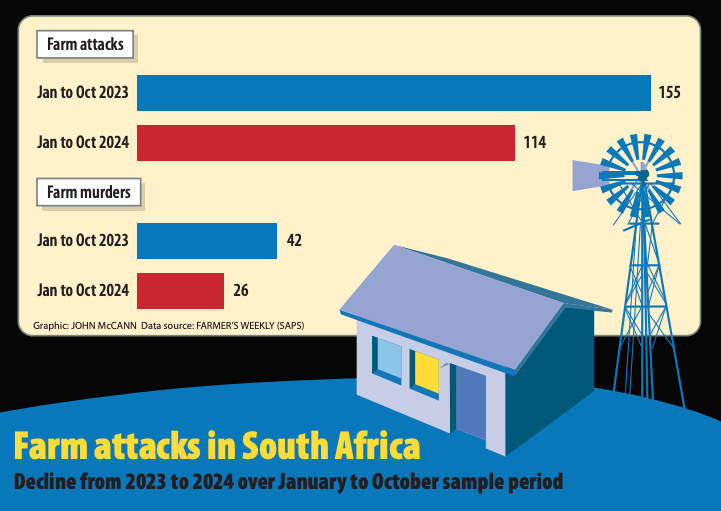
Several farmers from the Eastern Cape, Western Cape and KwaZulu-Natal who spoke to the Mail & Guardian about their feelings regarding the order precipitated by President Cyril Ramaphosa signing the Expropriation Act into law last month, as well as the high number of murders and assaults on farms, said they have no intention of leaving South Africa.
Their concerns about the Act ranged from worry that it could in future be used to expropriate land without payment under the “nil compensation” clause, which allows the government to do so if it is in “the public interest”, to believing that the law is “unlawful” and that it can be challenged constitutionally.
But the Expropriation Act is not part of South Africa’s land reform regime; it is designed to enable the state to acquire a specific property from a private owner to fulfil a public function. The scope of the Act is limited because only the department of public works is empowered to expropriate property in this context.
Eastern Cape farmer Riaan Ardendorf, 43, who keeps cattle and sheep and grows soya and sunflowers, was sceptical about Trump’s asylum offer, saying he has financial and familial commitments that tie him to South Africa. He added that he lives peacefully with his Xhosa neighbours who are also farmers and has no intention of leaving.
“I’m an eleventh-generation farmer. My family’s been here for forever. We come from Dutch and German descent,” Ardendorf said.
“We can’t go. I’ve got a mum and dad who are now old, and they can’t just pick up and leave. We’ve got commitments to the banks. If everybody picks up and leaves, who is going to buy land? How are you going to settle your debts with the banks because the banks are not interested in those laws? They don’t care about this Expropriation Act.”
Ardendorf said farmers could not just “walk into America and buy a farm” and would have to take other jobs. “You are going to pay for living expenses there and pay your debts here? If I don’t pay this farm off my dad’s house stands surety for me,” he said.
Crime
Regarding crime, he said his deep rural farm is not easy to access because of poor roads, a problem farmer unions often raise with the government because it makes it difficult to get products to market.
“The crime is a hell of a lot worse for those farmers, guys that have got easier access to their properties via road networks where guys can drive with any type of vehicle. They are more in the firing line than guys like me, who are extremely remote, where it’s 4X4 only because the road hasn’t been great in 22 years,” he said.
However, he said he could not help wondering whether Trump knew something about what might lie ahead down the road for farmers.
“We don’t know what Trump’s angle is and what information he’s working off, and that’s our biggest worry at the moment …We don’t know what Trump has got …What does he know is coming?
In KwaZulu-Natal, a farmer who asked to remain anonymous said he had, under duress, sold his farm in the Midlands to the provincial department of agriculture and rural development 12 years ago.
“One of the other farmers said ‘no’ and he was taken out two months later, killed, shot twice in the back of the head. Nothing was stolen,” he said. “So, when your family starts to put pressure on you, because they feel something similar might happen to you, your mindset changes … My staff were begging me not to sell. It was a two-year nightmare.”
The farm, which he had rehabilitated from scratch after buying it, now lies derelict under government ownership, because it was never transferred into the names of his former workers.
“My head did not come around for three years. I went and farmed all over the place. I spent four years in Ethiopia and in South Sudan and then came back to South Africa after I swore blind I’d never come back. And it’s because it’s hard. It’s because we’ve got a connection to the people and to the land and to the language and to our customs and cultures,” he said.
Robin Barnsley, an egg farmer and former president of the KwaZulu-Natal Agricultural Union, said he is concerned about the Act, which he believes is “open to challenge” constitutionally.
But for him, it’s business as usual. Barnsley recently invested heavily in a new system to improve production efficiency and said many Afrikaans farmers are doing the same.
“I think that he [Trump] makes decisions built on arguments devoid of a reasonable factual basis. He doesn’t understand what he’s doing. I think he’s trying to talk consistently to the right wing in his country, and to the right wing globally,” he said.
“It would be nice to be able to disregard him, but you can’t because he’s a powerful man. He’s exceptionally dangerous because he’s creating risk for the world economy more than expropriation without compensation is creating risk for us.
“Representative bodies for Afrikaners have all distanced themselves from [Trump’s offer], which says to me he hasn’t got his facts right. I associate with a lot of very young, very astute Afrikaans farmers, and they are investing significantly. They haven’t held back. They might lament what’s going on around the pub, but they carry on with what is in their best financial interest,” he said.
Western Cape wheat, barley, canola and Black Angus cattle farmer Derek du Toit, 31, believes the Act is merely an attempt by President Cyril Ramaphosa’s ANC to garner votes but trusts the policy will not be fully implemented.
“They are in decline. They’re in big trouble. They’re going to extremes to try and win the popular vote. They’re not doing it for the people,” he said. “It’s a selfish attempt to remain in power because it’s a popular idea, you get land for free for the majority.”
South Africa is one of few countries in the region with “proper food security and that is thanks to the farmers”, Du Toit said.
“We are working hard. We make a living, and we make do with what we’ve got. It’s not that we get any assistance from the government at all. It’s quite the opposite. What they’re threatening to do, you’d think that Zimbabwe would be a cautionary tale. You’d think that they’d see, ‘Oh, maybe this is not such a good idea to take land and redistribute it’.
“It’s such a short-sighted idea. I believe it won’t be fully implemented. I want to believe that, I want to have hope in our country that it won’t fully happen, as it did in Zimbabwe, just because there’s still some sense alive in our government, and some humanity, not just an attempt to grab power or to remain in power,” he said.
He said Trump’s offer should be extended to all farmers because people of all backgrounds and races have been victims of farm attacks.
“This is the first time that a major political, outside figure, has reached out and said we are willing to help if the need arises,” Du Toit added.
He said South African farmers who have moved to the US and Canada have been successful in the past and that Trump’s motivation could in fact be a desire to lure good farmers rather than altruism.
While farmers might not be rushing to emigrate to the US, lawyers, doctors and other professionals are among the more than 20?000 people who, by Tuesday, had contacted the South African Chamber of Commerce in the United States of America through email and social media to inquire about moving.
The organisation said these inquiries probably represent about 50?000 to 70?000 people because many were inquiring on behalf of their families.
The chamber’s chief executive, Neil Diamond, speaking from his Washington, DC, office, said his email server had crashed this week because of the influx of 7??600 emailed inquiries for information about Trump’s executive order.
“Most are from Afrikaans folks and there were some from temporary agricultural visa workers that come to the US. Some of the emails were from professionals, people in the legal profession, the medical profession, and a lot of young people indicating that they would like to seek a new opportunity and a brighter future.”
Diamond said he was “pushing” the US state department and the US consulate in South Africa for further information because only the government could handle the asylum process. He expected that Washington would publish an email address to which people could direct inquiries within a week.
Submit and get free exposure here: Showcase Your Business | Advertise Your Special Offers.