
Will the real Don Quixote please stand up?:
And so we come to the Everest of novels, both the parent of the modern Western literary canon and the text that prefigures all those that followed its publication in 1605 and 1615. But two parts, two books? Yes — the first of many surprises that await those making the acquaintance of Miguel de Cervantes’ übertext Don Quixote.
First, make that Miguel de Cervantes Saavedra, “almost certainly born in 1547”, according to one laconic source, showing due and proper scepticism for the facts attendant on the great writer’s life.
Where? In Tobias Smollett’s marvellously entertaining and judiciously speculative The Life of Cervantes that prefaces his 1755 translation of the novel, the reader is offered: “One author [Thomas Tamayo de Vargas] says he was born at Esquivias; but offers no argument in support of his assertion … Others affirm he first drew breath in Lucena, grounding their opinion on a vague tradition which there prevails: and a third set [Don Nicholas Antonio] take it for granted that he was a native of Seville, because there are families in that city known by the names of Cervantes and Saavedra; and our author mentions his having, in his early youth, seen plays acted by Lope Rueda, who was a Sevilian.”
With the benefit of a few extra centuries of Cervantine scholarship, The Oxford Companion to English Literature (sic!) sweeps away Smollett’s delightful, informed conjecture and declares: “Born in Alcalá de Henares of an ancient but impoverished family”.
The biographers agree on the straitened circumstances of Cervantes’ family life, his father universally described as a down-and-out surgeon. Worse awaited Miguel. He enlisted in the army, fought at the great Battle of Lepanto in 1571, when Don John of Austria led a coalition fleet from Christian states to a decisive and history-changing victory over the Turkish navy. Severely wounded, Cervantes lost the use of his left hand.
Four years later, returning to Spain, he was captured by a “Barbary corsair” and sold as a slave to a “Moor” in Algiers (Smollett’s version); modern sources reckon his master was a “renegade Greek”. Whichever, Cervantes tried to escape several times until, mercifully, he was ransomed and made it home at last to Spain in 1580.
For the next 36 years, earning a living worried at Cervantes in much the same way that Herman Melville was to struggle to make ends meet. Tragically, their masterpieces Don Quixote and Moby-Dick granted them literary immortality but not daily wherewithal.
Cervantes, Melville and Joseph Conrad led adventurous, sea-faring lives before beginning literary careers. Their time before the mast hugely benefited their writing, some of which took place under the least prepossessing of circumstances. In Cervantes’ case, as he hints in the preface or prologue to the first volume of Don Quixote, in jail.
“And to what can my barren and ill-cultivated mind give birth except the history of a dry, shrivelled child, whimsical and full of extravagant fancies that nobody else has ever imagined — a child born, after all, in prison, where every discomfort has its seat and every dismal sound its habitation?” (John Rutherford’s wise and witty translation for Penguin Classics, 2000.)
Translation is a vexing aspect of reading Quixote. To begin, take its full title. Smollett gives us The History and Adventures of the Renowned Don Quixote; Rutherford offers The Ingenious Hidalgo Don Quixote de la Mancha and the much-hyped Edith Grossman version (2003) is The Ingenious Gentleman Don Quixote of La Mancha.
Even more illuminating of the translators’ approaches and styles is the way they render the novel’s famous opening line.
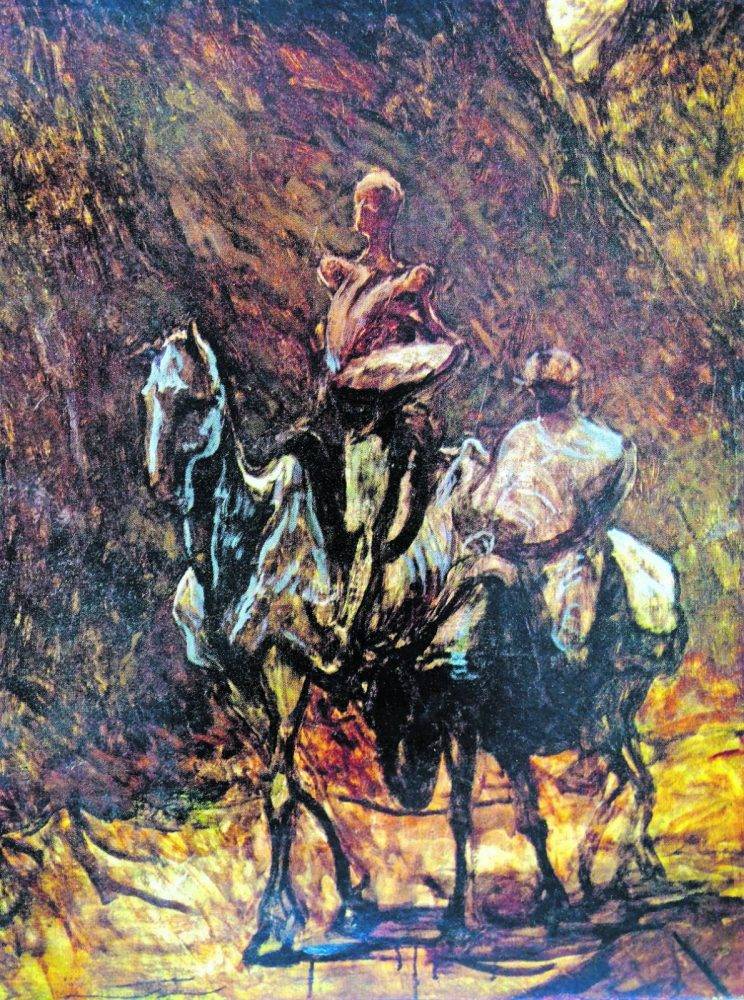
Smollett: “In a certain corner of La Mancha, the name of which I do not choose to remember, there lately lived one of those country gentlemen, who adorn their halls with a rusty lance and worm-eaten target [shield], and ride forth on the skeleton of a horse to course with a sort of a starved greyhound.”
Rutherford: “In a village in La Mancha, the name of which I cannot quite recall, there lived not long ago one of those country gentlemen or hidalgos who keep a lance in a rack, an ancient leather shield, a scrawny hack and a greyhound for coursing.”
Grossman: “Somewhere in La Mancha, in a place whose name I do not care to remember, a gentleman lived not long ago, one of those who has a lance and ancient shield on a shelf and keeps a skinny nag and a greyhound for racing.”
It was JM Cohen’s conscientious translation (1950) for the Penguin Classics that introduced me to Don Quixote (real name: Alonso Quixano or perhaps Quixada, Quesada or Quexana!). The aged country squire, his mind beguiled and addled by reading too many chivalric and pastoral romances, decides to become a knight errant himself and sets off on adventures of his own.
So it is that the reader becomes closely acquainted with his old horse Rocinante, travelling and conversational companion Sancho Panza, Quixote’s beloved Dulcinea del Toboso, Sancho’s long-suffering wife Teresa, and a score of other characters, objects, places and happenings. These include bachelor Sansón Carrasco, the wicked men from Yanguas, the barber, the helmet of Mambrino, the fighting windmills, the village priest, the Parliament of Death, the Cave of Montesinos, the island of which Sancho became governor (yes!) and the fabulous Cide Hamete Benengeli, the real author of the book — about whom more below.
After Cohen’s rendering came the revelation of Smollett’s fluent and vivacious translation, though one not without flaws and controversy. Even in Smollett’s day it was held he had no Spanish and had worked from a French translation or, worse, resorted freely to borrowing from the accurate rendering of the late painter Charles Jervas (also Jervis).
On the 200th anniversary of Smollett’s translation, Carmine Linsalata, a Stanford PhD, published his doctorate as Smollett’s Hoax, but not giving enough weight to his subject’s education as a surgeon with a good grounding in Latin, and hence a facility for romance languages.
Furthermore, Smollett was a great comic novelist. The influence of Don Quixote is evident in his riotous epistolary novel The Expedition of Humphry Clinker — note the dropped E in the protagonist’s first name — and so his translation is what the eminent Mexican novelist Carlos Fuentes claimed: “… the one where the feeling and the tone both come through … the homage of a novelist to a novelist. It is a novelist’s translation.”
While the Grossman version seems to swerve from wit and humour at crucial points, serving up an austere comic-lite Quixote, Rutherford shows triumphantly there does not have to be a binary choice between stodgy accuracy and fluent vivacity.
Still, whichever translation you pick up, a feast awaits. No synopsis of this vast novel — 940 pages in most editions — is offered here. But some tips for reading might help.
One, the famous windmill scene occurs very early — chapter VIII in the first volume.
Two, do not be seduced by 19th century German Romantic readings of Don Quixote as the “Knight of the Woeful/ Sad Countenance” or “Sorrowful Face”. Smollett’s coolly ironic “Rueful Countenance” and, best of all, Rutherford’s “Knight of the Sorry Face” catch the Spanish humour and self-deprecation.
One needs to remember that Germany, despite being the self-appointed definer and arbiter of all things, most recently of genocide, can be wrong now and then.
Three, Cervantes’ novel is a masterclass in incisive, satirical literary criticism. He pokes fun at and fatally undermines certain genres, particularly exaggerated tales of chivalric heroism and the plays of his detested rival Lope Felix de Vega Carpio.
To achieve this, Cervantes interpolates his versions of stories from particular genres, the shepherd’s tale for instance, which illustrate his litcrit point but don’t necessarily advance the main narrative. These “intercalated” tales can be skipped but you might well enjoy them because they are superb examples of high send-up.
Four, you will fairly often be met with two facing pages of solid text, with no paragraph breaks. This is no printer’s error but the admirable result of the English text reflecting the Spanish’s discreción. Verbally, discreción is the ability to speak in paragraphs that while lengthy are also lucid, rhythmic and compelling. The written version is dazzling.
Five, Cervantes raises questions of authorship and invents “postmodernism” centuries before they were sparks in anyone’s imagination.
In volume one he reveals he is merely the link between the real author Cide Hamete Benengeli and the reader. There are playful clues and denials in that name, however: Cide is “My Lord”; Hamete is the Spanish for the Arabic name Hamed, “he who praises” and Benengeli is a wonderful comic creation, referencing berenjena, aubergine in Spanish, and sneaking in a connotation of brinjal-eater.
Cervantes shows in volume two Quixote and Sancho discovering their literary existence and celebrity in a bookshop. This also allows him to repudiate the “false Quixote” authored by one calling himself or herself Alonso Fernandez de Avellaneda, the appearance of whose outrageous rip-off no doubt encouraged Cervantes to write the second part of Don Quixote published in 1615.
Six, some say Cervantes died on the same day as William Shakespeare, 23 April 1616. Almost certainly?
Special Economic Zones are propelling Africa’s green hydrogen drive:
When Egypt, a prominent player in green hydrogen development in Africa, recently announced seven new upcoming projects worth US$ 40 billion to be rolled out over the next decade, it noted that the projects would be positioned in one location: a special economic zone (SEZ).
The new projects announced by Egypt’s cabinet in February, together with ongoing developments not only in Egypt but around the continent, reaffirm Africa’s place as a potential key supplier of green hydrogen, particularly to Europe.
A 2023 report from the European Investment Bank predicts Africa could produce over 50 million tons of green hydrogen annually by 2035. Egypt’s pipeline projects were worth US$ 83 billion as of August 2023.
What is also emerging as a trend across many African countries investing in the new energy form, however, is the strategic positioning of green hydrogen projects in special economic zones.
According to Penninah Munyaka, a Nairobi-based commercial lawyer and green energy advocate, the reason for this is straightforward: given the heavy capital required to develop green hydrogen projects, host countries are leveraging on their SEZs to expedite the development of green hydrogen.
“Extraction of green hydrogen demands huge capital investments that are prohibitive for developing countries,” she said.
The cost of production of green hydrogen in developed markets ranges from US$ 4.10 to US$ 7 per kg, according to an international energy consultancy company, ET Energy World. These costs are, however, significantly higher in developing markets such as Africa.
According to the Green Hydrogen Organisation, achieving global green hydrogen goals by 2050 will require between US$ 450 and US$ 900 billion in investment, posing significant challenges for developing markets.
African countries are, however, strategically leveraging tax incentives and other strategic benefits in special economic zones to grow their green hydrogen capacity as the continent looks to be a supplier for developed markets, thanks to its huge green energy potential.
In Egypt’s case, the seven new projects are to be established at the Suez Canal Special Economic Zone. Yet, they are not the first in a vast economic zone that stretches over 450 million square metres of space nestled between the Red and Mediterranean seas.
President El-Sisi and Norway’s president Jonas Gahr Støre kicked off a 100 MW green hydrogen plant at the Suez Canal Economic Zone during COP 27 in November 2023. India’s ReNew started a 220,000 ton project in the SEZ in 2022.
Over 20 green hydrogen projects were identified in Egypt in a 2023 Rystad Energy report, many of these are in special economic zones. In January 2024, Egypt teamed up with ACWA Power of Saudi Arabia in a US$ 4 billion green ammonia project, a precursor to green hydrogen production. The Suez Economic Zone was a signatory.
A similar strategy is being pursued by neighbouring Morocco, also a fast-developing green hydrogen hub, with the country targeting 1 GW of green hydrogen power capacity by 2040.
In November last year, Gaia Energy, a green energy company, partnered with FIT Voltaira Morocco, a car and e-bike cable manufacturer, to launch an integrated project that includes a solar PV and green hydrogen plant at the Tanger Med Industrial Platform, a special economic zone.
Morocco World News reported that the mega project will feature a green ammonia plant producing 1.4 million metric tons annually. It will also process 320,000 metric tons of green hydrogen, using a 2 GW solar plant and a 4 GW wind project to provide power.
Green hydrogen projects in special economic zones that are strategically located around ports, such as those in Egypt and Morocco, could play a key role in the transportation and exportation of green hydrogen.
South Africa
In South Africa, the Freeport Saldanha SEZ is “poised to become one of the first movers to establish a green hydrogen hub in southern Africa,” according to a December article by ESI Africa.
“It has an operational port; there are railway lines; but, importantly, and quite compellingly, it has a steel mill. ArcelorMittal has been operating the steel mill for many years,” Kaashiefah Beukas, the CEO of Freeport Saldanha SEZ, is quoted in the article.
At Coega Special Economic Zone, Hive Hydrogen South Africa, a branch of UK’s Hive Energy, is working on a US$ 5.8 billion green hydrogen project.
The project already has an offtake partner, a Japanese partner, Itochu Corporation, which, according to a 2023 agreement, will offtake the green hydrogen to be generated from the proposed facility.
The proposed Namakwa Special Economic Zone in the Northern Cape will host a 10-GW electrolyser park and a green ammonia production plant. South Africa’s national ports authority, Transnet, is developing a US$ 800 million deep-water port, the Boegoebaai deep-water port, and a rail project that will be used to transport and export the green hydrogen to be generated at Namakwa.
The South African Green Hydrogen Commercialisation Strategy includes the provision to “include GH incentive schemes for both production and local manufacturing that leverage appropriate SEZ development benefits” and the country’s Atlantis Greentech Special Zone is positioning itself to provide the industrial facilities required to develop green energy infrastructure including for green hydrogen, according to the zone’s CEO, Matthew Cullinan.
Meanwhile, Kenya’s “Green Hydrogen Strategy and Roadmap,” unveiled at last year’s Africa Climate Summit in Nairobi, provides clear directions for investors in the sector, offering incentives through Export Processing Zones and Special Economic Zones.
The Africa Green Hydrogen Alliance, comprising Egypt, Kenya, Mauritania, Morocco, Namibia, and South Africa, aims to produce 30-60 million metric tons of green hydrogen. This could boost their GDP by US$ 66-126 billion by 2050, amounting to 6-12% of their current GDP, according to the alliance’s website.
“More commercial incentives should be provided while ensuring that the legal frameworks are in place, stable, predictable and capable of nurturing the new industry,” Munyaka said.
– bird story agency
Useful links: https://www.reuters.com/world/middle-east/egypt-signs-7-green-hydrogen-mous-worth-potential-40-billion-2024-02-28/
https://www.bird.africanofilter.org/stories/turning-africa-into-green-hydrogen-el-dorado-gets-real-at-cop-27
https://www.bird.africanofilter.org/stories/egypt-deal-takes-africa-s-green-hydrogen-ambitions-to-the-next-level
Ousmane Sonko a rising star in Senegal:
In his book, Long Walk to Freedom, Nelson Mandela narrates the events of his release from prison; and then specifically points out that the people who supported him — and gave everything for the struggle — saw him as some sort of a messiah. In his humble appeal, that great son of the soil said: “I am not a prophet or messiah, I am an ordinary man made a leader by extraordinary circumstances.”
Across the African continent there is injustice and oppression of one by another in the quest to assume or retain power. This is the case in Senegal.
If Mandela’s quote is anything to go by, then the extraordinary circumstances of Senegal have produced a rising star. This is the first time in democratic Senegal that the general elections will not take place as provided for in the Constitution.
The elections were supposed to be held on 25 February, with the incumbent president, Macky Sall, publicly declaring that he would not run for a third term. But it seems Sall still has an interest in who takes over from him.
Sall wants his party’s candidate to win the elections but everyone knows that his preferred candidate could not have won the elections if they had been held last month. This may explain why Sall postponed the elections. It may have been an attempt to buy time to find a better replacement from within his Alliance for the Republic party; someone electable who could deliver victory for the party in power.
Reports now suggest that the election date is 24 March. About 19 other candidates will contest in the elections. Sall has assured the nation that he will leave office on 2 April, when his mandate comes to an end.
Every given election is a moment in the making of history, either for the better or for worse and some candidates stand out like a shining jewel. In this election, there is no candidate who has sparked the interest of so many and stolen their hearts as a 49-year-old man who the regime is determined to remove from the ballot. His name is Ousmane Sonko, a former tax inspector turned politician. A husband and father of six.
In 2014, the African Patriots of Senegal for Work, Ethic and Fraternity (PASTEF) was established by Sonko, who went on to serve as a member of the National Assembly from 2017 to 2022. And a year before the presidential elections of 2019, in which Ousumane was determined to participate, he published a book titled Solutions, which served as his manifesto. (Interestingly, among his suggested solutions to the problems of Senegal is the replacement of the franc with a domestic currency.)
Sonko came in third position, with 16% of the total vote cast. This was a record achievement for a newly formed political party, as well as for a candidate who was targeted by well calculated smear campaigns to discredit him. There are serious fears among the ruling elite that if Sonko participates in this year’s elections, he might turn the tide in his favour and may be the next president of Senegal.
The political persecution of Sonko could have been predicted by anyone. In September 2021, Sonko formed the Free the People coalition and began to poach some parties from the United in Hope coalition, to which the ruling party belongs. For a charismatic fellow like Ousumane, the sky’s the limit. His coalition successfully gained control of local councils in the capital Dakar and he was elected mayor of Ziguinchor during the 2022 local elections. This is in addition to the 56 out of 165 parliamentary seats held by his political party.
Since February 2021, Sonko has been arrested a number of times for various alleged offences. He has been in prison on charges of disturbing public order, rape and threatening a woman with death. After two years of investigations, the rape charges were established to be false and Sonko was cleared on 1 June 2023. But Sonko was still sentenced to two years in prison on charges the state defined as “corrupting youth”.
According to Sonko, all these allegations and charges against him are politically motivated and he refused to attend the trial of 1 June 2023, which saw him convicted and made him ineligible to contest the 2024 elections. This court verdict sparked countrywide mass protests. In July 2023, they arrested him again on charges of “disturbing the public order” and his party was dissolved by the government on 31 July 2023, and that also prompted nationwide protests. The government tried to ban TikTok t in August 2023, under the pretext that the users are mostly Sonko supporters and a threat to national peace and stability.
The courts of Ziguinchor went even further by removing him from the electoral list, a case that Sonko and lawyers fought all the way to the supreme court. The highest court of the land ruled otherwise and declared that Sonko is eligible to run for public office and must be reinstated on the electoral list. The Sonko wave is far from over. His political rise seems to be unique and unstoppable.
The Senegalese government would do well to create an atmosphere conducive for a free and fair election this year by allowing all eligible candidates to contest without fear or favour. Senegal is one of the few democratic states in West Africa with no history of military coups. It is imperative that it keeps that exemplary posture for the region and the continent. To persecute and suppress one man at the expense of democratic credentials is not worth the cost.
Aaron Ng’ambi is a geopolitical analyst, leadership instructor and a social entrepreneur.
Submit and get free exposure here: Showcase Your Business | Advertise Your Special Offers.
