
Wine is not just for sipping, it is also for employment opportunities:
As you indulge in a glass of South African wine, you’re not just savouring its bold, complex flavours, but also partaking in an industry that plays a vital role in the economy.
From the vineyards to the bottle, the wine sector drives economic growth, enhances rural development and exports top-tier products worldwide, all while embodying the country’s rich agricultural heritage.
The country has maintained its position as one of the top wine producers globally, ranking eighth in the world, according to South Africa Wine, which provides support services to the wine and brandy industry. It says wine tourism contributed R7.2??billion to GDP in 2023, creating 34??406 employment opportunities and 80?173 jobs at wine farms and cellars.
In the same year, the local industry contributed 4.1% to the world’s wine production and 4.3% to the world’s wine exports.
Wines of South Africa, another organisation in the sector, said earlier this year that the country’s white wine “continues to win the popularity contest, with sauvignon blanc leading the charge, followed by chenin blanc and chardonnay”. For red wine, shiraz takes the lead, closely followed by pinotage and cabernet sauvignon.
Key markets driving export growth include the United Kingdom, Germany and the Netherlands, with increasing interest from China and the United States, said Rico Basson, chief executive of South Africa Wine.
Although the sector struggled during the Covid-19 pandemic when alcohol bans and lockdowns were in place, it maintained its position as a key export commodity.
“While the wine sector has faced several challenges, it has also adapted and evolved, leveraging new technologies and trends to thrive in the global market,” Basson said.
“The South African wine sector has shown resilience and adaptability in various challenges, focusing on quality improvements and sustainability while navigating economic and environmental pressures.”
There are at least 11 steps in the wine-production process, starting from the cultivation of vines to harvesting and transforming the grapes into wine and the final stages of distribution, export and international trade. Then there is wine tourism, which includes tours, tastings and wine-related events that attract tourists and promote wine regions.
The industry is complex and multifaceted, and many players — from farmers, vineyard managers, cellar masters and wine tasters to packaging specialists, distributors, sellers and promoters — have a crucial part in the value chain.
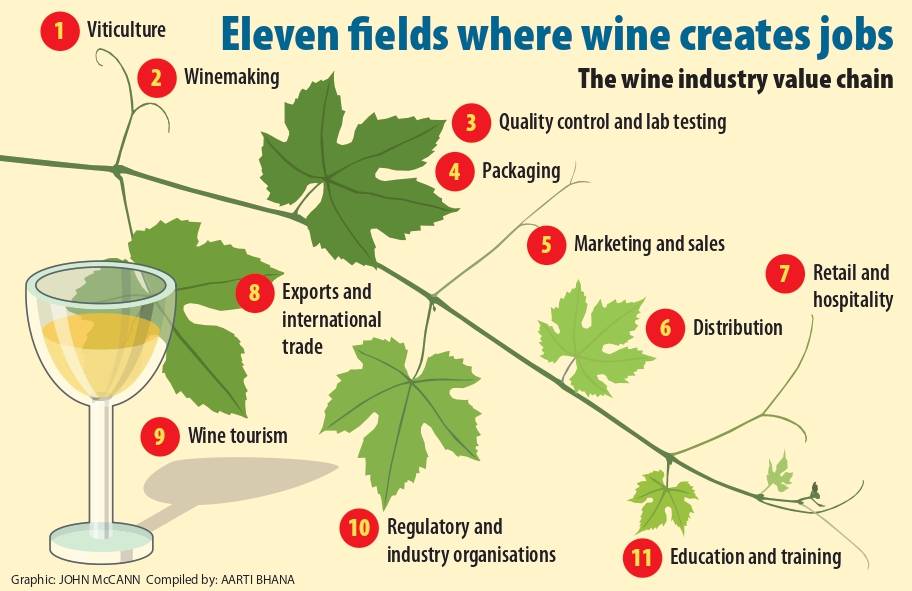
“This sector has substantial potential for driving economic growth, particularly for regions with high-quality wine production,” Basson said.
“Expanding into new international markets can significantly increase revenue and create economic opportunities. Wine exports contribute to trade balances and can boost local economies by creating jobs and increasing investment.
“By attracting tourists, wine regions can stimulate local economies through spending on accommodations, dining, transportation, and related services. Developing wine tourism can create jobs, promote regional development, and increase overall economic activity,” he added.
The wine sector also plays a role in rural areas, driving the informal economies there when seasonal workers harvest the crop.
“During the harvest season, they will put more workers onto the farm to assist with actually doing the harvest. As a result, typically, what you see is that the informal sector around some of the big farming towns is growing quite significantly,” said Citadel chief economist Maarten Ackerman, listing beauty salons, restaurants, street food vendors and spaza shops as examples.
The wealth management firm recently presented a report that highlighted the informal economy flourishing around wine farms in the Western Cape.
According to Basson, for every R1?million in sales revenue in the wine industry, 7.51 informal jobs are supported.
“The employment-to-employment multiplier of 3.15 means that for every job in the wine industry, an additional 2.15 jobs are supported throughout the rest of the economy, for a total of 3.15 jobs when including the initial job in the wine industry,” he said.
“These figures highlight the industry’s role in providing opportunities within the formal and informal sectors.”
Let that sink in as you continue to sip on the flirty, fruity flavours of a real South African wine.
ActionSA and DA both woo ANC as Tshwane coalition talks reach impasse:
As the ANC‘s national leadership directs its Gauteng counterparts back to the negotiation table with the Democratic Alliance (DA) in the province, ActionSA national chairperson Michael Beaumont says the party will field its own mayoral candidate next Thursday to replace current mayor Cilliers Brink.
In an interview with the Mail & Guardian, Beaumont urged Luthuli House to press on with its plan to remove Brink through a motion of no confidence. Such a move, he suggested, could pave the way for a coalition government involving ActionSA and restore the ANC’s influence in the region.
This call for action follows a lack of progress in negotiations between the ANC and DA on Wednesday, as the ANC considers the possibility of forming a partnership with the DA in Gauteng, akin to their national alliance.
Beaumont expressed scepticism about any potential future collaboration with the DA, warning the ANC against yielding to national leadership pressures to forge a relationship with what he described as the “subpar DA in Tshwane.”
“We will present our own capable mayoral candidate to succeed Brink, whose tenure has been marked by a decline worse than that of [former Johannesburg mayor] Kabelo Gwamanda and [former eThekwini mayor] Mxolisi Kaunda. At least their departure left their metros in better shape than Brink’s will to leave Tshwane,” Beaumont said.
He added that ActionSA would not support the DA in the forthcoming motion, a stance endorsed by its highest decision-making body earlier this week. Beaumont said his party believes its proposed alternative will be a better option than the current abuses of trust, which it plans to reveal in due course.
ActionSA’s decision to formally withdraw its coalition agreement with the DA follows the latter’s overtures to the ANC about forming a “grand coalition” in key metros, including Tshwane, Johannesburg, and Ekurhuleni, sideling ActionSA from crucial discussions, despite being in a multi-party coalition together.
DA’s provincial chairperson Fred Nel said while the ANC tabled the motion of no confidence, discussions were ongoing to have the party vote in its favour to allow for an arrangement which would allow the DA-ANC coalition to govern all Gauteng metros.
This is despite the ANC’s agreement to vote the DA out of the Johannesburg and Ekurhuleni metros through a coalition agreement with ActionSA.
Nel expressed concerns that the ANC provincial leadership might deviate from the national leadership’s decision to form a government with the DA, similar to what occurred during the establishment of the provincial government of unity.
The ANC, which had accused the DA of using bullying tactics during negotiations, excluded the party from the provincial government by taking on board smaller parties including the Inkatha Freedom Party, Rise Mzansi, and the Patriotic Alliance.
The DA has called on ActionSA Tshwane councillors with positions in the municipal executive to do the “honourable thing” and resign.
ActionSA is willing to go to the opposition benches in the city council if negotiations with the ANC and Economic Freedom Fighters do not work out, Beaumont said.
“The DA has always gone to the ANC first, if it happens that the ANC chooses the DA, we will gladly settle in the opposition benches, but if the ANC is to learn from us, the DA has a big brother syndrome of wanting to be first, something the ANC will also experience if they agree to their demands,” he added.
ActionSA leader Herman Mashaba said the party is ready to defend its decision to consider an alternative municipal coalition government for Tshwane and that the decision not to allow the DA back in was made with careful reflection and thorough discussion within ActionSA’s senate, its highest decision-making authority.
Beaumont said the party’s councillors will not resign until the council leadership is dissolved. The party currently has two councillors in the Tshwane municipality’s executive — deputy mayor Nasiphi Moya and the MMC for economic development and spatial planning, Hannes Coetzee.
At a media briefing last Sunday, ANC acting national spokesperson Zuko Godlimpi confirmed that the party was in discussions with the DA, among others, to regain control of Tshwane after being ousted eight years ago. Godlimpi also noted ongoing talks with ActionSA and emphasised the need for a multi party agreement to effect change in the metro.
“We observed the auditor-general’s report. Many of our local government institutions are in crisis. Finances and service delivery are poor. We have intervened in Johannesburg and eThekwini; naturally, Tshwane is next. The exact nature of this intervention will be shaped by ongoing discussions,” he said.
The ANC has struggled to secure agreement with its Gauteng leadership over who it works with at provincial level, as evidenced by the fact that the party has been forced to constitute a minority government.
Earlier this month, the ANC national working committee visited Gauteng to address the disappointing results of the 29 May general elections, which saw the party’s support fall below the 50% plus one required to govern.
Calls have also been made within the ANC to dissolve the party’s Gauteng provincial executive committee.
At Sunday’s briefing, ANC Gauteng chairperson Panyaza Lesufi stressed the need for accountability if the national executive committee or working committee decides to dissolve or strengthen the provincial leadership.
“We must understand why we lost the elections. We have seen structures going through dissolution or new leadership, but outcomes remain unchanged,” Lesufi said, cautioning against “viewing dissolution as a panacea” and stressing the importance of addressing underlying issues.
Godlimpi concurred, adding that any structural changes must be part of a comprehensive organisational review.
“We are not contemplating disbandment. If we do reach that decision, it must be based on thorough, data-driven assessment,” he said.
ANC Chief Whip Mdumiseni Ntuli said last week that the party was deliberating whether it was worthwhile to wrest control of Tshwane from the DA, given its current state. This discussion aligns with President Cyril Ramaphosa’s directive for the ANC to stabilise local government and address political issues that have led to unstable coalitions.
Earlier this week, TimesLive reported that the ANC in Tshwane had rejected a proposal from the provincial leadership to form a coalition with ActionSA, citing concerns that its financial difficulties could undermine the ANC’s efforts to regain support in Gauteng.
However, ANC provincial spokesperson Lesego Makhubela dismissed these claims as false.
The DA’s Nel said the party was awaiting response from the ANC as to whether it will vote in their favour.
Submit and get free exposure here: Showcase Your Business | Advertise Your Special Offers.
