Zambia tallies the costs of mining for electric batteries:
The United States leap-frogged competitors in the scramble for African minerals required to power the global energy transition when it signed a Memorandum of Understanding (MoU) with Zambia and the Democratic Republic of the Congo in late 2022 for the development of a regional value chain in the electric vehicle battery sector.
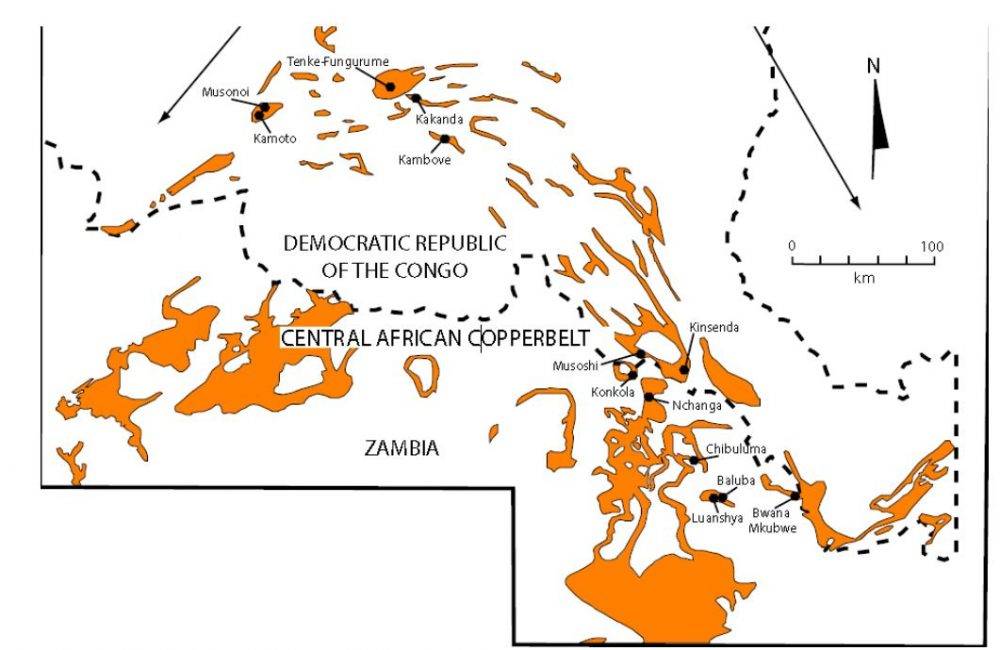
The MoU challenged the dominance of China, South Africa, Hong Kong, Mauritius and India as the traditional consumers of Zambian copper, gold, lithium, cobalt and manganese exports. It targeted large volumes of critical transition metals that occur in the Katanga Copperbelt, a mineral-rich strip stretching from Lualaba Province in the south-eastern DRC to the Luapula province in northern Zambia.
According to the US state department, the MOU aimed to “facilitate the development of an integrated value chain for the production of electric vehicle batteries in the DRC and Zambia, ranging from raw material extraction, to processing, manufacturing and assembly”.
Transition minerals
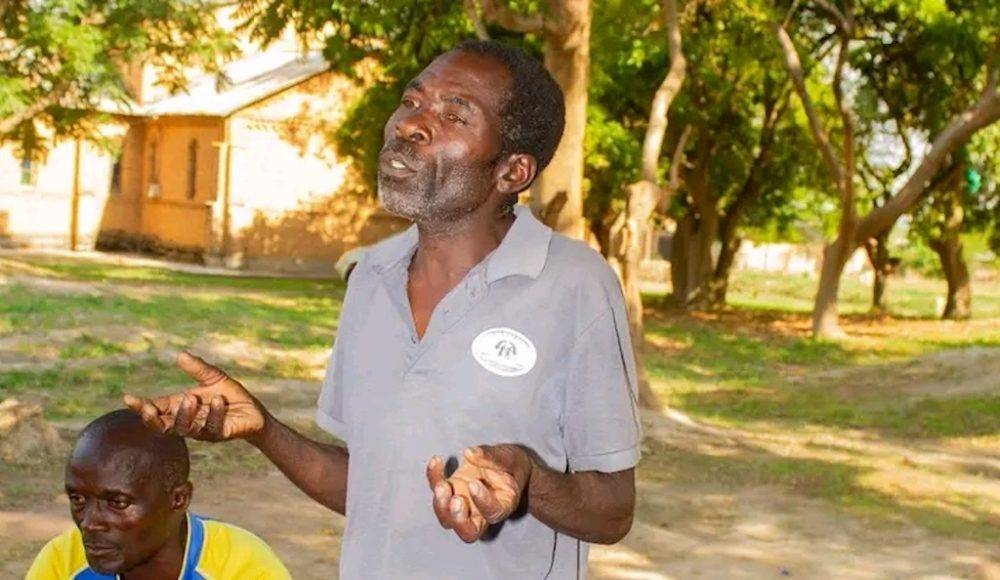
The growing demand for transition minerals in the region has inspired a surge in exploration for and mining of copper, cobalt and manganese in Zambia. However, most of the mining activities are unsustainable and inflict costs on local communities while bringing them no tangible benefits, said Vusumuzi Sifile Sibanda, executive director of Lusaka-based NGO Panos Institute Southern Africa.
“Despite the existence of various policies and regulations to ensure mining is done in a sustainable manner which takes issues of public safety, public health and environmental protection into account, there are many loopholes which allow the mining industry to abuse communities and degrade the environment,” he said. “There is widespread air pollution, water pollution and environmental degradation in all mining areas in Zambia. These activities impact on the health and livelihoods of people in mining areas.”
Although Zambia has legal and policy frameworks designed to safeguard land ownership rights and security of tenure, these policies are rendered ineffective by the Mines and Minerals Development Act, which enables mining to take precedence over all other land uses when minerals are discovered, Sibanda said.
This provision renders local communities vulnerable to evictions and other forms of human rights abuses by mining licence holders. Sibanda said most of the human rights violations common in mining areas are linked to high poverty levels which force people to give up their land. It also leaves them with no choice except to take up hard labour mining jobs for very little or no pay.
“High levels of poverty in the mineral-rich areas suggest that Zambians are not benefiting from the growth of the mining industry yet. The law makes it mandatory for mining companies to provide compensation to people affected by mining, but there are loopholes in enforcement which have resulted in very limited, if not non-realisation of the intended objectives.”
Manganese curse
Oxpeckers visited Luapula Province in northern Zambia to gauge the effects of the pursuit of energy transition minerals on the local people and environment. Luapula is rich in natural as well as mineral resources but despite its potential to reap economic benefits from a combination of tourism and mining investments, the province remains grossly under-developed with 81.1% of its population living in poverty, according to the Bank of Zambia.
Nsama Musonda Kearns, director of Care for Nature Zambia, an NGO working to promote environmental conservation and sustainable development in the country, said locals accuse companies mining manganese of committing human rights abuses such as illegal and uncompensated evictions, forced labour and environmental degradation.
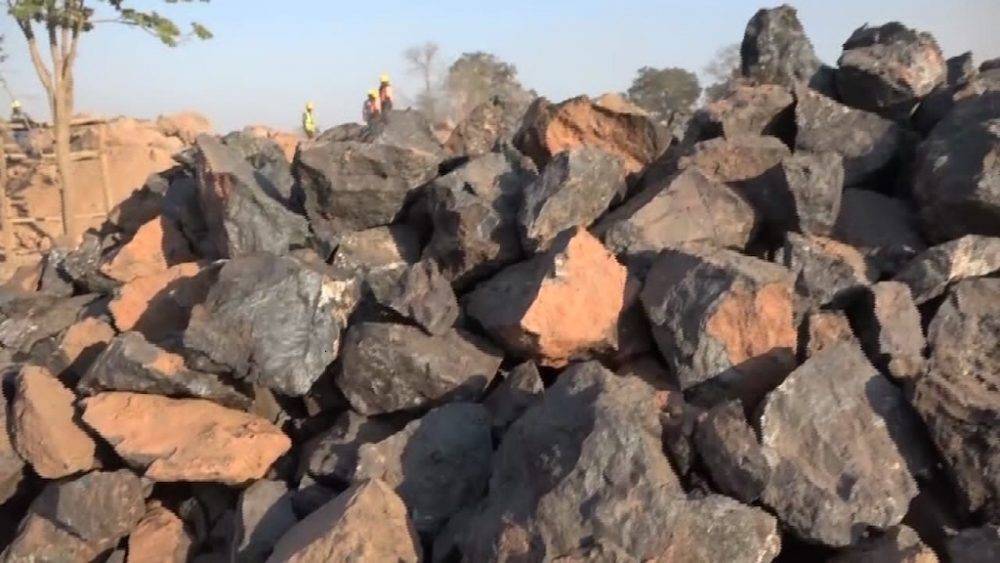
Manganese is one of the main energy transition minerals required for the manufacture of electric batteries. According to the Luapula provincial administration website, the province “has enormous mineralisation of manganese ore deposits” and aimed to set up a manganese refining plant to create employment for locals.
But Kearns said Luapula has not realised any benefits from decades of mining for manganese: “The communities are not benefiting from mining, yet all the rivers and streams in the Mansa River catchment are polluted with mine effluent. The pollution affects thousands of people downstream who depend on these rivers to meet daily water needs for their households.
“Luapula is facing the curse side of the mining boom as host communities fight land grabs and environmental injustices that include air pollution, water pollution, land degradation, child labour and low wages in return for hard labour. They also face dilapidation of roads by heavy mining trucks. All this causes loss of revenues that would otherwise contribute to poverty reduction and development in Luapula,” she said.
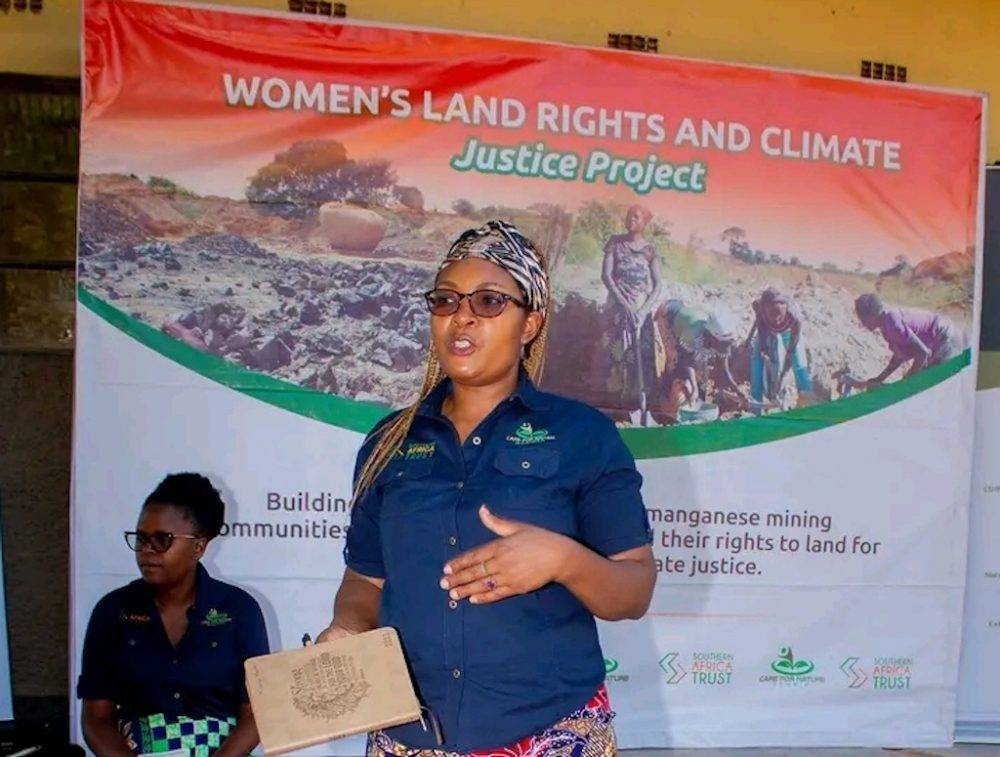
In October 2023 Care for Nature Zambia established the Women’s Land Rights and Climate Justice Project to help women fight evictions, land degradation and environmental pollution by mining companies. It also seeks to strengthen the women’s collective capacity to advocate for decent jobs in the mining sector.
“The project will help the women protect their communities by enabling them to hold mining companies to account for the damage caused by mining. It seeks to promote women’s participation in local mining policy and decision-making. We also hope that working with women in mining-host communities will boost our campaign to stamp out child labour from the Zambian mineral value chain,” Musonda Kearns said.
Host communities
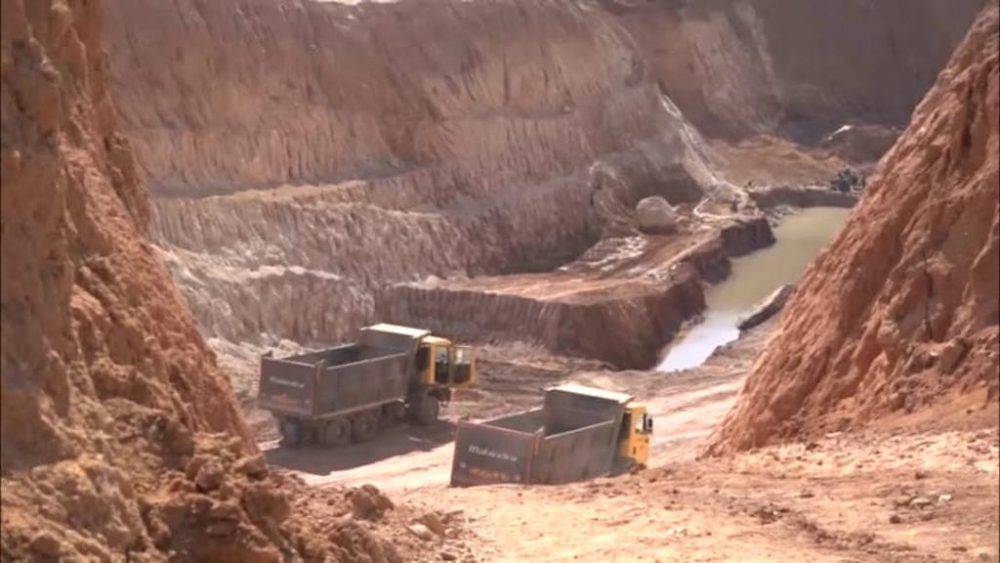
The acrimonious nature of interactions between Zambian host communities and mining operators is best illustrated by the treatment of the people of Mwale village in Mansa District in Luapula by a company using equipment branded “Atezo Mining”. Locals accused the mine of displacing people and polluting several feeder streams of the Mansa River catchment area with untreated mining effluent.
Oxpeckers was unable to determine the legal status of the mine, and a search for “Atezo Mining” through Zambian mining and company registration records yielded nothing. But community members shared the minutes of a November 2023 community meeting where the effects of the harmful activities of the miner were discussed. All the people who spoke at the meeting alluded to the destruction caused by mining around the village. They also reported a pervasive fear of dispossession and eviction from their lands as the mine expands.
“Three women who attended the meeting testified that they have lost land to the mine. Everybody in the meeting said they fear losing their homes because the mine is still expanding outwards from the centre of the village. One woman said she feared that her house would collapse into the open-cast pit, which is now two metres away from the houses,” the minutes recorded.
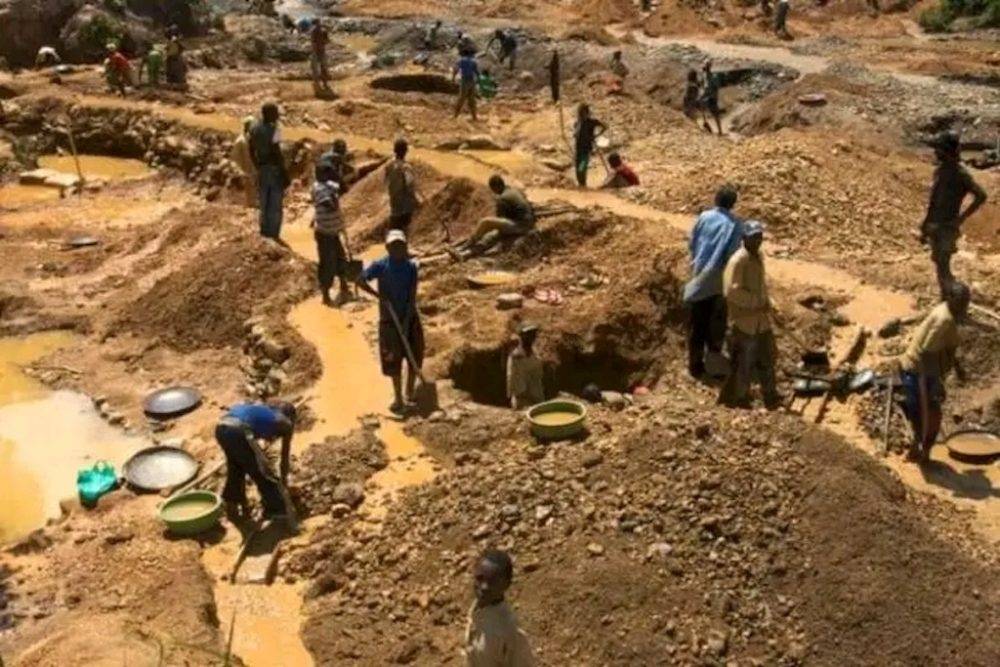
With shrinking land and no security of tenure over what remains of it, women in Mansa have turned to illegal artisanal mining for manganese to make ends meet. The women told the meeting that the income is too low when compared to the bad working conditions.
“Buyers pay as low as K2.50 [10 US cents] per bucket of manganese ore, which they are forced to accept out of desperation because they need income for their households,” the minutes stated. “The women are happy to be in mining, but they worry that the working conditions are not safe.
“They use hoes and picks to extract manganese-bearing ores before sorting and transporting it to points of sale. They have no protective clothing and carry the ore on their heads. They always complain of severe headaches and backaches because manganese is a very heavy base metal.”
Lead poisoning
While new mining projects sprouting across Luapula present Zambia with fresh challenges, Kabwe in the Central Province is still reeling from environmental and public health problems caused by lead contamination from a zinc and lead mine which closed 30 years ago.
Lead is a base metal used for making car batteries, pigments, ammunition, cable sheathing, lead crystal glass and radiation protection gadgets, among other industrial uses.
Chrizoster Phiri, Kabwe Central’s MP, told Oxpeckers that “everything” in Kabwe is tainted with lead contamination. British conglomerate Anglo-American Corporation operated the Broken Hill Mine from 1904 to 1974, when the Zambian government nationalised and incorporated it into the state-owned Zambia Consolidated Copper Mines (ZCCM) group. ZCCM closed the mine in 1994 amid a slump in global copper prices and demand.
“Kabwe faces a disaster from the contamination of water and soils with lead from the tailings dump. It is now in the soil, in the water and it circulates in the dusty air we breathe. The land is bare because the contaminated soils cannot sustain any vegetation,” Phiri said.
Lead contamination is believed to cause health and cognitive developmental diseases among children in Kabwe. Phiri said studies suggest that lead poisoning causes damage to the central nervous system, which is common among infants in Kabwe. It is also believed to be the cause of memory loss, which is rife among children in the town.
“The children lose concentration at school and at home. When sent to buy groceries in the shops, some return empty-handed because they forgot what they were sent to do,” Phiri said. “Some are born with deformed body organs because of abnormally high levels of lead in the body before birth. Lead contamination is also driving the high prevalence of abortions, still-births and premature births among women in Kabwe.”
According to a study published in the International Journal of Environmental Quality in September 2021, Kabwe is not the only Zambian town struggling with lead mining-related contamination: “Our research shows that lead contamination is pervasive in Zambian towns. The most contaminated are mining towns, although lead contamination has been identified in water bodies that run through non-mining towns (like Kafue.) The three main routes through which people get exposed to lead are ingestion, inhalation and eye or skin contact.
“The primary sources of lead contamination in Zambian towns are the mining and smelting industries. They contaminate the soil, ground sediments and water bodies that flow through or receive water from mining towns,” reads a summary of the findings of the study, entitled “The current trends in lead contamination in Zambian towns: save the innocents”.
Critical minerals
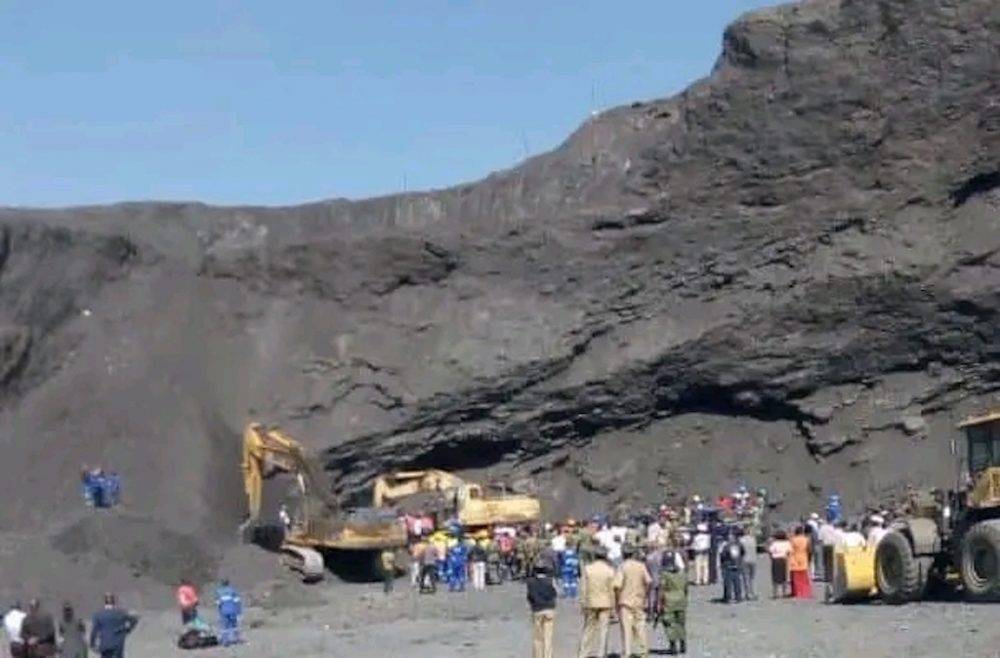
Zambia is yet to start lithium production. Lithium is in demand as a critical transition mineral due to its role in the production of lithium-ion batteries used in electric vehicles, mobile phones and renewable energy storage systems.
The government is still seeking partners to exploit the new lithium resources in Kalomo and Sinazongwe communal areas of the Southern Province.
Amid the boom in new minerals and value chains, copper remains the country’s major mineral export. According to statistics from the Bank of Zambia’s Direction of Trade Report issued in May 2023, Switzerland, China and Singapore were the top importers of Zambian copper in the first quarter of 2023.
The US, Hong Kong, South Africa, Luxembourg, Mauritius, Botswana and Namibia also imported large quantities of Zambian copper in the same period: “Total export earnings fell by 3.9% to US$ 2.8 billion, reflecting lower export volumes. A decline in copper output amid low grade ores, operational challenges and routine closures for maintenance at some mines accounted for the reduction in export volumes,” the report said.
Policy frameworks
The Centre for Trade Policy and Development is a Lusaka-based think-tank that advises the Zambian government and private investors in the extractives sector on the formulation of effective policy frameworks to protect the environment while maximising mining benefits for local people and the national treasury.
Its director, Isaac Mwaipopo, said Zambia must ensure that the pursuit of profits from its critical energy transition mineral wealth does not compromise national environmental integrity or threaten the well-being of host communities.
To create conditions for a sustainable and conflict-free mining industry, Zambia must harmonise all land-related laws that are currently being enforced in different ways by the Ministry of Mines and Minerals Development, the Ministry of Lands, the Ministry of Agriculture and the Ministry of Green Economy and the Environment, he said.
“It is necessary for these ministries to come together to define land uses and allocate land-use zones. The goal should be to harmonise the designation of lands for various uses like mining, agriculture and environmental protection zones. Such planning will ensure that land use conflicts are minimised.
“There is a need for [miners to have] environmental and social impact assessment plans to ensure their adherence to environmental protection laws. Mining companies must have comprehensive plans for the rehabilitation of mines when operations cease. This may involve re-planting native trees, restoring natural ecosystems and actions to limit the impacts of mine-related water and air pollution,” Mwaipopo said.
Community consultations prior to the start of mining operations must be anchored on transparency and inclusive dialogue between mining companies and local communities, he added. The communities must be informed about the impacts of mining activities and participate in decision-making processes. They must also have access to jobs, skills training and infrastructure development, among other benefits.
Mwaipopo said Zambia also needs new legal frameworks to encourage the use of precision mining and closed-loop recycling systems to minimise the production of mine wastes and better protect the environment.
Artisanal mining
According to the Centre for Trade Policy and Development, Zambia’s newfound wealth of critical minerals has spurred an increase in artisanal mining activities which need to be curtailed to avoid potential revenue leakages.
“With this expansion [of mining], there is a need for careful management as mining operations could potentially impact biodiversity sensitive areas like game parks, forest reserves and water catchments,” Mwaipopo said.
“Large-scale land-based investments such as mining and agriculture are contributing to forest degradation and are a precursor to climate change. This indicates the urgent need for decision-makers to re-think the mining sector by ensuring that mining practices are sustainable and inclusive in the long term.”
He blamed a lack of policy coordination among Zambian government agencies charged with environmental protection for causing confusion that has resulted in mining permits being issued in biodiversity-sensitive areas such as the Lower Zambezi National Park and North Swaka National Park.
“Such cases clearly demonstrate the existence of tensions between Zambian conservation and mining interests and require coordinated efforts to protect Zambia’s sensitive biodiversity sites from the mining of critical metals,” he said.
Parliamentary statement
Protracted efforts through email, instant messaging and calls to obtain comments from the Zambian Ministry of Mines and Mineral Development, Ministry of Green Economy and Environment, and the Ministry of Media, Information and Broadcasting were ignored.
Oxpeckers also did not receive any responses to messages requesting interviews with Zambian Green Economy Minister Collins Njobvu, Mines Minister Paul Kabuswe and Principal Director in the Ministry of Information and Media Henry Kapata. Questions sent by e-mail to Kapata received no response.
However, a statement presented to parliament by the Ministry of Water Development, Sanitation and Environmental Protection in June 2020 shows that from 1985 the government knew about the negative effects of copper, gold and cobalt mining on its water resources.
“A number of environmental problems including air pollution, water pollution and land degradation were identified as key problems during the National Conservation Strategy and the National Environmental Action Plan in 1985 and 1992, respectively. Air and water pollution were attributed mainly, but not limited to mining,” the ministerial statement noted.
“A study carried out in 2005 under a project sponsored by the World Bank revealed that the Kafue River Basin was constantly under threat from mining and mining and industrial activity. Water quality varied along the river, with the Upper Kafue in the Copperbelt particularly affected with base metals such as copper and cobalt. New studies in the North-Western Province show that water bodies there are also showing signs of elevated mining-related pollutants.”
The ministry also revealed that investigations by the Zambia Environmental Management Authority, an independent environmental regulator, in the Copperbelt border region showed the Mwambashi, Mushimba, Chingola, Mushishimba and Kafue rivers were most affected by mining pollution.
The major pollutants in all the rivers were manganese, copper, cobalt, iron and total suspended solids, water-borne particles that exceed 2 microns in size. Among other negative effects, mining had also caused siltation and changes in water chemistry with pollutants leading to the death of aquatic life and pollution of water sources, the study found.
Oscar Nkala is a Zimbabwe-based Oxpeckers associate who works on transnational investigations across borders in sub-Saharan Africa. This investigation is part of the Oxpeckers #PowerTracker series titled ‘The human cost of energy in Africa’.
Find the #PowerTracker tool and more investigations here.
Election 2024: The centre could hold … or things could fall apart:
NEWS ANALYSIS
The election results have reshaped South Africa’s political landscape. How did it happen? And what happens next?
MK. That’s what happened. Like in the movie Jaws. Just when you thought it was safe to get back into the water, Jacob Zuma has returned to centre stage.
The uMkhonto weSizwe party’s sensational surge to almost 15% of the national vote put paid to any chance of the ANC retaining its majority.
Populism sells well in the modern age of politics, especially the ethno-nationalist sort. Europe has witnessed a return of it in recent years, and the same in the Global South. And that’s what drove change in this South African election, reflected in the performance of MK and the Patriotic Alliance (PA).
Established parties of the centre, such as the ANC, either went back or, like the Democratic Alliance (DA) and the Inkatha Freedom Party (IFP), stood still. Other, smaller, centralist parties, whether new or old, struggled to attain a foothold — Rise Mzansi — or were extinguished — Cope.
But MK’s surge is not just the product of ethno-nationalism and its sibling, digital disinformation. Zuma’s popularity is enormous among large pockets of Zulu speakers.
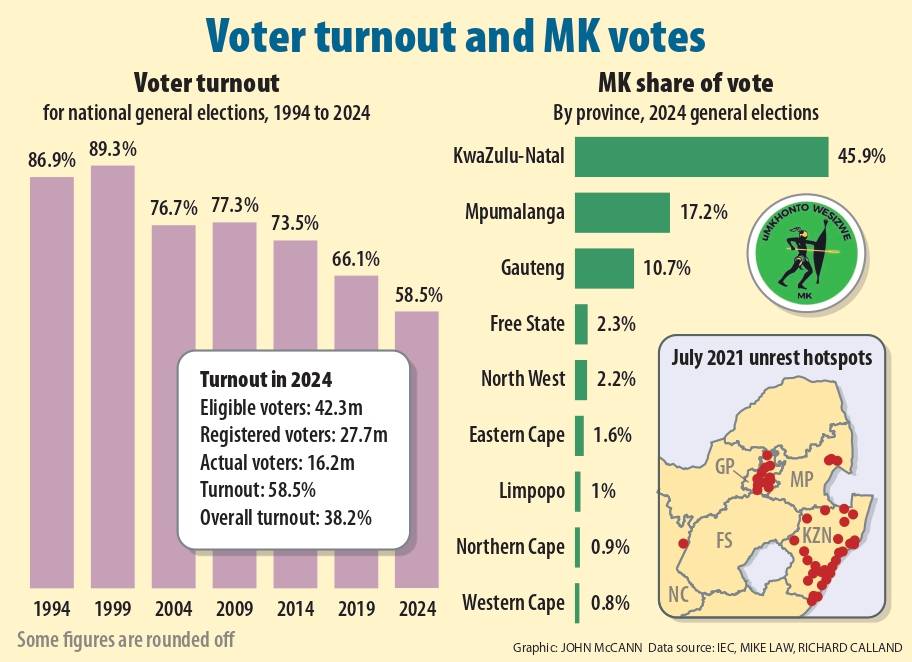
We knew that already. The country found out the hard way in the July 2021 unrest in KwaZulu-Natal (KZN). The “heat map” of the July 2021 unrest is eerily similar to that of MK’s electoral success.
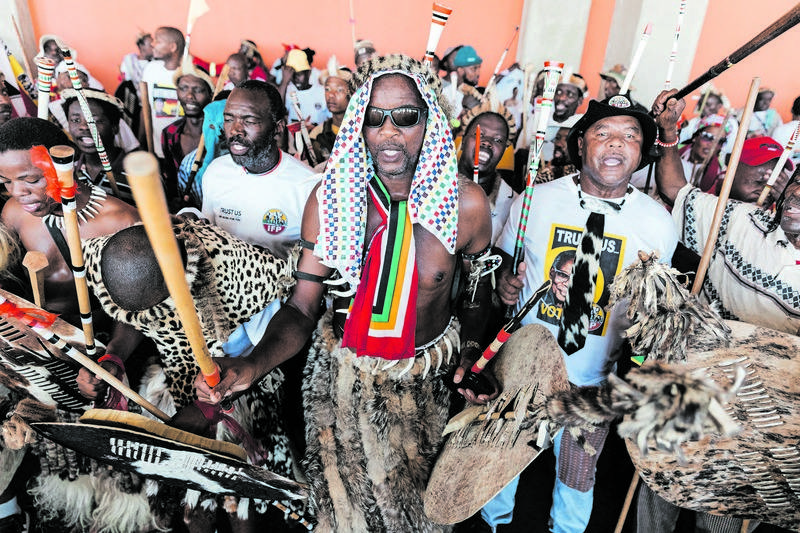
This is not to crassly suggest that all Zulu communities are violent. But it is to point out that there is a risk — that those places where people who heeded the call from Zuma and his family to rise up in 2021, after his incarceration for contempt of court, are also the places where MK got the most support in the election.
And populists tend to get their voters to turn out in higher numbers. They get their supporters agitated. More moderate political actors might be more right, but they are also more boring, which isn’t good for turnout.
So, another factor here was that turnout was higher in KZN than in any other province — about 4% more than the national average.
Outside KZN, MK’s next-best percentages came in from Mpumalanga, which has a bigger proportion of Zulu speakers than any province outside of KZN. Then, it also hit double digits in Gauteng, which has the highest gross number of Zulu speakers outside of KZN.
It barely hit 2% in any other province. So, it’s an ethnic party — the evidence is overwhelming.
That doesn’t mean the entire Zulu nation voted for Mr Zuma and his break-out party. A shout-out must go to the IFP, which somehow managed to grow is KZN vote, and increase its seats in the National Assembly, in spite of such a sensational political onslaught on their KZN stronghold.
Like all major political movements in South Africa, the IFP has had some volatility in its complex history. But, in the modern age, it has evolved into a very respectable actor.
There are some good and capable people in the IFP’s top leadership, including its dignified leader Velenkosini Hlabisa and the seasoned parliamentarian Narend Singh, and so it would probably be a very reliable partner in a coalition government.
It is important to have some KZN representation in the top rungs of South Africa politics. It might even be critical for keeping the peace.
At the ANC’s 2022 national conference, there were no prizes for the KZN ANC. Its own fault, of course, having put itself in opposition to party and national president Cyril Ramaphosa’s faction, which was about to sweep the floor.
But, in any country, if the largest ethnic group doesn’t have a decent stake in the body politic, it will forge its own.
That’s what MK did, using those same ANC KZN structures. It was a sabotage job, from the inside. A classic Zuma-style intelligence operation, sleeper cells and all.
MK organised in KZN wearing ANC regalia, mobilising ANC branches though ANC leaders, according to numerous sources inside the organisation (the real one).
Another party that didn’t survive the KZN hit is the Economic Freedom Fighters (EFF). It has declined. Many of its lost votes were in KZN, where it seems the party had been borrowing some of Zuma’s voters who couldn’t support Ramaphosa’s ANC.
But even outside KZN, the EFF’s growth came to a halt. That’s two elections in a row now, after a similar oscillation in 2021. Political capital generally rises, then it falls. Malema must be asking, “Where to from here?” for his Red Berets.
Already, he’s singing off a different hymn sheet — reflecting his reduced power — with fewer than one in 10 voters supporting his militant, but one-trick-pony, political positioning.
He’s clearly re-positioning fast and adjusting his ambition to be a king-maker in the new coalition world.
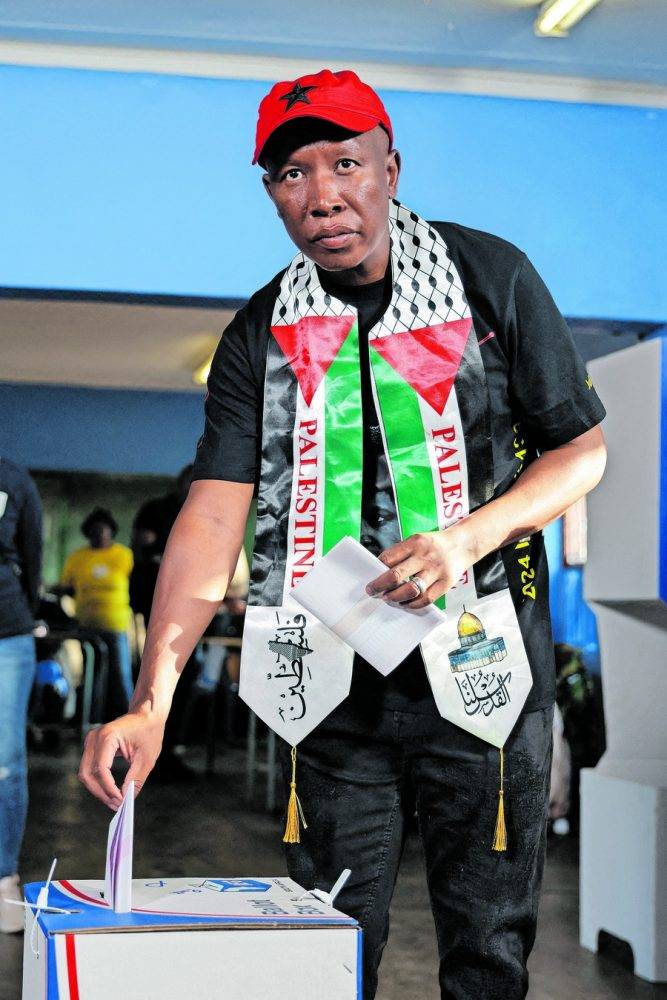
He wants in on the new government, that’s for sure. There’s no other endgame for him, at this point.
The DA did well — even if its critics are spinning it otherwise. It kept a comfortable majority in the Western Cape and increased its seats in the National Assembly. It has become the largest party in the metros.
Job well done, from its perspective.
The DA’s expansion, however minor, is even more impressive in the context of the PA’s growth among working-class coloured voters, a critical constituency to have in order to hold a majority in the Western Cape, and the Northern Cape.
The DA took some losses from the PA, as did other parties, but won them back elsewhere. It clawed back votes from the Freedom Front Plus and even made inroads into ANC votes in some parts of the country.
It was not a good election for the “chattering-class” parties, such as Rise Mzansi, Build One South Africa and Good.
Or for ActionSA. Being the new kid on the block only sells for one election. It’s a tough and unforgiving electoral marketplace. After that, you need to stand for something clear and occupy an ideological space if you’re going to keep growing.
On the positive side of the balance sheet for Election 2024 there is, first of all, the grace and dignity with which the ANC accepted its hard fall to well below 50%. This should not be underestimated, given how many election losers seek to cling to power or claim rigged processes.
Second, despite some disappointing technological and other glitches on election day, the IEC withstood the pressure and deserves particular praise for staring Zuma down last weekend, when he sought to intimidate it into postponing the declaration of the election result.
Third, it could herald the start of a new era, with a competitive multi-party democracy.
Or, on the other side of the balance sheet, the start of a period of fractured politics, where populist parties — now with at least 26% of the vote combined (EFF, MK and PA) — fill the vacuum created in the centre-ground, as ANC dominion dissolves.
Turnout fell below 60% for the first time in a national election, on the back of one-third of eligible voters turning their backs on democracy and not registering.
Bottom line: only one in seven eligible voters voted for the ANC. The transition from the era of the dominant party is well and truly over and the ANC is struggling for legitimacy.
So, that’s the report card. But what does it mean?
It means a hung National Assembly, more open to different scenarios than was initially predicted. And hung provincial legislatures in KZN, Gauteng and Northern Cape (where the ANC is just a seat short of a majority).
Let’s focus on the National Assembly, because the deal that is struck there could shape the deals to be done in the provinces.
This is a critical moment in South Africa’s fate. The centre could hold or things could fall apart. And it doesn’t have much time to decide.
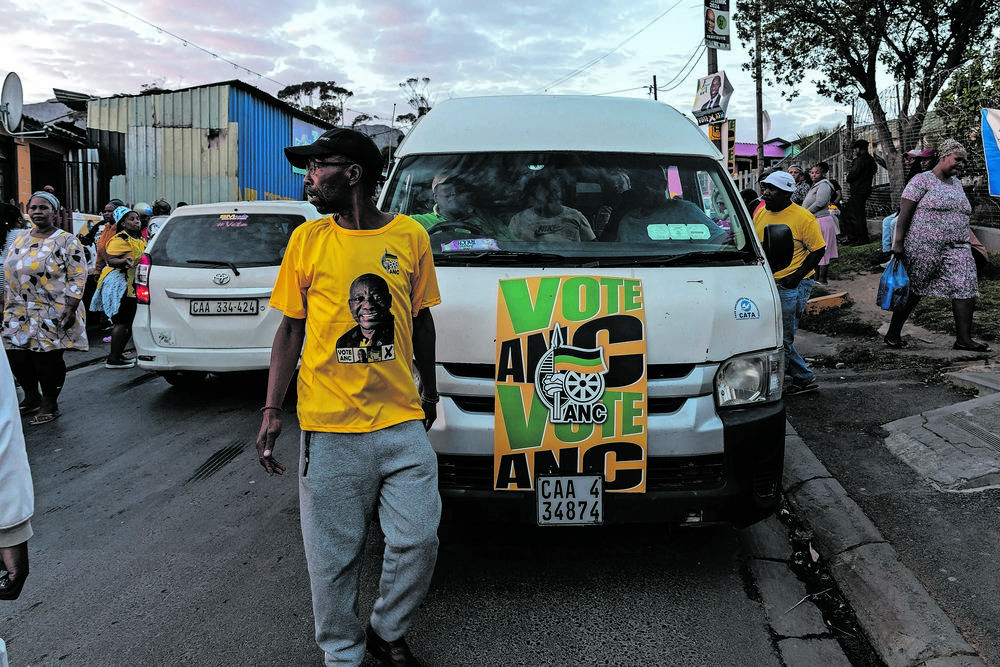
The first sitting of parliament must be held within 14 days of the declaration of the result (which was on 2 June), at which a president and speaker must be elected.
Constitutionally, it is plausible to elect these office bearers without an outright majority (that is, 201 MPs). But it would be dangerous to do this, especially from Ramaphosa’s perspective, as a president elected without the majority support of parliament is vulnerable to a motion of no confidence from day one.
If a president is removed in a no-confidence vote, it counts as the end of a presidential term, and presidents in South Africa are limited to two. Ramaphosa has already served one. If he’s removed in this manner, he can’t be president of South Africa again.
So, especially from the ANC’s perspective, that makes it particularly important to have at least a skeleton agreement in place in the next two weeks that can account for a majority of MPs in the National Assembly.
It might not be a fully fledged coalition agreement, in the strict technical sense of the term. It could be something less, such as a supply-and-confidence arrangement to prop up a minority government. But that, too, would have a price, such as key positions in the legislature and elsewhere in the state architecture.
Coalition negotiations are notoriously difficult to predict and anything could emerge. Talks have been held with pretty much all parties, as well as the ANC’s alliance partners.
The bids are in and it will ultimately be left to the ANC national executive committee to choose its bride.
Many in the business community and elsewhere would like to see a deal between the ANC and DA. That could happen. The DA is open to it, even if it might be a tough sell to some of its voters (the same, of course, for the ANC).
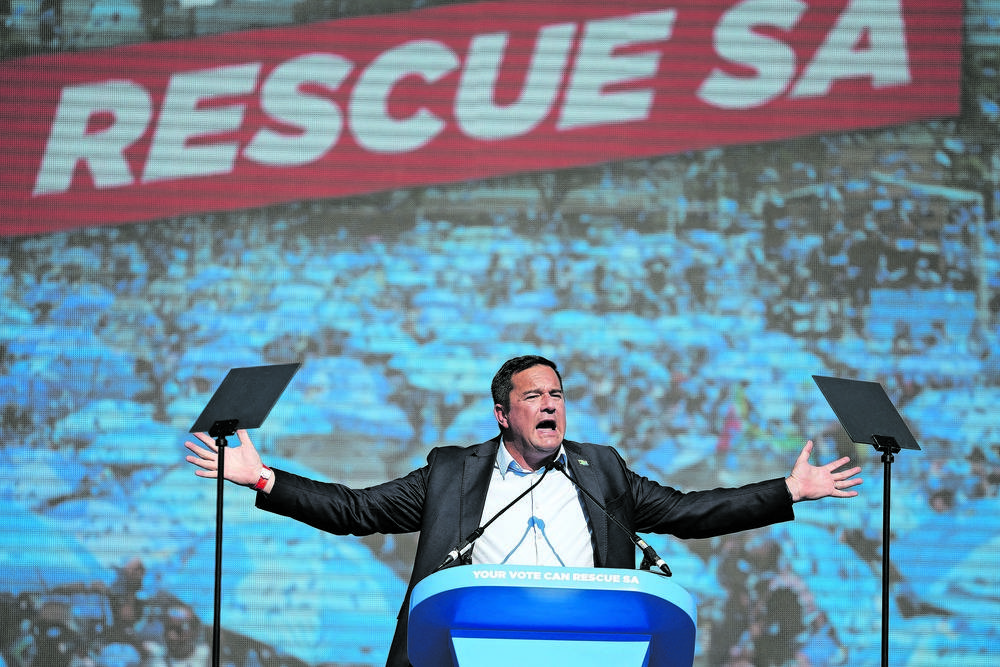
There is a good cohort in the ANC who would like it to happen too. The DA has the attraction of being a more reliable coalition partner than the rest, showing some appreciation for good coalition practice in its wobbly introduction to the local government sphere.
And a stable and predictable coalition partner is in the ANC’s best interests, as it is likely to inspire economic confidence at a time when it is in short supply.
A three-way agreement between the ANC, DA and IFP would probably be even better. It would square the game in the KZN provincial legislature. It could make the deal an easier sell to the DA-sceptics in the ANC, positioning it as something broader than just a straight ANC-DA alliance.
It would include strong representation for KZN, key to national peace — the old guard, so to speak, holding the centre, against the rowdy new kids on the block.
It would be a stable and accountable basis for preserving and advancing a progressive political project.
But DA cynicism is a real thing in the ANC and its alliance partner trade union federation Cosatu.
Some of it breeds from imagery of the past, some is at least ostensibly ideological, although the parties really aren’t as far apart as their campaign rhetoric suggests — especially now that the radical economic transformation bloc has, to a very large extent, already left the ANC and set up shop elsewhere.

The allergic reaction of Cosatu and other “old left” factions of the ANC is understandable. But it is not strategic.
Asking what coalition arrangement would best advance working-class interests is an important and legitimate question. But, a return to the plunder of state capture under Zuma, with the concomitant breakdown of institutional capability and integrity in the state, or the parasitic compradorship of the EFF is not the answer.
These are faux revolutionaries. They are not left parties in any real sense of the notion. If anything, they are counter-revolutionaries.
Progressive politics is best served by maintaining the rule of law and constitutional rights and freedoms; by continuing to rebuild state institutions and capability. The most stable and accountable coalition government will be able to deliver a transformative agenda.
But the ANC national working committee in its “wisdom” has decided to explore the possibility of an ultra-broad equivalent of the “government of national unity” concept and include a much longer list of parties in the new government.
It must be a non-starter. For one, the DA surely won’t do it. Sharing power with the ANC already presents significant electoral risk for the DA and supporting a government that involves the EFF is asking too much.
So, if that proposal is seriously pursued, it will push the game towards Malema and the ANC + EFF + dodgy smaller parties — a deal that used to be called the doomsday scenario — until Zuma reminded us that there might be something even worse.
Submit and get free exposure here: Showcase Your Business | Advertise Your Special Offers.