
A 2022 cabinet directive to Zambia’s government agencies to actively bid to host major international events is bearing fruit for the hospitality sector, with the Lusaka and Livingstone hosting of global conferences in recent months.
The influx of international delegates has provided a much-needed boost to hotels, conference venues and other tourism-related businesses, indicating recovery and opportunities for growth after the Covid-19 pandemic.
For 2026, the country has secured the hosting the African Marketing Confederation Conference, the African ICT Conference and the Africa Supply Chain Conference, all of which will take place in Livingstone, and bring in about 2?000 delegates.
According to data released in July by the tourism ministry, hotel occupancy has risen, with hotels in Livingstone reporting 70% occupancy. The national average is 55%, compared with 40% pre-2023.
Last December Zambia scrapped visa fees for travellers from an additional 53 countries, bringing to 167 the number whose nationals can enter the country visa-free. It based the decision on the rationale that increased visitor numbers and the gains in hotel bookings, local spending and visits to tourist sites would far outweigh the revenue lost from visa fees.
There is an international marketing push under the “Destination Zambia” campaign, which is leveraging high-profile platforms such as BBC Global Storytelling and Expedia to elevate Zambia’s profile as a premier travel destination.
The Expedia campaign targets key source markets the US, the UK and Germany, and promotes diverse destinations beyond the hubs of Lusaka, Ndola and Livingstone. It includes collaboration with more than 200 travel agents and 550 airlines.
“This partnership marks a milestone in Zambia’s strategy to elevate its global tourism image,” Zambia Tourism Agency chief executive Matongo Matamwandi said.
“It will help us attract high-value tourists and reach our 2025 target of 2.4 million international arrivals.”
In his State of the Nation address on 12 September, President Hakainde Hichilema said tourist arrivals had increased from 554??000 in 2021 to 2.2 million in 2024, a jump of almost 300% .
He attributed this to the visa waiver policy, as well as intensified marketing and the hosting of international meetings and conferences.
While international arrivals remain a priority, the government is also committed to stimulating domestic tourism through the “Take a Holiday Yamu Loko” campaign, which encourages Zambians to explore their own country.
The first half of 2025 saw a 92% increase in domestic tourists to more than 240??000 from 129??000 in the same period last year.
To improve connectivity to tourism destinations, the government is upgrading provincial airports and planning two new ones. The Lusaka, Ndola and Livingstone international airports have recently undergone upgrades to accommodate more traffic, while a fourth $ 85 million project is under way in Mfuwe, a tourism hotspot in the east of the country.
Using $ 100 million from the Green, Resilient and Transformational Development Project funded by the World Bank, the government is next year set to roll out tourism development initiatives across the country, including infrastructure in emerging tourism destinations, Hichilema told parliament in his address.
Zambia’s traditional tourism market has been in Livingstone, home to the Victoria Falls, and the Lower Zambezi,.
As the focus shifts to the “Northern Circuit”, local airlines are tapping into the drive by increasing in-country and regional flights.
Transport and Logistics Minister Frank Tayali said the government aims to position Zambia as a key aviation hub in the region by improving air connectivity and expanding aviation infrastructure.
Hyundai Tucson review: Why diesel mid-sized SUVs are still important:
The Hyundai Tucson got a facelift in April and looks more stylish than ever.
The Mail & Guardian had it on test for a week and found that the 2-litre turbocharged diesel engine was what made the Tucson stand out in an otherwise flooded mid-sized SUV market.
Its direct competitors are the Kia Sportage, VW Tiguan and the Haval H6. The Sportage and Tiguan are also available in diesel variants, while the Haval H6 is only available in petrol and hybrid.
The diesel Tiguan costs close to R50 000 more than the Tucson and, although the Sportage is around the same price as the Tucson, the Hyundai delivers better power output.
While all three of the competitors are excellent vehicles, and also offer better features in some aspects, the Tucson provided me with an excellent drive and fuel consumption figures that I would normally die for. I managed to average 6.5 litres/100km over the week.
The 2-litre turbodiesel engine, which delivers 137kW and 416Nm of torque, made it very easy to boost on highways. Turbo lag and wind noise were minimal and the vehicle felt very assertive on the road.
The Tucson offers a quiet and refined ride which gives comfort to the driver.
It is also no slouch on the inside and that is something that you don’t expect.
The exterior is stylish and futuristic, a look that usually points towards a sporty interior. However, Hyundai does well to make it feel very premium and posh on the inside, emphasising comfort.
There are some nice finishes and soft materials used along the dashboard to further enhance that posh experience.
The back is very spacious for passengers.
The 12.3-inch infotainment system is well integrated on the dashboard, and very responsive, and the climate-control panel sits below the infotainment system which makes it easy to navigate and adjust.
I just wish Hyundai had gone for a more stylish gear shifter to tie everything together. It detracts from what is otherwise a very elegant interior.
Pricing and verdict
The Hyundai Tucson is available in three variants: 2.0 Premium AT (petrol) priced at R559 900, R2.0D Executive AT (tested) priced at R709 900 and a R2.0D N Line AWD AT priced at R859 900.
For me, the mid-spec model is exactly where the Tucson should be playing. The diesel engine stands out and the fuel consumption is marvellous for a family car.
Overall, the Tucson impressed in every aspect for the money.
Chery Tiggo 9 sets the standard in Chinese class:
Chery has brought a number of new-energy vehicles to South Africa recently. Adding hybrid and plug-in hybrid variants to existing models, the brand also launched its flagship Tiggo 9 in August.
It did that by crash testing it on the Kyalami circuit to showcase the safety of the vehicle.
But make no mistake, this is not a car you would just want to waste on a crash test.
The Tiggo 9 is a seven-seater available in two variants, the Pinnacle CSH and the Vanguard CSH, which we had on test. Both are plug-in hybrid electric vehicles (PHEV), but the Pinnacle is front-wheel drive while the Vanguard is an all-wheel drive.
Chery has made the car look very classy from the outside. The Tiggo 9 strikes a balance between grandeur and poise. Sleek body lines flow seamlessly into an imposing front fascia, where a bold 3D diamond grille takes centre stage, framed by sculpted LED headlamps.
At the back, a full-width LED light bar stretches across the tailgate, inspired by diamond jewellery, which is a testament to the luxury the car offers.
The attractive 20-inch alloy wheels cap the luxurious exterior perfectly. They are not over the top or futuristic, but are an exceptional fit with the rest of the car’s looks.
What I love is that, although Chery has made this vehicle look much classier than the rest of the Tiggo range, it still keeps the identity of a Chery. If you see it on the road, you might wonder what Chery it is, but you will definitely know that it is a vehicle from the brand.
Interior
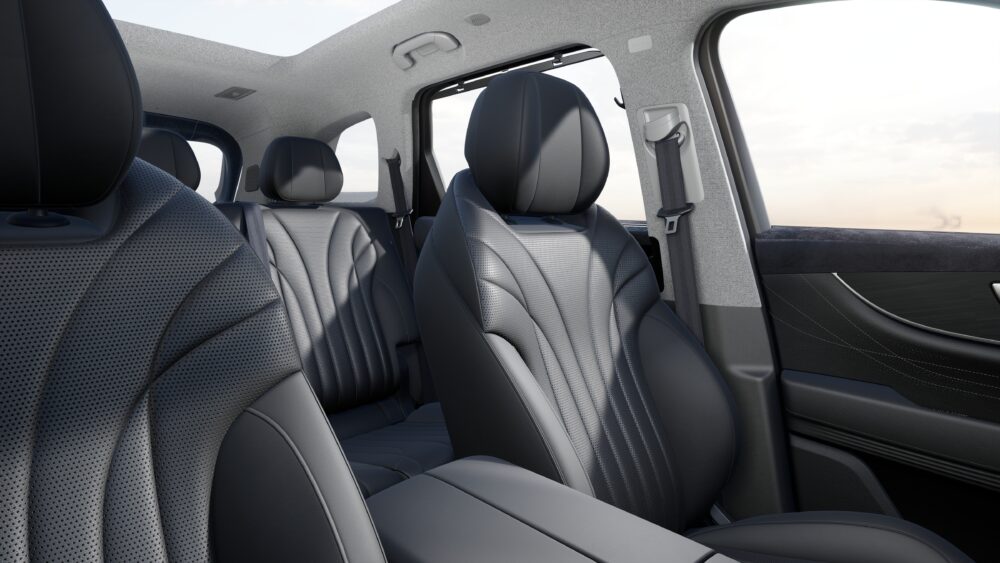
The interior is where Chery really makes you feel the luxury.
The seats are heated, ventilated and also offer massages to the front seat passengers, while the second row has independent climate control and also heated and ventilated seats.
The second row of seats is adjustable, which means that if the third row is not being used, those passengers have the option to move further back and recline.
However, if there are passengers in the third row, they can be comfortable if the second row is moved forward.
In seven seaters, it usually feels as if the passengers in the third row could suffocate, but the adjustability of the second row in the Tiggo 9 makes it very easy for everyone to be comfortable.
The Tiggo 9 also has a 15.6-inch infotainment system and a 10.25-inch digital cluster.
Chery incorporated the screens from the Jaecoo J7 into the Tiggo 9 to give it a more premium feeling.
But everything on the inside of this car feels premium and posh.
You would never say that you were sitting in a Chinese car, but here we are, and we have to give them credit for how far they have come.
The Drive
A week ago, I posted a video on TikTok talking about the features in the Tiggo 9, compared to those in a R4 million Range Rover, and I struck a few nerves.
A lot of the comments said that you needed to drive the two vehicles to see that they were incomparable.
That’s true to a certain extent. I mean, the Chery Tiggo 9 doesn’t have air suspension, but it still does have a Macpherson front suspension and a rear multi-link suspension that makes it feel very firm and solid.
Not to mention, it has three electric motors paired to a 1.5-litre turbocharged engine that pushes out 455kW of power and 920Nm of torque.
That is an exceptional amount of power and, even though it is a large seven-seater, this car picks up speed so quickly, it can zoom when you need it to and doesn’t feel nervous on the road at all.
Of course, there will be body roll when it comes to handling because it is a big vehicle, but I found handling to be smooth and simple.
Thanks to the 34.4kWh battery used in the Vanguard variant, the vehicle has up to 160km of electric range alone and a combined range of 1 400km.
Essentially, that means that you could make it from Johannesburg to Cape Town on a single tank and charge.
I found that driving it in hybrid mode gave me an excellent 1.7 litres/100km and when the battery was depleted, I still managed to stay under 7 litres/100km.
Safety
In terms of safety, the Tiggo 9 was put to the test in front of the South African media by undergoing Africa’s first dual-vehicle collision test.
Two Tiggo 9 SUVs collided in a controlled 50% offset head-on crash while travelling at 50km/h. The demonstration was designed to prove that the Tiggo 9 delivers world-class protection in one of the most dangerous accident scenarios.
The Tiggo 9 passed the test as expected (video below).
The car also has a number of safety features, like a 540-degree camera, automatic parking, front and rear parking sensors, lane-departure warning, traffic jam assistance and remote parking assistance.
Ultimately, the Tiggo 9 makes you feel incredibly safe, despite having a superb amount of power at your disposal.
Verdict
The Pinnacle variant is priced at R839 900 and the Vanguard costs R989 900.
It is excellent value for money for the amount of features you get, the luxury you experience, the power it produces and the fact that it is a PHEV, at the end of the day.
The only issue I have with the Tiggo 9 is that, although it is a seven-seater, it doesn’t give the same feeling that the Omoda C9 gave and that is priced just R10 000 above it.
Submit and get free exposure here: Showcase Your Business | Advertise Your Special Offers.
