
Zee Nxumalo isn’t chasing depth — she’s living it:
After running around all morning, I am finally settled by my laptop, going through the questions I prepared the night before.
I do not get through the first five when Google Meet asks me to admit my guest.
Zee Nxumalo’s manager asks that we cap the meeting at 20 minutes. I don’t hesitate — she is a star and she is busy.
“Zee has a quick question for you,” he says.
A question for me? Panic sets in briefly but I am open.
“We are working on titles for my upcoming EP. Do you think it should be in English or Zulu? I am sitting with my team and we are trying to figure that out. What do you think?” she asks.
Suddenly, I am part of the team, not that my opinion matters but it is an unexpected entry point into a conversation that refuses the stiffness of a traditional interview.
It is disarming. It is generous. It is perhaps also indicative of the kind of artist Zee Nxumalo is becoming: one who is not only building a catalogue but actively negotiating identity in real time.
At 23, Nxumalo occupies a rare position in South African music, both a product of a digital moment and a shaper of it.
Her rise from viral breakout to cultural mainstay has been swift but not accidental. There is, in her trajectory, the unmistakable imprint of a generation that understands the elasticity of genre, the currency of relatability and the necessity of reinvention.
Her sound, an intuitive blend of Afropop storytelling, amapiano’s rhythmic elasticity and contemporary dance sensibilities has allowed her to move between spaces with ease: the club, the radio, the algorithm.
But more than that, it has allowed her to remain legible to a young audience that recognises itself in her, not in perfection but in process.
That process, she insists, begins internally.
“I don’t think I’m that spiritual,” she says, almost reflexively, when I ask about the emotional and philosophical underpinnings of her upcoming EP.
“But I would say I’m a person who listens to their mind a lot. Like, I listen to my thoughts. Most of the songs that I do, it’s internal conversations that I have with myself, then I just put it on the mic.”
There is something quietly radical about the refusal to over-intellectualise what many would readily label as “depth”. Nxumalo does not position herself as a vessel of meaning as much as she does a translator
of feeling. The distinction is subtle but important.
“Maybe it’s in the feeling of the song,” she concedes. “Even if someone doesn’t understand what I’m saying, they would feel — they would know.”
It is this instinct to prioritise feeling over form that has underpinned a career marked by both commercial success and cultural resonance.
In 2025, Nxumalo became the most streamed female artist in South Africa, surpassing global heavyweights and signalling what many have described as a generational shift: the re-assertion of
local sound is dominant within its own ecosystem. More than 100 million streams later, the numbers tell a story. The atmosphere, the virality of a track like Aweh Mah, the ease with which her music travels across TikTok, taxis and terraces tells another.
For all the metrics, there is a negotiation happening beneath the surface, one that played out at the beginning of our conversation. The question of language, of naming, of who an artist is allowed to be as they scale.
“I want an English name,” she says of the EP. “Shingai is saying: ‘No, that’s not authentic to Zee.’”
There is laughter in the room but also a tension that feels familiar
in contemporary South African music, the push and pull between global accessibility and local specificity. Nxumalo listens. She asks.
She weighs.
“I don’t see it happening,” I said. “It’s a little far left for Zee and her brand … you’re the sister from the hood. That’s how people connect with you.”
It is a loaded phrase, “the sister from the hood” but Nxumalo does not reject it. Instead, she folds it into her understanding of self, even as she pushes against its limits. There is no singular direction here, only a series of possibilities.
The EP itself, planned for release sometime in April, she reveals, is compact with just four tracks but expansive in theme. “Sixty percent of the EP is very motivational,” she says. “The first song is about protection, then there is prayer and then the last one is about love.”
It is a structure that mirrors, in some ways, a personal arc, from safeguarding the self, to seeking guidance, to arriving, tentatively, at intimacy.
While Nxumalo might resist the label of “spiritual”, the language of the project suggests otherwise. Or perhaps, more accurately, it suggests a redefinition of spirituality — one that is rooted less in doctrine and more in introspection.
Her collaborators on the project reflect a similar openness. Contributions from collectives such as Shakes & Les signal a willingness to move between sonic worlds.
“I’m very intentional,” she says of her approach to collaboration. “Because I feel like when I stick to one thing … I try as much as I can to explore. It takes out bits and pieces of me that I never knew existed.”
Exploration, for Nxumalo, is not a side note; it is central to her practice. It extends beyond music into fashion, where she treats clothing as an extension of mood, of energy, of narrative.
“Fashion is how I express myself most of the time,” she says. “If I’m feeling very happy, you’ll see pink, orange … If I want to feel chilled, you’ll see grey. Lately, I’ve been into red.”
There is a synaesthetic quality to the way she describes it, colour as emotion, outfit as sound. It is perhaps no surprise, then, that brands have taken notice.
Partnerships with global names like Puma and Nivea position her not only as a musician but as a cultural figure, one whose influence extends into lifestyle, youth identity and visual language.
And yet, even as she expands, there is a clear commitment to remaining in motion.
“I was in an Uber last week,” she says, laughing, “and I was like: ‘I want to do maskandi.’”
It is said casually but it speaks to a deeper impulse to refuse stagnation, to remain porous. Gospel, R&B and maskandi are not strategic pivots so much as they are curiosities waiting to be explored.
Her writing process mirrors this ethos. It is, at once, disciplined and instinctive.
“When I get into the studio, I listen to the beat … and I don’t want to hear what other
people think,” she explains. “Because immediately, I’ll start following your direction.”
There is a lesson here, one she learnt, she admits, through failure.
“There was a point where I couldn’t write a song at all,” she says.
“I was trying to be deep like other writers … and it wasn’t working. Then I just did me.
Authenticity, then, is not a fixed state but a returning again and again to one’s own voice, even when it falters.
As the conversation draws to a close, I ask the inevitable: How does she want the EP to make people feel?
“I want them to feel like them,” she says, simply.
“I want them to dance … but also, I want them to feel uplifted. I want to encourage them to spend more time with themselves.”
It is a modest ambition, on the surface. But in a cultural landscape increasingly defined by noise, by speed, by spectacle.
There is something quietly radical about an artist who insists on feeling, on reflection, on the self as both source and destination.
Somewhere between the question of language and the insistence on individuality, between the dance floor and the interior life, Zee Nxumalo is building something that resists easy categorisation. Not quite global, not only local. Not entirely spiritual but deeply felt.
And perhaps that is the point.
How sugar’s rise and collapse shaped KZN:
Sugar was never just a crop in KwaZulu-Natal. It was an empire, an economy and for thousands of indentured labourers who arrived in 1860, it was a destiny.
A single crop grown over swathes of hectares of rolling green hills was the life force of the Indian and Zulu-speaking communities.
For more than a century-and-a-half, this shimmering grass transformed the Natal coastline into a corridor of green gold, enriching colonial barons and anchoring the livelihoods of generations of South Africans.
Today, that world is collapsing — and with it, the fragile ecosystem of towns, farms and families built around the industry.
A crop built on sweat and suffering
The sugar story begins with the 1860 indentured labourers — men, women and children who crossed the kala pani (big waters) with nothing but hope and a five- to ten-year contract.
They worked from dawn to dusk under harsh master–servant conditions, bent over the fields beneath the searing African sun. Their semi-slave labour laid the foundations of an industry that would reshape the province’s economy and enrich the British elite who controlled it.
From this suffering emerged a community of 1.4 million South Africans of Indian origin — a people who built families, businesses and cultural, arts and sporting institutions that today form an integral part of KwaZulu-Natal’s identity.
The majority still reside in the Group Areas Act gulags and ghettos of Phoenix and Chatsworth — poor, jobless, hopeless and disillusioned.
Sugar was the crucible in which this community was forged, a single crop that dominated the garden province’s socio-economy for decades.
Yet 165 years later, the empire built on their sweat is in ruins. There is no statue on the sea front where the semi-slaves disembarked on 16 November 1860 from SS Truro. The first batch of intrepid working-class pioneers were followed by hundreds of ships until 1910 — ferrying almost 200 000 people, including traders, artisans and religious figures.
The fall of a titan
Tongaat Hulett, once the pride of the sugar belt and a 134-year-old industrial icon, has collapsed under the weight of mismanagement, scandal and shifting global markets.
What was once South Africa’s most trusted agro-industrial giant has unravelled into a R12 billion corporate implosion.
The business rescue practitioners were blunt: the downfall was rooted in “historic accounting irregularities, financial misstatements and governance failures that destroyed roughly R12 billion in shareholder value”. A massive fraud scandal — still unprosecuted — triggered a chain reaction. Banks withdrew support. Suppliers demanded cash upfront. Investors fled. By the time the crisis peaked, Tongaat owed lenders R6 billion, forcing the Industrial Development Corporation (IDC) to inject R900 million simply to stabilise operations.
What followed was a slow-motion collapse
Suspended trading, failed rescue plans and finally, the application for provisional liquidation after the rescue plan became “no longer implementable”.
The mills in Tongaat, Maidstone and Felixton have fallen silent. Entire towns built around the rhythm of the milling season now face an uncertain future.
Tongaat Hulett snapped about a quarter of the 18-million tonnes of sugarcane crops hand-picked by thousands of black labourers. The lifespan of these precious sticks of sugar is short — 24 hours and counting — otherwise they are useless for sugar and by-products production.
The industry provides 65 000 jobs across the jobs pipeline.
The human cost of collapse
The shockwaves are devastating. Almost 24 000 Zulu-speaking workers, small-scale farmers and rural residents who depended on the industry face deepening hardship. One thousand commercial cane growers are in limbo. Hundreds of transporters who hauled cane from field to factory are stranded without contracts. Small growers — the backbone of the rural economy — are among the hardest hit.
As Dr Robert Zunke, CEO of SA Canegrowers, warned, mills could become “mothballs” as global pressures, including President Donald Trump’s 30% tariffs on sugar imports to the US, squeeze the industry further, alongside competition from Brazil and India.
“Buy Made in South Africa,” he urges millions of supermarket sugar-loving consumers.
The collapse is not just economic. It is cultural, historical and deeply personal.
Two men, two destinies: The sugar baron and the indentured visionary
The sugar belt’s history can be told through two men who represent opposite ends of its social spectrum.
On one side stood Chris Saunders — the polished sugar baron, the corporate toast of KwaZulu-Natal, whose influence stretched from Tongaat Hulett’s boardrooms to the corridors of provincial power. He embodied the establishment: wealth, pedigree and the confidence of a man born into the upper terraces of the colonial economy.
On the other side stood Babu Partabsing Bodasing — an indentured labourer who arrived with nothing but grit, hope and the clothes on his back. When his indentureship ended, he made a decision that defied the script written for thousands of labourers: he cashed out the value of his contract and bought 600ha, later expanding to 8 000ha of sugar land in Stanger and KwaDukuza.
In an era when land ownership by Indians was rare, Bodasing’s leap was revolutionary. He transformed himself “from labourer to landowner, from contract worker to agricultural pioneer.”
His family became what many regarded as the royalty of the plantations — self-made, respected and rooted in the soil they once toiled.
Today, the collapse of Tongaat Hulett threatens that legacy. Keval Bodasing, the sixth-generation custodian of the family’s sugar destiny, now faces a future clouded by uncertainty.
His story is not a footnote — it is a testament to resilience, vision and the audacity to rewrite one’s fate. The Bodasing brand was huge and generations were “ingrained from birth” to continue farming.
A province at a crossroads
KwaZulu-Natal now stands at a historic junction. The collapse of Tongaat Hulett is not merely a corporate failure — it is the unravelling of a system built over 165 years. The abandoned cane fields and shuttered mills are more than industrial ruins; they are symbols of a province struggling to redefine itself.
What began as a colonial enterprise that reshaped land, labour and society may end not with triumph but with what the document calls “a quiet industrial obituary”.
If that happens, the loss will not only be measured in balance sheets. It will be felt in the fading memory of a crop that once turned hardship into opportunity for generations.
The bitter irony
There is a painful symmetry to this moment. An industry built by the resilience of indentured labour — people who endured suffering to build a future in a strange land — may now wither in the era of freedom.
The collapse of sugar is not just an economic story; it is a story about memory, identity and the fragility of industries that once seemed eternal.
Sugar turned green fields into gold. Today, those fields stand as reminders of both the promise and the peril of an economy built on a single crop.
The question now is whether KwaZulu-Natal can imagine a future beyond sugar — and whether the residents who built this industry will be supported as they navigate the uncertain road ahead.
Historical perspective
Five years after his death during the Covid-19 pandemic on 12 March 2021, the slow collapse of KwaZulu-Natal’s once-mighty sugar industry — after 134 years as the province’s economic backbone — would have pained King Goodwill Zwelithini kaBhekuzulu deeply, especially given its impact on small growers and rural workers.
In the 1990s, during a royal visit to Port Louis, he sought the support of Mauritian Prime Minister Dr Navin Ramgoolam to help revitalise the sugar sector for his subjects living in deep rural belts of poverty and unemployment.
Over the decades, the monarch’s profound appreciation of the province’s multicultural tapestry often resonated during the anniversary of the Indian indentured labourers: “The story of the Zulu nation cannot be told without the story of the Indian and German communities.”
Now, the current Zulu royal household has spoken out, saying the industry is the lifeblood of thousands of workers.
One solution may be to turn sugarcane into ethanol as a biofuel. At least the private homeowners at Mount Edgecombe Estates could sleep in peace and swing golf balls around the prestige greens and fairways — developers Tongaat Hulett do not own this gated village nor the ecosystem of Zimbali.
Marlan Padayachee, formerly a political, diplomatic and foreign correspondent, is a freelance journalist, photographer and researcher.
Corruption, looting in ANC municipality:
Sentenced prisoners, parolees-turned managers, water mafias and even a municipal minibus operating in a taxi rank in other parts of the Free State are among the questionable expenditures of the struggling Maluti-a-Phofung municipality. These are startling revelations by city manager advocate Mzwakhe Mofokeng, 14 months into his tenure.
Mofokeng said he had uncovered a deep-rooted culture of corruption in the municipality and, since taking office, had dismissed 11 senior managers implicated in irregularities.
“This is my 14th month and I can tell you these people are thugs — and I know how to deal with thugs. These people have been milking this municipality for a long time.
“Some of these people have been suspended because the municipality has been paying individuals who are in prison and even paying for their overtime. Where on earth have you seen that? The person I’m talking about was part of the municipality. He got sentenced, he is in prison and we picked it up.”

One of the officials who Mofokeng dismissed was a convicted criminal who was hired as a revenue manager, just two months after being released from prison.
“This guy did not disclose that he had a previous conviction or that he had been released on parole two months earlier. I fired him for non-disclosure because the law requires you to disclose,” Mofokeng said.
“We have 87 managers who are earning more than R1.4 million. I’m reviewing that and people are not happy. Even though Mangaung is a metro, they have only 16 managers, while we have 87. What do you call that? Some of the managers do not even have job descriptions; they do not have posts. These are non-existent positions in the organisational structure.”
For several years, the troubled Maluti-a-Phofung municipality has been plagued by corruption, maladministration, ghost employees, water cuts, electricity outages and sewage failures, issues that have sparked repeated community protests.
Infrastructure failures have forced several businesses to close or relocate, including the Harrismith abattoir and NLG Gloves which moved to Gauteng. Clothing factories in the area have fallen from 28 to 16 over the past few years.
In 2018, the Free State provincial government placed the Maluti?a?Phofung municipality under administration after years of corruption, maladministration and service delivery failures that sparked violent protests.
Amid spiralling non?payment to Eskom, the municipality’s debt grew sharply and by July 2024 stood at around R8?billion, leading to a North Gauteng High Court order for intervention.
In September 2024, the municipality and Eskom reached an eight?year distribution agency agreement — extendable to 15 years — designed to restore technical and financial sustainability, enable the municipality to pay for bulk electricity and stabilise services for residents.
The municipality’s financial problems are partly the result of factional fighting in the ANC. Rival groups allegedly appointed staff on inflated salaries — some general workers earning up to R100 000 a month at one point, sources say.
On the service delivery challenges, Mofokeng said the municipality had been spending more than R10m a month outsourcing work that could have been done internally if staff were properly capacitated.
In some instances, he said, “water mafias” deliberately purchased household water pumps instead of industrial-grade pumps, leading to frequent breakdowns and water cuts.
“I’ve bought water tankers because we were spending about R4m every month on them and it didn’t make any business sense.
“The reason I say these people are thugs is that they will shut valves or take advantage of a burst pipe and shut off water to the whole of QwaQwa so that they can profit from supplying water tankers. That is not acceptable.”
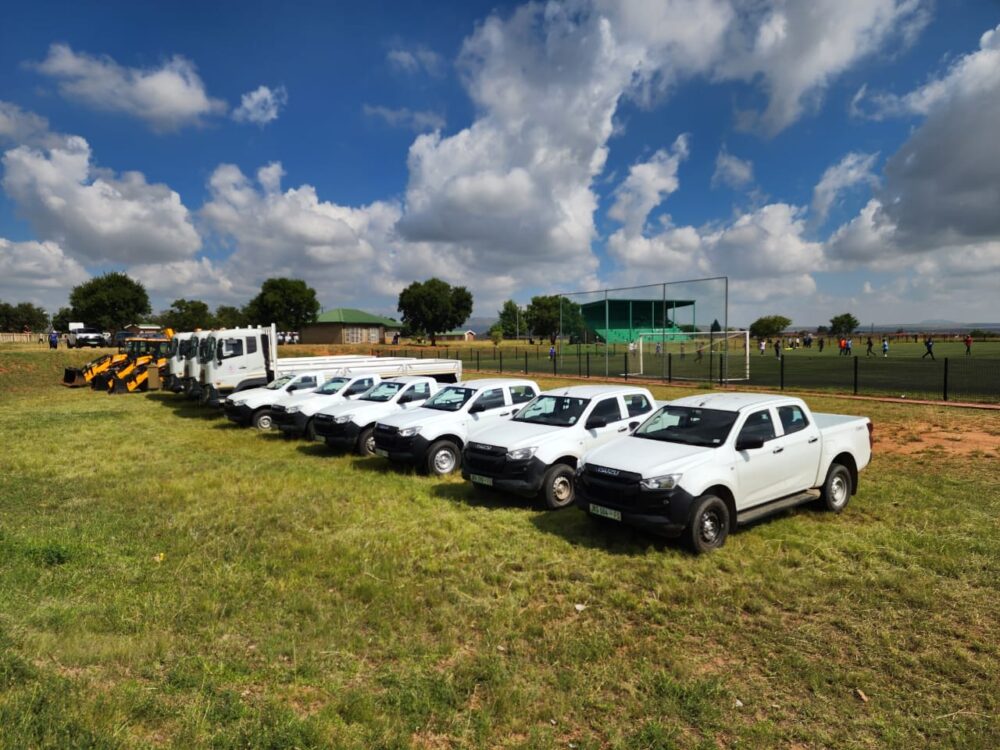
Mofokeng said the municipality had also been spending large sums outsourcing TLBs [Tractor Loader Backhoes] and cherry pickers — services that could be handled internally.
“I’ve been spending about R2m on TLBs because the municipality didn’t have any. I’ve now bought four TLBs. I cannot do business with local people at the expense of the municipality. After buying those TLBs, I received death threats from people saying I am ‘closing their taps’.
“Some of the TLBs being claimed for are not even working. We also lacked cherry-pickers, so I’ve acquired two trucks after spending between R1.5m and R2m on outsourcing.
“We have also gone to Parys to pick up a Kombi that was doing rounds but on the NaTIS, it still belonged to the municipality. These are the very same people accusing me of corruption.”
Mofokeng said that before his appointment, the municipality bought generators worth R4.5m but they never worked, were never commissioned and no longer had guarantees.
“We are dealing with thugs here. Not all of them but many of them are thugs.”

Some managers without portfolios signed overtime for others and shared the pay. “We have since addressed the issue of overtime.”
In another case, a manager was found with 20 litres of fuel and claimed it was for staff cutting grass. Mofokeng said the workers hadn’t worked in two weeks because it had rained. “They are stealing petrol every day.”
Senior municipal leaders have accused Mofokeng of acting recklessly and doing as he pleased.
One of them alleged that Mofokeng had taken four municipal vehicles and hired bodyguards without a proper risk assessment. They also raised concerns that while the mayor was driven in one vehicle, Mofokeng allegedly had multiple vehicles and more security personnel.
“There must be a security assessment to justify such protection. Municipal managers are not mayors or speakers and the law does not require them to have blue lights,” the source said.
“Mzwakhe is travelling with four vehicles — you can imagine how many bodyguards he has. He is transported in a Mahindra, a double-cab Ford and another new Ford from MAP Water. They have even modified the vehicles so they don’t look like municipal cars. Recently, his chief protector was arrested for pointing a firearm at someone.”
The source said Mofokeng’s bodyguards were hired irregularly and paid large sums from municipal coffers. Some of the bodyguards were relatives of his personal assistant from Lesotho and were not properly trained.
“The concern is how these municipal vehicles are being used and the overtime being paid. There are no service delivery vehicles in Harrismith yet these cars are being used by the municipal manager,” the source said.
Mofokeng denied the allegations, calling them “nonsense” and said he was not being driven in four municipal vehicles. He had one backup vehicle while the other car he used was his personal vehicle, which he drove himself. Mofokeng said he had worked in government as a chief director for more than 15 years and owned his own high-quality vehicles, making it unnecessary to misuse municipal resources.
He said he has had to arrange security for his own safety because of the contracts he had challenged.
“I have never driven municipal vehicles. Those Mahindras are very heavy and my spine would not handle them. I earn R2.3m, which is enough to buy a good car,” he said. “It is allowed. Previous officials also had external security and records show they spent R1.3m per month. I am not spending that; I only pay salaries of less than R100 000 in total for three people.”
Responding to claims about his personal assistant, Mofokeng said she had served under multiple municipal managers and had been acting in the role.
“I advertised the post because I wanted consistency. She was the best candidate. I did not interview her myself; I simply endorsed the panel’s decision. Whether she is from Lesotho is irrelevant. I have proof that she is a South African citizen. She may have roots in Lesotho but that does not matter.”
Mofokeng said his critics should provide evidence if they wanted to accuse him of corruption.
“They are just irritated and want me gone because there has been a culture of non-compliance here.
“People were appointed to non-existent or unfunded posts and I am correcting that … For the past 20 years, this municipality had a disclaimer. We are likely to get a qualified audit with findings but it is an improvement.
“These people have been milking this municipality for years and that will not continue under my watch. I would rather leave and go home to my children.”
He said he had gone as far as hiring a company from Johannesburg because local appointments are influenced by politics.
“You hire people and the next thing they are being instructed by political structures on who to hire or fire.”
Submit and get free exposure here: Showcase Your Business | Advertise Your Special Offers.
