
Zille shakes up Jozi mayoral race:
The possible return of Helen Zille to the political front line as the Democratic Alliance’s (DA) mayoral candidate in Johannesburg has set off a ripple effect across the city’s political organisations, prompting opposition parties and the ANC to reassess their own leadership offerings ahead of the 2026 local government elections.
While the DA deliberates on whom to formally place as its mayoral candidate, senior party officials from the other parties including the ANC have expressed worry that Zille being in the mix would force them to change their election strategy and field stronger candidates to challenge her.
Zille, the DA federal council chair, a former mayor of Cape Town and former Western Cape premier, remains one of the DA’s most recognisable political figures and is credited with building the party’s administrative credibility during her leadership.
Her entry into the race would dramatically reshape the political terrain in a city that has been plagued by leadership turnover, coalition fragility and deteriorating service delivery.
In the DA itself, Zille’s potential candidacy is not without internal debate. Some party members believe her leadership experience and administrative record make her the strongest available option to stabilise the city’s governance.
Others are concerned that her combative style and controversial public statements could alienate centrist voters or complicate future coalition negotiations.
“She brings a level of seriousness and experience that no one else in the party has right now,” a DA official said.
“But there’s a question about whether her style will attract the support the DA needs in the townships and the greater Johannesburg.”
Zille has confirmed her interest in the position and has told the Mail & Guardian that she managed to apply for the position before the deadline last Friday, adding that she was confident that her application would be supported by internal structures who have canvassed her to enter the race.
The 2026 municipal elections are expected to be fiercely contested, particularly in Johannesburg, where no single party has secured an outright majority since 2016.
The city’s role as the economic hub of the country makes it a battleground in the political contest for urban governance. With Zille entering the race, the mayoral contest is set to become a test for all political parties who have to field stronger candidates to challenge Zille.
The ANC, which currently governs Johannesburg through a fragile coalition, is facing renewed scrutiny over its candidate, Dada Morero, whose political standing has been weakened by the recent disbandment of his regional executive structure after its term expired earlier this year.
The Johannesburg regional executive committee, which is chaired by Morero, is also being forced to find a stronger candidate to challenge Zille following the disbanding of his branch in June when its term expired. The expiration allows stronger contenders to put their names up for the regional elections, thereby also fighting for the mayoral position.
Morero’s brief first tenure as Johannesburg mayor in 2022 lasted less than a month and was marked by controversy. His current term, which began in August 2024, has also been precarious.
A senior official in the ANC’s Greater Johannesburg region told the Mail & Guardian that the party is under growing pressure to field a stronger candidate that can represent the party strongly, even in the face of a Zille challenge.
“We’re in a difficult position. The emergence of Zille forces us to think seriously about a stronger alternative. Morero has been strong, but we ask ourselves if he can withstand a challenge against Zille in a mayoral challenge. The problem is that he remains the strongest candidate in the region, unless they can deploy someone in the national leadership,” the regional leader said.
At the upcoming ANC regional conference, Morero will contest the chairperson position against his former deputy, Loyiso Masuku. For Masuku, a victory could bolster her chances of becoming the ANC’s preferred mayoral candidate for the 2026 local government elections.
The city has seen at least six mayors since 2021, and the ANC’s ability to retain control has depended on fragile alliances with parties such as Al Jama-ah and the Patriotic Alliance.
Public criticism over poor service delivery, budget irregularities and persistent infrastructure failures has further eroded confidence in the party’s local leadership.
ActionSA is also grappling with strategic questions about its mayoral candidacy. The party’s founder, Herman Mashaba, previously served as mayor under a DA-led coalition and remains its most recognisable figure.
His departure from the DA in 2019 and subsequent formation of ActionSA allowed him to capitalise on dissatisfaction with the city’s governance. However, the party has since redirected its focus to national expansion, and internal debates have surfaced over whether Mashaba should be re-deployed to Johannesburg in 2026.
According to a senior ActionSA councillor, the prospect of a Zille candidacy has forced the party to consider its leadership options more urgently. “If she is selected by the DA, which we believe she will, we will need our biggest contenders including the president to run because he remains our strongest candidate in the city,” the councillor said.
But, early this month, Mashaba “shrugged off the claims” that he’s planning another run for Johannesburg’s mayoralty. He told EWN that ActionSA has not yet formally selected its mayoral candidates for key municipalities, and emphasised his intent to back other leaders within the party for now, effectively neither confirming nor denying a personal return to local politics.
For smaller parties that have gained influence in Johannesburg through coalition arrangements, the emergence of a high-profile DA candidate presents a new challenge.
The Patriotic Alliance, Al Jama-ah, and the Economic Freedom Fighters (EFF) have all played kingmaker roles in the city since 2021, using their positions to negotiate seats on the mayoral committee and other executive roles.
But Zille’s possible candidacy could polarise the electoral contest, pushing voters towards more defined choices and reducing the leverage of smaller parties in post-election negotiations.
The EFF, which has styled itself as the radical alternative to both the ANC and the DA, has not indicated whether it will field a mayoral candidate in Johannesburg.
Its electoral support in the city has remained relatively flat since 2016, and its role in coalition politics has been largely tactical. However, with the possibility of a high-profile DA candidate in the race, the party may be forced to clarify its position on executive leadership.
Egypt stops Global March on Gaza in its tracks:
The day started with fear and uncertainty. We had arrived in Cairo two days before amid rumours of detentions, assaults, and deportations. A former colleague of mine had warned, “Watch your back, the authorities are hectic.”
I was in Egypt to join the Global March on Gaza scheduled for Friday??13 June. About 4??000 activists from more than 80 countries had responded to the call to go to the border of Egypt and Gaza, set up a camp and demand the opening of humanitarian corridors into Gaza and an end to the siege.
The idea was to meet in Cairo, board a convoy of buses and to travel to the town of el-Arish in the Sinai Peninsula. Carrying rucksacks, sleeping bags and tents, the participants would then march 45 kilometres on foot to the Rafah border.
Arriving in Cairo as tourists, we would be informed where the pick-up points for the buses would be. We had also been informed that the Egyptian authorities had been approached for permission to proceed to el-Arish. Even before leaving South Africa, we had heard that people were being turned back at the airport in Cairo or that some who had cleared customs were being rounded up and deported.
The atmosphere was reminiscent of those old spy movies set in the Eastern Bloc. “Be careful who you speak to, try not to attract any attention, don’t venture out on your own, beware, even the walls have ears.”
Stories of the notoriety of Egyptian prison conditions and the “disappearance” of people were rife. There were also stories of people who had been attacked by locals opposed to our presence. And above all, that the march would not be allowed.
And so we spent Thursday night huddled in our hotels like fugitives. Surreptitiously we were instructed to be ready to leave at 7am. Directions to the pick-up points would be issued just before we leave the hotel. Later on, the departure time was changed to 12.30.
In the reception area our cohort was informed of a further change in plans. For security reasons we would no longer be travelling by bus. We needed to divide ourselves into groups of three and call for a taxi or an Uber and head off to an address provided. We were instructed to leave the hotel one group at a time, to be followed by the next, only if the previous group had informed the others that they were in their respective vehicles and on their way.
We (myself and two other South Africans) were the first to leave. With rucksacks on our backs and the best wishes of our fellow travellers, we stepped into the blinding midday sunlight and made our way to the street corner where our Uber would pick us up.
Muhammed, our driver, a pleasant affable chap, offered us a cigarette, as we set off on the highway out of Cairo. About an hour out of Cairo we reached the Kamphashir toll station. It was chaos. Cars, tourist buses and minicabs were being held up by dozens and dozens of law enforcement types, some in uniforms, others in plain clothes, all of them armed. There was also a military presence. People were being asked for their passports and told to step out of their vehicles and wait on the side of the road.
Amid it all, we concocted a story that we were heading to a youth hostel just beyond the toll gate to spend a few days at the ocean. After handing over our passports and having our phones scrutinised, we were told to join the masses on the side of the road. Nobody seemed to know what was going on except that it was quite obvious that the authorities were onto us. We speculated that we would probably be forced onto the police transport vehicles and either taken directly to the airport to be deported or, worse, taken to a detention centre.
Some of the organisers tried to negotiate our safe passage to continue. After about an hour the authorities offered back our passports on condition that we returned to Cairo. And because most of the taxis and Uber drivers had understandably left the scene, we would have to make use of the transport provided by the police.
A few “delegates” took up the offer but the majority of the roughly 250 people chose to stay put, determined to continue on our mission. The decision was also taken that if we were not allowed to proceed then we would set up camp right there on the side of the road. The rejection of the offer seemed to infuriate the officers present.
After almost three hours in the scorching heat, we were penned in a confined space and told to wait as more military and crowd control vehicles rolled up. Men armed with Kalashnikovs and other weaponry surrounded us.
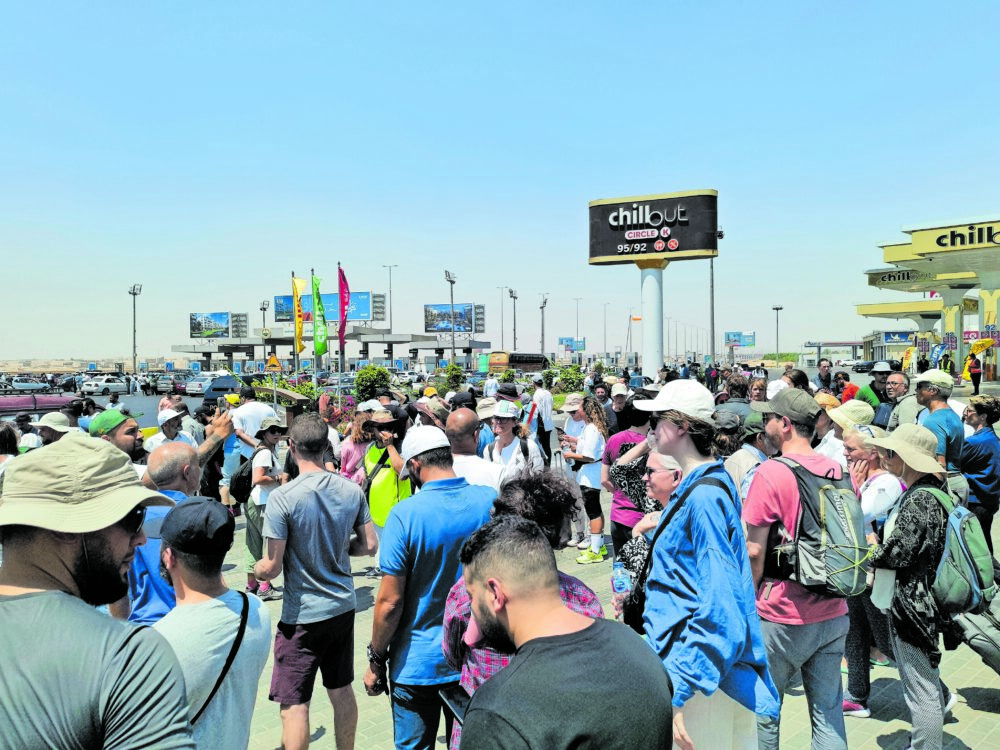
We were informed that we would not be allowed to proceed with our journey and that if we did not board the buses that had now replaced the police vehicles we would not get our passports back.
During the standoff we made the most of the solidarity inspired by comrades rallying around a common cause. There were activists from around the world, sharing what food and water that they had. Young people chanting the now universally known slogans in support of Palestine. A small group of Turkish musicians, playing traditional instruments and singing soulful songs, kept us entertained. Despite the oppressive heat, our spirits were high, united in our determination not to be moved.
And then, unannounced, a bunch of large burly men, bouncer types, descended on us. Senior activists advised the group to sit down, remain calm, interlock our arms and offer no resistance. In the face of barked commands and threats, a group of young people started singing freedom songs in support of Palestine. On command, the men suddenly started grabbing at those on the fringes. Any resistance was met by hard body blows and kicks. Some people also suffered baton blows to the body. In the ensuing panic we were forced to board the buses. Still shook up, I realised I was on the wrong bus. In the bus alongside singing broke out and the young people were rocking again, undaunted by the threats of violence.
We were kept waiting on the buses until our passports were returned to each of us. In the dark we headed back to Cairo. And then on the outskirts of Cairo we were unceremoniously dropped off, two or three at a time, at random intervals. Still shook up we made our way back to the hotel.
As I reflected on the day, I realised we had won. We were not cowered. We did not make it to Rafah but we did not capitulate. Our demand for the humanitarian aid corridors to Gaza to be opened and an end to the siege remain.
Jimi Matthews is a writer, photographer, editor, cameraman and producer. He covered the First Intifada in 1989 and has visited the Occupied Territories many times since then. His work included a major photo exhibition of his visit in 2023.
Act now to deal with the masculinity and mental health crisis in South Africa:
June is men’s mental health month in South Africa. The purpose is to encourage men to seek health services by promoting physical and psychological wellbeing.
A report by the World Health Organisation (WHO) reported suicide as the fourth highest cause of death among men aged 15 to 24 in South Africa. Further, suicide rates are significantly higher among men than women, with 10 861 of the 13 774 suicides reported in 2023 being by men. A number of parasuicides is unrecorded.
Research and practice demonstrate a correlational and causal relationship between the persistence of social ills and the prevalence of mental health conditions, compounded by poor services. Research also shows that young men are more at risk of substance use disorders, post-traumatic stress disorder, and other externalising mental health conditions.
There is no evidence to prove there is a link between young people who have died by suicide and are not at institutions of higher learning and training or employed. But there is evidence that proves a close and causal relationship between social ills and mental health. One would assume this is also the case with suicide as a symptom of mental illness such as depression and substance abuse for example.
This takes us to the intersection of these issues, the state of young men in our society, masculinity and mental health.
In May, we learnt of the increase in youth unemployment for the first quarter of 2025. According to Statistics South Africa, 62.4% of young people aged 15 to 24 are unemployed. Further, the University of Cape Town’s Southern Africa Labour and Development Research Unit reported that 30% of young people have not been in education, employment or training for the past decade.
These are not just statistics, these are people with dreams and aspirations. They are our family, friends, neighbours, and we see them every day. They are each and everyone of us. They are the antithesis to President Ramaphosa’s Tintswalo. I wish we had more Tintswalos, Mr President. I wish it was the rule and not the exception.
The other aspect of this calamity of unemployment are the psychological ramifications. Social issues such as gender-based violence, intimate partner violence, mass murder and the pervasive violence in our society are to an extent a reflection of our society. While we call for the criminal justice system to act in persecuting offenders, we must equally ask ourselves critical questions about men and masculinity in our society.
We have to do serious introspection and reflection on the society we are building, and the kind of men and manhood it produces. Something is fundamentally wrong in our society. As a psychologist, I have seen this in the gender disparity in the patients I work with on a daily basis. The people who should be in the room are often not there.
The feminist scholar, bell hooks, teaches that regressive forms of masculinity require that men suppress the emotional aspect of themselves, and if they do not do so, other men will. This is evident in state approaches to substance use, violence and crime.
Understanding the family as the basic unit of society, questions are to be asked about the home circumstances under which children grow up in. What conversations are had in our homes about mental health, health seeking behaviour, emotional wellness, consent, sexuality and masculinity?
Further, we must also ask about fathering and fathers in our society. Where do boys learn to be men? The State of South African Fathers report would be an important point of departure.
What role does social media and technology play in shaping manhood and masculinity? In a period of pervasive manosphere, how do we influence what our children, young men and men in general see as expressions of manhood and masculinity? What are the hegemonic narratives on manhood and masculinity?
One may ask: why focus on men when they cause so much harm and pain in our society?
South Africa has one of the highest femicide rates globally, with about seven women to have been murdered daily. We also have one of the highest gender-based violence rates and other forms of violence against women and children.
Equally, our country has one of the highest murder rates, with men being the victim in about 70% of the cases — and it is usually men who are the perpetrators.
Clearly, we have a masculinity problem in our society, and we cannot continue to treat it only as a legal and policing problem. It requires all of us to act, to play a role in shaping the lives of young men. In our homes, neighbourhood, schools, sports fields, churches and all other facets of life.
The Argentine social psychologist, Isaacs Prilleltensky, challenges us to build conducive social conditions of justice as a prerequisite for wellness, without which wellness becomes impossible.
As mental health practitioners, we carry a social responsibility to respond to social issues. In collaboration with communities, organisations and other institutions. We all ought to collectively labour towards a just and free society, and this includes our different professions being rooted at the core of our communities and being agents of change.
Siphelele Nguse is a clinical psychologist, scholar activist, and PhD candidate at Stellenbosch University.
Submit and get free exposure here: Showcase Your Business | Advertise Your Special Offers.
