Women’s body image is shaped by abusing diabetic drugs such as Ozempic:
At the glamorous Golden Globe awards in Hollywood earlier this year, a presenter joked about how the event was “Ozempic’s biggest night” — a quip about the diabetes medication that has seen many using it to lose weight. But alarm bells also rang. Just how far would women go to pursue impossible standards of beauty?
One of the world’s most powerful businesswomen, Oprah Winfrey, recently admitted she had taken a GLP-1 medication like Ozempic, because of its appetite-suppressing and weight-loss effects. Winfrey has often spoken about her struggles with weight and self-image.
“One of the things I realised the very first time I took a GLP-1 was that all these years I thought thin people had more willpower,” she said in an interview.
Being thin remains one of the most desirable markers of beauty. Supermodel Kate Moss infamously said, “Nothing tastes as good as skinny feels.”
Thanks to Ozempic and similar medications, losing weight has become easier for some — although it is expensive and has side effects such as nausea, stomach pain, vomiting and constipation.
But who cares — as long as you look good in a strappy dress, right?
Impossible beauty standards are nothing new. Corsets in the West, foot binding in the East and body modifications across African cultures, such as lip plates or scarification, show that beauty ideals have always been shaped by cultural values. Skin lightening products are still used despite health risks.
With social media and artificial intelligence (AI), beauty ideals are now more global, homogenised and unrealistic. Knowing that images are filtered or AI-generated doesn’t stop women from aspiring to those standards. This is taking a toll on well-being, especially among the youth.
So, how can we resist and reframe these ideals? To begin with, we need to understand why such biases exist. There’s a biological basis behind why some traits are universally considered attractive — youth and health signal reproductive fitness. But biology is only part of the story.
Social and cultural forces matter too. In South Africa, adverts long featured models who are fair-skinned, slim and straight-haired. But the tide is slowly turning. Miss South Africa 2020 Shudufhadzo Musida embraced her natural bald look and Zozibini Tunzi won the Miss Universe title with her short hair. They challenge the status quo and redefine what it means to be beautiful.
And we must not forget the intersection of race and power. The legacy of apartheid, combined with global media influences, continues to shape whose beauty is celebrated. Hair discrimination at South African schools, where learners with Afros or dreadlocks have faced disciplinary action — a stark reminder of how colonial beauty ideals still influence perceptions of acceptability.
With the world’s highest number of cosmetic surgeons per capita, South Korea shows the extremes of beauty culture. Procedures such as double eyelid surgery are given to middle school graduates as gifts to “improve” their appearance — aligning more with Western ideals. Yet this pursuit of perfection has created new social problems, with the term “Gangnam Beauty” mocking those who appear overly artificial.
South Africa may not have the same plastic surgery culture, but cities like Johannesburg and Cape Town are not far behind in embracing cosmetic enhancements — from botox to fillers — especially among young professionals. Influencer culture on platforms such as Instagram and TikTok fuels this, where filtered, polished appearances are rewarded with likes, partnerships and social capital.
More and more teens are exposed daily to content that promotes unrealistic body standards. Parents, teachers and communities need to actively counter this by promoting healthy self-image, diversity and media literacy. Attending heritage festivals, wearing traditional attire with pride, and showcasing African hair, skin tones and features in school projects or public platforms are small but powerful acts of cultural affirmation.
In our visual, hyper-curated world, we need to make use of our other senses. Listen to local music. Move your body. Join in at a street performance in Maboneng. Feel your own rhythm and worth outside the screen. Dance like nobody is watching.
We must remain aware of the messages we consume and the beauty ideals we internalise. How are they affecting our mental health — especially that of our daughters, sisters, nieces and friends?
Comedian Amy Schumer captured this tension perfectly when she said of her time when taking Ozempic to lose weight: “I looked great, but I couldn’t lift my head off the pillow. So, what’s the point?”
We rest our case.
Dr Babar Dharani is a senior lecturer at the Allan Gray Centre for Values-Based Leadership at the UCT Graduate School of Business and lectures on the MBA programme. Katherine Escreet lived in South Korea for five years, where she had a front-row seat to a deeply appearance-focused culture.
Misogyny is in a smirk, a meme or in violence:
Every year, when 9 August rolls around, we parade Women’s Day like a trophy. We are reminded of 1956, when thousands, including Lillian Ngoyi, Helen Joseph, Sophia Williams and Rahima Moosa, confronted the apartheid status quo of racial discrimination and female oppression. We are reminded to be awed by those women who challenged injustice, but not so inspired to become them.
This Women’s Day, we need to reflect on how the echoes of misogyny are reverberating around the world, with the rise of anti-feminist movements, the rolling back of women’s rights, affecting us all. It appears the “we” who hate women is growing and our socialised passivity allows the echo of misogyny to be deafening.
Misogyny isn’talways overtly violent; we don’t always call it hate, it’s advice, it’s a smirk, a shared meme. But the hate is there, unexpected, subtle and inherited. From the day women are born, they are socialised into being the other, being treated as defective, dirty and hysterical.
Women in liberal constitutional democracies today are told to be grateful — we have rights, programmes, seats at the table. Yet research suggests that, although the inclusion of women in leadership positions has increased, they hold less institutional power than men. Women are disproportionately confined to people-centred roles, while men consolidate their power on golf courses, over whiskeys in cigar lounges, free to let loose, be “politically incorrect”, express their distaste for equality, feminism and women’s rights movements.
I had better clarify that it is not all men, before I am labelled as a problematic woman, a misandrist, just more fuel for the effigy of female hate that incels and men’s rights activists love to burn. On the other hand, it is these same men who claim to be the ones marginalised. We are reminded that it could be worse — look at the women in Iran — as if formal equality cancels out inequalities in practice.
So, we women remember our place — not to destabilise the system, to be grateful that we are in the room at all, quietly holding our breath so as not to exhale too loudly, disturbing the misogyny in the air out of fear we will be kicked out of the room altogether. As misogyny seeps into our pores, we women start to internalise our inferiority, as thinkers such as bell hooks, Roxane Gay, Luce Irigaray and Naomi Wolf have pressed on over the years.
Religion, the handmaid of misogyny, socialised the previous generations. Traditions masquerading as cultural truths linger over society today. Misogynistic cultural truths became, and still are, the expectation: female suffering is graceful, female sexuality is shameful, men are natural-born leaders and women are completed by marriage. The familiar tropes extend to secular society: the martyr wife, the submissive daughter.
All women who don’t internalise these cultural truths are branded as “other”, are labelled deviant, dangerous and shameful. These problematic women are living cautionary tales used by others to warn their daughters of the dangers of being too loud, too wild, too free.
Loud, wild and free women are good fantasies, good TV and good memes to send. The patriarchy allows us women to admire, to be inspired by the Miranda Priestlys, Olivia Popes, Annalise Keatings, June Osborne, Lindiwe Dikanas, Beth Harmons, as long as their empowered persona stays in our offices, books we write or on our mood boards which we never act on.
We women are encouraged to be inspired to cosplay these characters at Halloween but not to become them. Emulation is threatening, disrupting business as usual. For that reason, people of all genders are socialised to be the patriarchy’s antibodies, policing women, judging, criticising, trolling or excluding them, attacking anyone who is too loud, too different, neutralising the threats that challenge the patriarchal norm.
Because we women are holding our breath so as not to disturb the misogynistic air, the presence of more women, women who are freer, wilder, louder than ourselves, makes us uneasy. That is the skill of the misogynist system; its internal mechanism has taught us how to divide ourselves. White women troll black women, cis women judge trans women. It works so well that not only is it so easy to hate women, but the default is for us women to hate ourselves.
The cultural pushback of women’s rights globally (such as the overturning of Roe vs Wade, the rise of anti-feminist movements) and the drive to push “traditional values” is the latest swing of the pendulum of patriarchy. From the tradwife making homemade jam to the day-in-the-life-of-a-stay-at-home-girlfriend reel, the soft girl aesthetic, embracing passive femininity, to the cottagecore wife and her domestic rituals.
These whitewashed heteronormative aesthetics create an online space for misogyny to thrive. Online spaces where little girls and women are moulded to dream of submission and exhausted girl bosses toy with the daydream of trading in their laptop for a sourdough starter. We are free only to exercise a curated femininity; we get to decide what kind of cookie-cutter female tropes we wish to embody — the Karen, the Pick-Me Girl, the Girl Boss or the Slay Queen.
As we remember our women struggle heroes this year, let their resistance inspire us to find new ways to resist social injustice.
Paige Benton is a postdoctoral research fellow at the University of Johannesburg, based at the African Centre for Epistemology and Philosophy of Science.
On 11 July, Protestant loyalists in Northern Ireland burnt, in effigy, a boatload of immigrants on a giant bonfire.
It was a redirection of the anti-Catholic hatred traditionally vented during “marching season”, with its 300-odd bonfires lit across the north. Defended as part of loyalist culture, the unspoken purpose is to intimidate and provoke.
In 2023, a photo of the Irish taoiseach (prime minister), Leo Varadkar, was torched in the same village, Moygashel. Unrest, in which more than 60 police officers were injured, also broke out recently in Ballymena and elsewhere in the Protestant north.
On occasions, racist agitation has brought together far-right hooligans from the north and south in a once-unthinkable alliance, flying the Union Jack and the Irish tricolour in the same upheavals; Northern Catholics appeared to stand back.
Now the numerical majority, and increasingly prosperous and well educated, they seem largely to have moved beyond the sectarian passions of the “Troubles”.
Apart from some minuscule Marxist splinter groups, the Irish Republican Army (IRA) has withered away. But the structures of far-right Protestant loyalist groups, like the Ulster Defence Association and Ulster Volunteer force, with their military machismo and adoration of the British Crown, remain in place.
This is the message conveyed by the huge murals at the junction of Catholic Falls Road and Protestant Shankill in Belfast, where historical antagonisms have left the scar of a 14m steel fence, known as the “peace wall”, between the communities.
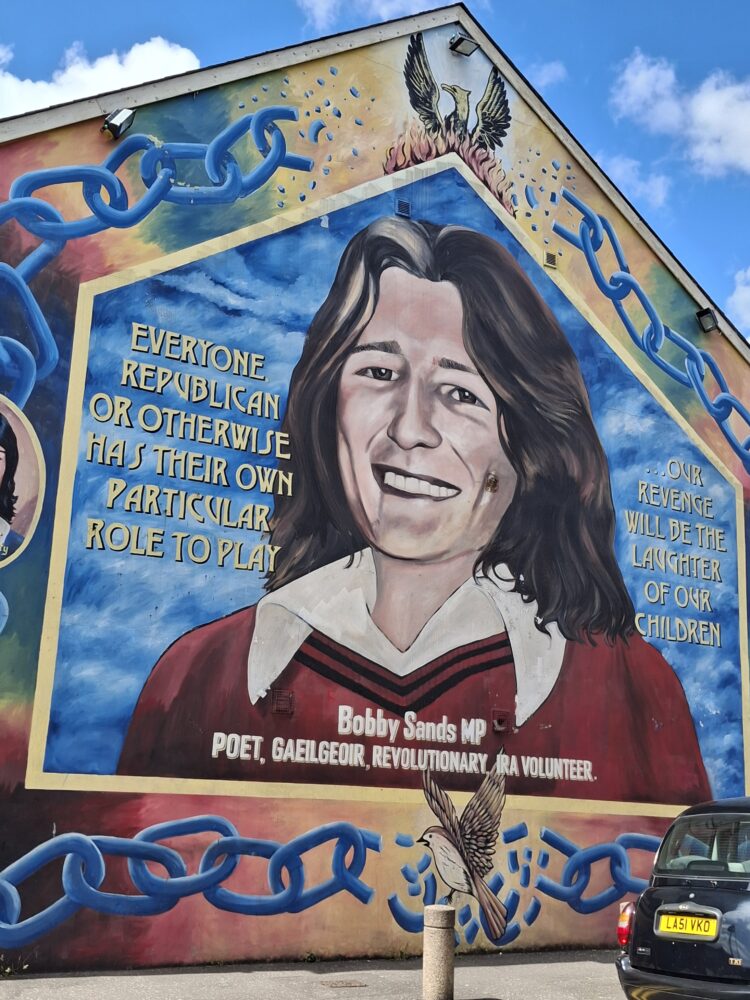
As monstrous street art, often two storeys high, the paintings are brilliantly executed. Frequently repainted, they are also a barometer of inter-group relations.
Of all the images created by Irish nationalists/Republicans, none that we saw glorified violence or portrayed heavily armed IRA paramilitaries in a heroic light.
These must once have existed but they have been replaced by images of dead hunger strikers and freedom fighters from distant conflicts, including Tamils and Palestinians.
The so-called “international wall” acclaims such figures as the 19th-century black American anti-slavery campaigner Frederick Douglass and Nelson Mandela, quoted as saying: “In my country we go to prison first and then become president.”
The martyrology includes a instantly recognisable, house-high portrait of IRA hunger striker Bobby Sands.
Protestant Shankill Road presents a contrast. Twenty-seven years after the Good Friday Agreement “decommissioned” weapons, and provided for a power-sharing executive, a huge mural, shocking in its brazen warlikeness, confronts the visitor.
It shows five paramilitaries of the Ulster Defence Association’s (UDA’s) C company, 1st Battalion, under the legend, “Forever honour their sacrifice”, armed to the teeth with pistols, Armalite rifles and a sub-machine gun.
The only outward-looking political sympathy proclaimed on Shankill is a flag marrying the Cross of St George and the Red Hand of Ulster with Israel’s blue-on-white Star of David.
Loyalism lives in the past. Its seminal event, repeatedly pictured, is the victory of Protestant “King Billy” (William III) over the deposed Catholic King James II at the Battle of the Boyne. The 11 July bonfires mark the event — 335 years later.
Virulent anti-Catholicism is also projected through a mural of time-honoured Protestant icon Oliver Cromwell, reviled by Catholics for the “effusion of blood” during his conquest of Ireland.
Beside a graphic image of Cromwell’s “Ironsides” putting to the sword a downed Irish rebel, he is quoted as saying: “Catholicism is more than a religion, it is a political power. Therefore I’m led to believe there will be no peace in Ireland until the Catholic church is crushed.”
In our day, who proclaims, “God save the King!”? Shankill does, in capitals a meter high. During our visit on 2 July, the road is awash with red, white and blue bunting. After Queen Elizabeth’s death, it was a swollen river of bouquets.
The cult of the royal family embraces even the late Queen Mother, whose image is emblazoned with the English and Scottish flags — loyalists identify strongly with the Protestant Scots forcibly inserted in Gaelic Ireland — and the words: “No rebel hate will harm this state, the Bible and the Crown.”
The Bible is not the main issue: a Protestant church on Shankill closed recently, we were told, for lack of attendance. With its ancestral conjurations and war dances, loyalism is best understood as a tribal, not religious, identity.
Underpinning it is the siege mentality born of native Irish resistance to “the Ulster plantations” — England’s seizure of half a million acres of arable land in the early 1600s, which ignited a bloody uprising. But it is also driven by an explosive cocktail of feelings of entitlement and loss of power.
Northern Ireland is the UK’s poorest region and one of the poorest in Europe. This flows in large part from the collapse of ship building and heavy engineering, Belfast’s traditional mainstays.
Decimated by political turbulence and Far Eastern competition, the workforce of Harland & Wolff (constructors of the Titanic) fell from 35?000 at peak to 3?000 in the late Eighties. Its shipyard finally closed in 2019. Ship building, long a Protestant closed shop, is no longer a perpetually flowing font of jobs for Protestant youth.
A 2015 survey by Queen’s University in Canada drove home the wide disparities within the school system, which is still largely segregated. It found, for example, that 76% of better-off Catholic girls left school with two or more A-levels, against 66% of their Protestant counterparts.
The least successful were working-class Protestant boys — the shock troopers of the far right — who faced barriers including “intergenerational distrust and negativity towards the benefits of education”.
One consequence has been the virtual disappearance of the religious incomes gap, formerly cemented by Protestant job reservation.
The dream of a permanent Protestant state, entrenched by partition and enwombed in the UK, seems beset on many sides.
Propelled by a higher birthrate and Protestant drift to the British mainland, Catholics have become the most populous group, by 45.7% to 43.5%, according to the 2021 census.
This might partly account for the shifting political balance — unionism has lost ground to both republican Sinn Fein and the non-sectarian Alliance party in recent elections.
Sinn Fein won most seats in the 2022 Northern Irish assembly poll, breaking the long-standing electoral sway of the “moderate” unionists of the Democratic Unionist Party (DUP).
Two years later, the DUP lost seats in the British elections, including that of Ian Paisley Jr — a dizzying symbolic blow given the 50-year hold of the Paisley dynasty — as Sinn Fein became the largest Northern Irish party in Westminster (it refuses to take its seats).
The DUP strongly denies any links with the paramilitaries, but down the years, its most diehard elements have manifested an instinctive solidarity with the loyalist ultras.
The cause of unionism has almost certainly been damaged by the survival into the modern era of loyalist groups, not as self-defence units, but as mafiosi in a depressed region, accused of drug trafficking, money-laundering and extortion, who have murdered each other in lethal turf battles.
One Shankill mural memorialises the murder in 2000 of Lieutenant Jackie Coulter of the UDA’s Belfast brigade — not by the IRA, but by loyalist rivals.
For two years, the unionist DUP paralysed the new power-sharing administration over claims that the post-Brexit trade protocol threatened its bond with the UK.
The irony is that mainland Britons do not seem overly interested in a region torn by divisions and incessant infighting. In a 2020 YouGov poll, 54% of Britons said they would not care one way or the other if it left the UK.
Thirty-six percent favoured a vote on Irish unification now; 25% were against, while a majority — 39% — professed ignorance.
Loyalist leader Jackie McDonald has few illusions about the British government, telling The Irish Times it would “dump us in the morning”.
The continuation of Northern Ireland as one of Britain’s first colonies is a great historical wrong. Unification is the stated policy of Sinn Fein and the major parties of the south.
But loyalist insecurities, highlighted by the Shankill murals, and the rise of the ultra-right, suggest the need for caution on the facile belief that radical change is at hand. Unity would require referendums on both sides of the border, and it is unclear whether the south would shoulder the security and fiscal burdens it would entail.
Then there is the Moygashel factor. Pointing to the flight to the right among alienated loyalist youths, Ulster Defence Association leader McDonald spoke of his persistent efforts to head off trouble.
Too many young loyalists “think they missed out on the conflict”, he says. “They’re saying: ‘We’ll not be told what to do by grey-haired old men. We’ll do a better job than you.’”
Drew Forrest is a former deputy editor of the Mail & Guardian.
Submit and get free exposure here: Showcase Your Business | Advertise Your Special Offers.